
We use bacteria and their viruses to study Genome architecture/Antimicrobial resistance. Lab website: https://www.teapawt.net/t.co/niGI6IAJKr
Austin, TX
Joined June 2020
- Tweets162
- Following37
- Followers195
- Likes20


Pinned Tweet
Knowledge of evolution may not be strictly useful in everyday commerce. You can live some sort of life and die without hearing of Darwin. But if, before you die, you want to understand why you lived in the first place, Darwinism is the one subject you must study - R Dawkins
2
This week, UT's College of Natural Sciences highlighted our recently published work on antibiotic resistance in a bacterial community. Check out their article here: cns.utexas.edu/news/research…

1
61
#RNA is more than genetic material; it can be a community defense factor. Our new publication shows that extracellular RNA released during bacterial cell death can bind and sequester cationic antibiotics, reducing their uptake in neighboring cells.
nature.com/articles/s42003-0…
102
Check out the Harshey Lab's latest publication on chemoreceptor Aer:
pubmed.ncbi.nlm.nih.gov/4187…
The Aer chemoreceptor in E. coli is best known for mediating aerotaxis by sensing metabolic flux through the electron transport chain via an FAD cofactor bound to its PAS domain. (1/5)

1
90
The Harshey lab recently published a paper introducing the Texas 2-step model to explain the mechanism behind YcgR function. Check out our story, now with commentary from the journal: journals.asm.org/doi/full/10…

76
We've uncovered an unexpected role for the E. coli β-sliding clamp: phage Mu C repurposes the Clamp to activate late gene transcription. Conserved clamp-binding motifs in the Mor/MuC family suggest clamp-dependent transcription is widespread.
pnas.org/doi/10.1073/pnas.25…

102
Check out our newest publication on the flagella brake protein YcgR: doi.org/10.1128/jb.00353-25
Here, we introduce the Texas 2-step model and provide evidence for the first step to explain the previously unresolved mechanism by which YcgR imposes counterclockwise bias at the motor.

131
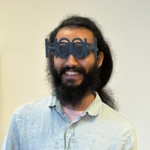
This week the Harshey Lab celebrated Dr. Nabin Bhattarai's fantastic thesis defense. He is shown here wearing fashionable hydrogen peroxide glasses and holding a model of E. coli's flagella motor, both representative of his PhD work. Congrats Dr. Nabin!


1
124
The Harshey lab has a new publication on swarming: journals.asm.org/doi/10.1128…
c-di-GMP has been thought to signal only one thing, transition to a biofilm. Our work shows that the choice is not binary, and that threshold amounts of c-di-GMP signal a habitat conducive to swarming.

1
217
New publication from the Harshey lab: doi.org/10.1371/journal.pbio…
The observation that 6/7 rrn operons in E. coli ‘cluster’ has been demonstrated by two completely different methods - FROS and Mu transposition; yet Hi-C methodology did not find it. (1/5)

1
2
341
Khang published his findings on the clustering of rrn by membrane associated sigma factors in PLOS Biology. Check it out here: doi.org/10.1371/journal.pbio…
1
138
The Harshey lab celebrated Dr. Khang Ho this week for his excellent thesis defense and his remarkable hard work these past 6 years. Congrats Dr. Khang!


3
188
Building and operating flagella consumes ~10% of cellular energy in E. coli. Our work shows there is a mutational cost to high energy consumption and begs the question: did the innovation of a functional flagellum impact the rate of bacterial evolution?
doi.org/10.1073/pnas.2412541…
Do microbes have memory? Read more in this ASM article highlighting work done by Souvik @necrosignaling in the Harshey lab.
asm.org/Articles/2024/August…

Last week, the Harshey lab celebrated the accomplishments of dear lab member Souvik @necrosignaling and said goodbye as he prepares for his new faculty position at UT Health Houston. Congrats Souvik!


‼️Out now in @PNASNews .
A heritable iron memory enables decision-making in Escherichia coli.
pnas.org/doi/10.1073/pnas.23…
Bacteria can 'remember', and store their memory in the form of intracellular iron.
@TexasScience @ut_mbs @UTAustin

Delighted to share that our preprint on the iron memory in E. coli is published in @PNASNews .
This work is a constant reminder to me that I should aimlessly stare at any data even more.
Serendipity for the win - never discard data instantly.
pnas.org/doi/full/10.1073/pn…
1/n
We had a fantastic collaborator in Abhyudai Singh @UDelaware. Congratulations to all the authors.
1
158