




Pinned Tweet
The world's income map has shifted since 1987.
Low-income countries went from 30% to 11%
High-income economies went from 25% to 41%
Learn more with the recently launched 2026-2027 @WorldBankGroup Country Income Classifications: blogs.worldbank.org/en/opend…

Can debt make countries more vulnerable during crises?
During the pandemic and the food-price and inflation shocks after, economies with higher external debt burdens saw more adverse changes in healthy-diet affordability.
New evidence from the IDR 2026: blogs.worldbank.org/en/opend…

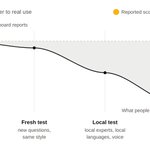
The strongest AI model tested in 2025 answered 96% of everyday questions correctly in Western European languages, but 80% in Sub-Saharan African languages.
New research explores why development needs different AI benchmarks: blogs.worldbank.org/en/opend…

Nearly 1 in 3 women globally have experienced physical or sexual violence in their lifetime. That’s 840 million women.
Gender-based violence destroys lives, limits opportunity, and holds back economies.
Explore the latest data: bit.ly/494ZYQh | #WBG16DaysForAction
European natural gas and Asian LNG prices more than doubled from their pre-conflict levels by September 2026.
What's driving the surge?
New analysis looks at how Gulf supply disruptions are reshaping global gas markets: blogs.worldbank.org/en/opend…

The November Food & Nutrition Security Update from the @WorldBankGroup is out.
Get insights on:
1️⃣ the global food market outlook
2️⃣ emerging issues
3️⃣ regional updates
Download: bit.ly/4jdUXK9

Tea prices have remained relatively stable despite weather-related production challenges.
Rising output in #India 🇮🇳, #Bangladesh 🇧🇩, and #Kenya 🇰🇪 has helped keep global supplies ample, while demand remains subdued: blogs.worldbank.org/en/opend…

World Bank Data retweeted

The geography of global poverty has changed substantially over the past two decades. So has the profile of those who remain in poverty. What does this mean for poverty reduction strategies?
Between 2003 and 2024, the number of people living in extreme poverty declined by approximately 1.2 billion. Yet progress has slowed over the past decade, and poverty has become increasingly concentrated in Sub-Saharan Africa, fragile economies, rural communities, younger populations, and groups with limited educational attainment.
A particularly important finding is that advances in urbanization and education, which were strongly associated with poverty reduction in East and South Asia, have been associated with much smaller gains in Sub-Saharan Africa.
This underscores a fundamental policy challenge: expanding human capital and transforming the spatial structure of economies are important, but their potential to reduce poverty depends on the economic opportunities available to people, particularly access to more and better jobs.
Drawing on harmonized household surveys from 154 countries, covering approximately 96% of the world's population, Minh Cong Nguyen, Nishant Yonzan, Ben Brunckhorst, Sotaire Kwizera, @ChristophLakner, @laraibarra_g, and Henry Stemmler examine these dynamics in their new @WorldBankGroup Policy Research Working Paper, "Beyond the Headcount: The Changing Geography and Composition of Global Poverty, 2003–2024".
Developed as a background paper for the World Bank’s 2026 Poverty, Prosperity, and Planet Report (3PR), this research offers important insights into why understanding who remains poor, where they live, and the constraints they face is essential to accelerating poverty reduction: documents.worldbank.org/en/p…
#Poverty #DevelopmentEconomics

A pregnant woman in rural Nigeria asks an AI health line whether bleeding in her sixth month is normal.
The quality of the answer depends on something most people never see: the benchmark used to test the system.
Why does this matter for development? blogs.worldbank.org/en/opend…

What if you could discover the world’s development data with one click? Now you can! #Data360, the @WorldBankGroup's flagship data hub is live!
Discover 10,000+ indicators and get the insights you need: data.worldbank.org/ | #DataMeetsDevelopment

Nearly one in five people worldwide are estimated to be at high risk from climate hazards.
The new PARCH map lets you explore where exposure to floods, droughts, heatwaves and cyclones overlaps with poverty and other vulnerabilities.
Explore the map: blogs.worldbank.org/en/opend…

Poverty.
Food security.
Jobs.
Governance.
Energy.
Agriculture.
Innovation.
The October 2026 World Development Indicators update brings new and revised data across the development agenda.
See what’s new and explore the data: blogs.worldbank.org/en/opend…

Interested in data visualization and development storytelling?
Join the Atlas of Global Development team and @Google's Data Editor @smfrogersfor the launch of new data stories on hunger, jobs, pollution, and many others.
Register: worldbank.org/en/events/2026…

About 99% of intercontinental internet traffic travels through submarine cables.
But most internet users depend just as much on terrestrial fiber networks.
Why is so little known about the infrastructure that carries local and regional traffic?: blogs.worldbank.org/en/opend…

Extreme poverty is falling—but becoming increasingly concentrated.
New @WorldBankGroup research covering 154 economies and 96% of the global population shows who remains in extreme poverty, where they live, and why progress is becoming harder.
Read: blogs.worldbank.org/en/opend…

Finding trade data is one challenge. Understanding what those data mean for policy is another.
A newly AI-powered tool now combines data discovery & methodological guidance in a single interface, helping users move more faster from numbers to insight: blogs.worldbank.org/en/opend…

Global coffee output is expected to rise 6% to a record 190 million bags in 2026-27.
As supply prospects improve, coffee prices are easing after weather-related disruptions earlier this year.
What does the latest outlook reveal?: blogs.worldbank.org/en/opend…

Global prosperity has improved but unevenly. At least 1 in 5 people still live in highly unequal economies, while progress has slowed markedly over the past decade.
See what new @WorldBankGroup #3PR finds about the changing prosperity gap: worldbank.org/en/publication…

A missed document can change a legal case. It can change a patent review.
But it can also change the answer to a development question.
New lessons from building ImpactAI, the @WorldBankGroup's tool for finding evidence on what works: blogs.worldbank.org/en/opend…

Interested in data visualization and development storytelling?
Join the Atlas of Global Development team and @Google's Data Editor @smfrogersfor the launch of six new data stories on hunger, jobs, pollution, digital development, and more.
Register: worldbank.org/en/events/2026…

Our latest @WorldBankGroup poverty update revises the 2024 global extreme poverty rate down by 0.3 percentage points—from 10.4% to 10.1%.
That equals about 22.5 million fewer people than previously estimated.
What changed and why in our new PIP update: blogs.worldbank.org/en/opend…
