

Quantum Secure Encrypted Money
Joined March 2025
- Tweets2.6K
- Following15
- Followers32K
- Likes2.4K




Pinned Tweet
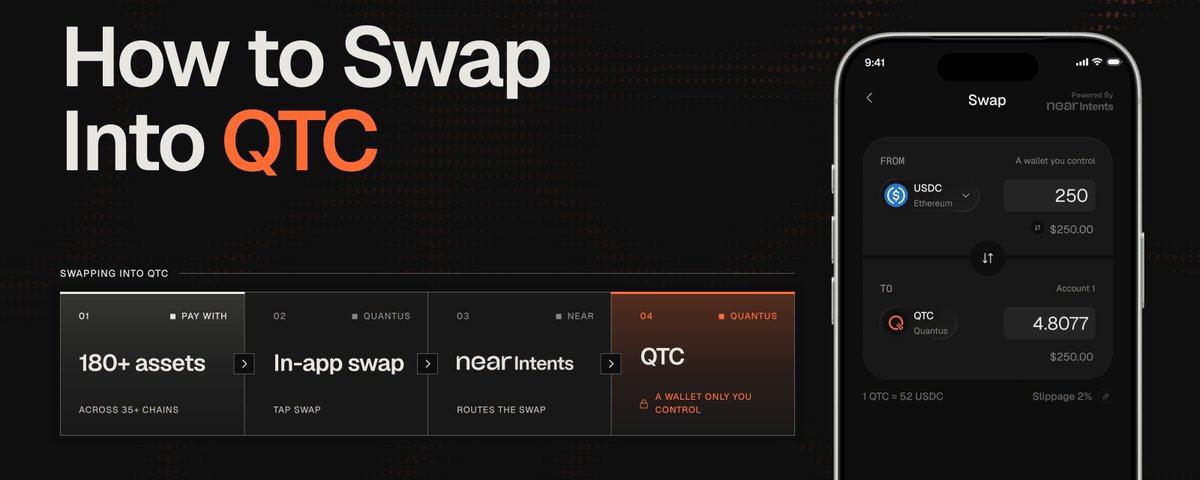
QTC is now live on near.com, powered by @near_intents.
Swap into QTC from 180+ assets across 30+ chains, including BTC, ETH, SOL, and ZEC.
Every swap is confidential by default.
Quantum secure encrypted money, now one swap away.
Your wallet screen has some gibberish you can’t understand.
And you hit Confirm anyway?
That’s blind signing, and it absolutely will get you rekt.
Friends don’t let friends blind sign.
Download the Quantus Cold Wallet and say goodbye to blind signing.
www.teapawt.net/QuantusNetwork/status/…


Buying a hardware wallet puts you at risk of data breaches where your name and home address end up on a leaked list.
Since hardware wallets are specialized crypto signing devices, they face increased risk of supply chain attacks.
Which could mean hidden hardware inside the device designed to steal funds.
Last month, tampered devices from an official reseller cost their owners about $90 million.
Using a dedicated phone as a crypto signing device avoids both of the above issues.
The flow for setting it up securely:
1. Factory reset the phone.
2. iPhones force you to connect to iCloud. Make a separate iCloud account with a unique email just for this.
3. Using Android? We highly recommend @GrapheneOS with a duress pin. A duress pin irreversibly wipes your device if typed in. You can set your duress pin as your birthday, since it’s often the first code attackers will try.
4. Delete every non-essential app off the device.
5. Update your operating system to latest.
6. Install only your crypto wallet app, no other software. We recommend the Quantus Cold Wallet.
7. Turn off wifi, bluetooth, and put the phone in airplane mode.
8. Keep it powered off when not in use. Bonus points for putting it in a faraday bag.
Download links here 👇
Android (Google Play): play.google.com/store/apps/d…
iOS (App Store):
apps.apple.com/us/app/quantu…
1
499
Cryptographers have known for 30 years that elliptic curves would one day fall to quantum computers.
The question was never if. It was what to build.
Quantus started with lattice signatures from genesis, so there's nothing to migrate.
@YuviLightman on that choice 👇
blockinsider.com/article/qua…


The most secure way to store your QTC
Set up the Quantus cold wallet in a few minutes 👇
www.teapawt.net/QuantusNetwork/status/…
Turn your spare phone into a cold wallet.
The Quantus Cold Wallet is live.
Store your QTC securely and sign post-quantum transactions without your keys touching any internet connected device.
Transaction data passes via QR codes.
Your private keys stay offline.
Available on the App Store and Google Play 👇

You can swap into QTC from many chains.
The most secure way to hold your QTC is always the Quantus wallet.
Self-custodial, post-quantum, digital money.
Download the Quantus Wallet👇
quantus.com/wallet/

Who decides what “quantum-ready” means?
Join the Quantum Alliance’s founding contributors, live on X Spaces.
What the Alliance is, how it works, and how anyone can take part.
Tomorrow at 3:00 pm UTC
With @YuviLightman @rcarback @cadillion @bizdevving @PQA_Rich @MehowHacks
Set a reminder 👇
www.teapawt.net/i/spaces/1aWQkAWbKVbmk…
Last week in quantum:
@glassnode reported that 7.12 million BTC have exposed public keys.
That's 35.4% of Bitcoin's issued supply, including 25.8% exposed through address reuse. A sufficiently powerful quantum computer could eventually derive private keys from these exposed public keys, putting those coins at risk.
@Microsoft began rolling out post-quantum TLS for Azure applications.
Azure App Service and Azure Functions are getting hybrid X25519 and ML-KEM-768 key exchange, combining classical and post-quantum protection. The rollout is phased, and compatible applications can use it without code changes.
@IBM announced Nighthawk r3 and plans for a 1,040-qubit system.
The next-generation processor is designed to execute 10,000 quantum operations across 520 programmable qubits. IBM plans to connect two of these processors in 2027, expanding its architecture toward larger quantum computations.
The Internet Architecture Board flagged major challenges in post-quantum authentication.
Its findings from an October workshop identified four obstacles: larger keys and signatures, slow migration of verification systems, the costs of alternative authentication approaches, and conflicting regulatory requirements. These could complicate the transition to quantum-resistant internet infrastructure.
@Cornell researchers demonstrated faster cooling for trapped-ion quantum computers.
Using chip-based laser technology, they reduced a targeted cooling operation from around 500 to 150 microseconds. The technique could help reduce delays in quantum operations, an important requirement for scaling trapped-ion systems.
The US Quantum Primacy Commission called for a stronger national quantum strategy.
Its preliminary report urged the US to move beyond research leadership and invest more in manufacturing, infrastructure, and commercial deployment. It warned that scientific progress alone would not guarantee leadership in quantum technology.
Bitcoin's exposed keys are becoming easier to quantify, while post-quantum protection is starting to reach everyday infrastructure.
Glassnode's Bitcoin public-key exposure figures, Crypto.news:
crypto.news/bitcoin-public-k…
Microsoft Azure, Preparing App Service and Azure Functions for post-quantum TLS:
azure.github.io/AppService/2…
IBM, Nighthawk r3 announcement:
newsroom.ibm.com/2026-11-11-…
Internet Architecture Board, Post-Quantum Authentication: Lessons from Prague:
ietf.org/blog/iab-pq-worksho…
Cornell University, Researchers develop faster laser cooling for quantum computers:
news.cornell.edu/stories/202…
Special Competitive Studies Project, US Quantum Primacy Commission preliminary report:
scsp.ai/2026/11/commission-o…


Last week in quantum:
A @Bitcoin Core developer floated "quantum landmines" to make theft expensive.
Cory Fields posted the idea to the bitcoin-dev mailing list on November 4 and labeled it a thought experiment. An owner would prepare in advance by creating a small quantum-safe output that secretly commits to proof they own a vulnerable coin. Anyone moving that coin would first have to lock up collateral from a quantum-safe wallet for a waiting period.
If the real owner reveals their proof during that window, they keep their coins and claim the attacker's collateral too. The idea protects only owners who still hold their keys, and the enforcement rules haven't been written.
Hong Kong gave its banks a post-quantum toolkit.
The Hong Kong Monetary Authority and the Hong Kong University of Science and Technology launched the Post-Quantum Cryptography (PQC) Toolkit on November 2. It helps banks take stock of their cryptographic assets and dependencies, set transition priorities, work with suppliers, and build practical timelines.
The banking sector's initial Quantum Preparedness Index score was 2.3 out of 10. The HKMA is targeting full quantum readiness, a score of 10, by 2030.
@IBM, @AMD, and @ORNL launched a quantum error-correction platform.
The co-design platform pairs IBM's 120-qubit Quantum Nighthawk processor with Oak Ridge National Laboratory's Umbra supercomputer, which runs on AMD Instinct MI355X GPUs and 5th Gen EPYC CPUs. It sits at IBM's quantum facility in New York and connects to the Oak Ridge Leadership Computing Facility.
Researchers will use it to test hybrid quantum-classical work on error correction, decoding, circuit compilation, and software orchestration. It supports the Department of Energy's Quantum Genesis Mission, which aims for a scientifically relevant quantum computer by 2028.
Ethereum moved its post-quantum target up a year.
At Devcon 8 in Mumbai, @ethereumfndn researcher @drakefjustin said he hopes to finish Ethereum's post-quantum transition by December 2028, a year ahead of the earlier 2029 target. Named signature candidates include leanSPHINCS and leanXMSS.
Hong Kong Monetary Authority, PQC Toolkit launch:
info.gov.hk/gia/general/2026…
Hong Kong Monetary Authority, PQC Toolkit circular:
brdr.hkma.gov.hk/eng/doc-ldg…
Crypto Briefing, Cory Fields' quantum landmines proposal:
cryptobriefing.com/cory-fiel…
IBM, ORNL, and AMD, quantum error-correction platform:
newsroom.ibm.com/2026-11-05-…
ORNL, co-design platform announcement:
ornl.gov/news/ornl-ibm-and-a…
Crypto Briefing, Ethereum's 2028 post-quantum target:
cryptobriefing.com/ethereum-…
Last week at @EFDevcon , @drakefjustin announced that @ethereum is moving its post-quantum deadline up a year, to December 2028.
Justin puts the odds of a quantum computer that can break today’s crypto at 10% by 2029 and 50% by 2032.
@YuviLightman’s new paper lays out the shortest path to post-quantum accounts on EVM chains.
www.teapawt.net/QuantusNetwork/status/…
EVM chains can offer post-quantum accounts without starting over.
@YuviLightman’s new paper lays out a practical approach built on two changes:
- Let accounts switch signature schemes while keeping their addresses
- Make post-quantum signatures cheap to verify
The approach covers user accounts and operator keys.
Consensus keys and pairing-based proofs need separate upgrades. The paper covers those too.
