Content creator | AI researcher & builder | AI insights from 2030 | @beyond_xai
Contact me →
Joined May 2026
- Tweets2K
- Following99
- Followers55.3K
- Likes3.3K


Codez retweeted

MAGI-2 is live, exclusively on Higgsfield.
Now you can try the largest near-SOTA video model for free.
> $0.08 per second of generation
> 480B parameters, about 28B active at a time
> Up to 30 seconds at 1080p and up to 20 references
Best deal for Black Friday with up to 70% OFF.
Open weights coming soon. Available now on Higgsfield, and via Higgsfield MCP.
Codez retweeted
i just reverse-engineered Theo's T3 Code setup from 100MB+ of telemetry he published from his own T3 Code
this is f*cking gold
Opus 5.5 conducts → Sol builds fast → Fable 5.2 goes deep → Argon second-guesses → Astra reviews
send this prompt and infographic to your T3 and ask them to run the same setup.
how:
→ he types into one Opus 5.5 thread
→ Opus splits it and delegates every piece async
→ 16 machines run it over the relay
→ another model family checks the work
here's the full guide:
• step 1 → one conductor:
Opus 5.5 = 69% of all turns
90% of turns are started by other agents, not by Theo
he typed 4,760 requests. agents did 40,460 turns
• step 2 → route by job:
> parallel slices → more Opus 5.5 (2,294 tasks)
> fast spec work → GPT-6.1 Sol in Codex (1,387)
> second opinion → Gemini 4 Argon in Antigravity (592)
> deep problems → Fable 5.2, ~20 min each (426)
>chores → Luna / Haiku (331)
half of all delegated tasks leave Anthropic
• step 3 → effort high, not max:
64% of Opus turns on high. Fable sits on high 95% of the time. max only for the hard bug
• step 4 → full access, with a seatbelt:
99.7% of turns run in full-access mode.
the risk is held by worktrees (433 vs 201 in root) and PRs, not by approvals
• step 5 → the fleet:
16 machines over npx t3 connect.
3 Linux boxes do 57% of the work. 94% of his requests come from the desktop, 4% from the phone
• step 6 → agents check their own work:
Sol hands 221 reviews to Astra on ultra/max.
agents open the app themselves: 589 previews, 470 PRs linked to threads
• step 7 → settle the inbox:
806 threads settled, 307 snoozed, 46 steered mid-run. 563 turns ran on a schedule
what to expect:
6,786 delegated tasks, 97.5% finished
peak: 66 tasks running at once
98% of input tokens come from cache
he prompts between midnight and 4 a.m. agents keep going at ~1,000 turns an hour while he sleeps
honest take:
this is telemetry, not his AGENTS.md. you see how he works, not what he tells the models.
and full access only works because every thread lives in its own worktree and ships as a PR
the win: one conductor, a few cheap specialists from other vendors, and you only settle what's done
Paste the prompt into one Opus 5.5 thread in T3 Code right now to set up your own conductor.
then read the full guide on building AI agent teams in T3 Code in the article below ↓


i just fired the guy i paid $1,500 a month for google seo and created GrokBot, powered by an LLM optimisation engine
the engine under the hood is jam
here's what jam does every week:
• asks chatgpt, claude, perplexity and gemini the 190 questions my buyers actually ask
• reads all 720 answers and logs who gets named and which sites get cited
• finds every question where a competitor wins instead of me
• ships the fixes, then reruns the exact same questions to prove it moved
google seo got me to page 1. jam gets me into the answer
find more info below ↓

introducing jam: the infrastructure to get your product discovered in the ai era
as founders, we know firsthand how complicated and tedious aeo can be
we built jam to change that. the only proactive, end-to-end aeo platform with open pricing
build your own plan and start spreading with jam by copying the prompt below
if you want to automate the entire process, try out: spreadjam.com

3
539
i just reverse-engineered Theo's T3 Code setup from 100MB+ of telemetry he published from his own T3 Code
this is f*cking gold
Opus 5.5 conducts → Sol builds fast → Fable 5.2 goes deep → Argon second-guesses → Astra reviews
send this prompt and infographic to your T3 and ask them to run the same setup.
how:
→ he types into one Opus 5.5 thread
→ Opus splits it and delegates every piece async
→ 16 machines run it over the relay
→ another model family checks the work
here's the full guide:
• step 1 → one conductor:
Opus 5.5 = 69% of all turns
90% of turns are started by other agents, not by Theo
he typed 4,760 requests. agents did 40,460 turns
• step 2 → route by job:
> parallel slices → more Opus 5.5 (2,294 tasks)
> fast spec work → GPT-6.1 Sol in Codex (1,387)
> second opinion → Gemini 4 Argon in Antigravity (592)
> deep problems → Fable 5.2, ~20 min each (426)
>chores → Luna / Haiku (331)
half of all delegated tasks leave Anthropic
• step 3 → effort high, not max:
64% of Opus turns on high. Fable sits on high 95% of the time. max only for the hard bug
• step 4 → full access, with a seatbelt:
99.7% of turns run in full-access mode.
the risk is held by worktrees (433 vs 201 in root) and PRs, not by approvals
• step 5 → the fleet:
16 machines over npx t3 connect.
3 Linux boxes do 57% of the work. 94% of his requests come from the desktop, 4% from the phone
• step 6 → agents check their own work:
Sol hands 221 reviews to Astra on ultra/max.
agents open the app themselves: 589 previews, 470 PRs linked to threads
• step 7 → settle the inbox:
806 threads settled, 307 snoozed, 46 steered mid-run. 563 turns ran on a schedule
what to expect:
6,786 delegated tasks, 97.5% finished
peak: 66 tasks running at once
98% of input tokens come from cache
he prompts between midnight and 4 a.m. agents keep going at ~1,000 turns an hour while he sleeps
honest take:
this is telemetry, not his AGENTS.md. you see how he works, not what he tells the models.
and full access only works because every thread lives in its own worktree and ships as a PR
the win: one conductor, a few cheap specialists from other vendors, and you only settle what's done
Paste the prompt into one Opus 5.5 thread in T3 Code right now to set up your own conductor.
then read the full guide on building AI agent teams in T3 Code in the article below ↓
Codez retweeted
Introducing MAGI-2, exclusively on Higgsfield.
Up to 30 seconds of frontier 1080p quality, with 0.08$ per second of generation.
Open weights video model with 400B parameters coming soon.
Now available exclusively on Higgsfield and via Higgsfield API.
🤖 Made with AI
Codez retweeted
T3 Code Creator just revealed his personal setup for building a fleet of agents in T3 from scratch.
this is f*cking gold
Grok Bot files the work → Fable 5.2 plans → Opus 5.5 builds → Neon writes it up → you only approve
how:
→ Grok Bot turns issues, Slack and mentions into briefs
→ T3 Code runs every model in its own harness
→ each slice gets its own thread and worktree
→ a different model family reviews every diff
save the infographic, here's the guide:
• step 0 → what it is:
T3 Code = open-source control plane for coding agents. free, runs on your machines, uses your subscriptions
Grok Bot = always-on dispatcher with its own cloud computer
• step 1 → the roles:
> Grok Bot → files tasks, never merges or deploys
> Fable 5.2 → lead: writes SPEC.md, takes the hardest
> Opus 5.5 ×2 → builders, one slice each
> GPT-6.2 Astra → read-only reviewer
> Gemini 4 Neon → README, changelog, UI strings
• step 2 → write TEAM.md:
one charter every agent reads. roles, file ownership, max 3 review rounds, max 4 handoffs without a human
• step 3 → connect the fleet:
run npx t3 connect on every box. Grok Bot gets the MCP link and can list, search, launch, wait on and read threads
• step 4 → the lead plans, you approve:
Fable reads the brief + codebase, writes SPEC.md, then stops. you tap Approve on your phone
• step 5 → builders fan out:
one worktree, branch and port per slice. failing test first, then the fix. docs wait for the final diff
• step 6 → another family tries to break it:
Astra hunts edge cases: unicode, two tabs, expired auth. sev 1–2 bugs go back to the builders. 3 rounds max, then it's your call
• step 7 → ship + learn:
draft PR + morning report on your phone. a weekly post-mortem rewrites TEAM.md, so the same bug never ships twice
what to expect:
in GILD's pipeline Astra rejected 417 of 1,287 Opus additions
~$12.75 per feature at API list prices (my estimate)
Theo merged 28 PRs before bed on his podcast
T3 Code: $0. you pay for your model plans only
honest take:
more agents ≠ better code. without a spec, file ownership and a cap on review rounds, you just get more PRs to read.
the win: the boring loop runs while you're away, and you only make the calls that matter
Send it to your GrokBot right now to set up your first cross-model team at T3.
then read the full guide on building AI agent teams in T3 Code in the article below ↓
Codez retweeted

The AI Blender Series Continues...
Here's my latest video created with Fable 5.2 on High, with Claude renting its own GPUs through Higgsfield GPU.
On my mac this would have taken 20 hours or more.
But Claude can now rent GPUs on its own and instead it only took about 50 minutes.

Codez retweeted
T3 Code creator just shared 1-hour workshop how he builds multi-agent workflows from 0% to 100%:
" my agents are using Opus 5.5, GrokBot, and Gemini 4 Neon. i don’t rely on one model as a bottleneck - I use them all"
• 10% → 2:35 - one app for Claude Code, Codex & co
• 30% → 8:49 - npx t3 connect: any machine, remote
• 55% → 14:44 - T3 code sub-agents build & review
• 80% → 23:43 - agents catch regressions before you do
• 100% → 35:28 - 100+ agents clearing your backlog
most people still babysit one agent on one laptop - Theo closes the lid, runs threads on other machines and merges 28 PRs before bed
bookmark & watch - then read the full playbook on AI agent teams in T3 Code below ↓
Codez retweeted
T3 Code founder just shared his personal setup for building agentic teams with Grok Bot + Opus 5.5
one Grok Bot runs your whole fleet of machines. Opus 5.5 does the coding. you only approve
how:
→ Grok Bot gets one MCP link to T3 Code
→ you give it one rule: code goes to Opus 5.5
→ it spins up threads on every machine you own
→ works from your phone, even with the laptop closed
save the video, here's the guide:
• step 0 → what it is:
Grok Bot = always-on agent with its own cloud computer
T3 Code = open-source control plane for coding agents. free, runs on your machines, uses your subscriptions
• step 1 → the stack:
- Claude $100 plan → Opus 5.5 for the actual code
- Grok Bot → the dispatcher that never sleeps
- T3 Code on every box you want it to control
• step 2 → connect the fleet:
run npx t3 connect on each machine. one command, free, no Tailscale needed
• step 3 → give Grok Bot the keys:
Settings → Environments → Copy MCP URL → paste it into Grok Bot, sign in with OAuth. it can now see every linked machine
• step 4 → the one rule Theo uses:
tell Grok Bot "call T3 Code with Opus 5.5 for any task where it is applicable"
code runs on your Claude plan, Grok Bot's limits stay free for planning
• step 5 → make it work:
- "spin up an Opus 5.5 thread on each machine to check disk & RAM"
- "go through these PRs and pick the best ones"
- "split the backlog, one thread per issue, each in its own worktree"
every thread gets its own branch. nothing merges without your approval
what to expect:
- 8 threads on 8 machines from one chat (Theo's demo)
- works over the internet, not computer use
- control everything from your phone
- T3 Code: $0. you pay for Claude + Grok Bot only
honest take:
this is a dispatcher, not magic. bad briefs still give bad PRs, and you still review every diff. the win: your agents keep working while you're away from the desk
Save it so you don't lose it.
then read the full guide on building AI agent teams in T3 Code in the article below ↓
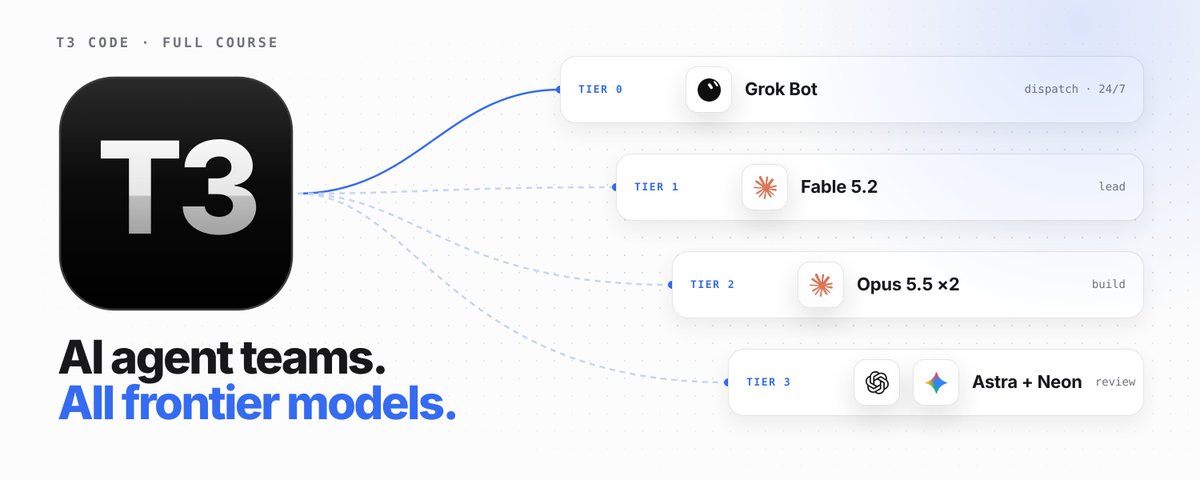
T3 Code is the MOST underrated AI dev tool right now
It runs Fable 5.2, Opus 5.5, GPT-6.2 Astra and Gemini 4 Neon as one team. Grok Bot feeds it work 24/7
In this full course: how to build it in 6 steps with 14 prompts
Codez retweeted
Paradigm CTO just dropped his playbook for building “Effective Agent Swarms” for models like Opus 5.5.
Ask big → Run in the cloud → Get out of the way
this is a 10-step blueprint on how to make your codebase and your workflow swarm-ready:
> step 1 → be unreasonably ambitious:
rewrite the dependency that slows you down, build a database tailored to your workload.
his team rebuilt Tempo in 5+ languages in days
> step 2 → move your agents to the cloud:
real work runs 24/7 and won't fit on a laptop.
ask your agent to set up a durable cloud agent with Nanocode on Vercel, Cloudflare or Postgres
> step 3 → give targets, not chores: "Make this 10x faster" beats "optimize X".
Instead of "fix all bugs", have it differentially test against a reference and close every gap
> step 4 → run codebase-wide refactor prompts:
• encode implicit state machines in the type system
• swap shared state for lock-free actors,
• parallelize sequential async calls
• add OTel tracing to every component
> step 5 → do the simple thing:
frontier model + short prompt + well-set-up codebase, then step away.
skip custom plans, memory, compaction and skills, because every model cycle wipes them out
> step 6 → remove what distracts the swarm:
delete code comments, .skills and docs/ folders. Agents read the code for you anyway
> step 7 → replace unit tests with simulation:
ban agent-written unit tests in AGENTS.md and add deterministic simulation tests so agents hunt bugs and never repeat them
> step 8 → own your stack:
monorepo everything and rewrite risky dependencies TigerStyle to cut supply-chain risk
> step 9 → let the swarm become your controversial:
push to master through a merge queue.
the agent thread is the new pull request, and testing, benchmarks and releases run on the same infra as your agents
> step 10 → flip how you interact:
stop pinging agents and let them ping you. an inbox with one decision at a time, a loss-curve UI for perf work, an infinite canvas for parallel ideas
find the full setup from Paradigm below, then…
send this thread and the article below to your Claude Code and ask it to setup your first agents swarm.

Codez retweeted
Grok Bot is f*cking insane for building a second brain...
send this prompt to Grok Bot and it turns everything you read, watch and think into a knowledge base that organizes itself
then go even further with the full guide below: