a new way to: inference. pre-training. post-training. quant. kerneling where no one has kerneled before.
Ottawa
Joined October 2025
- Tweets1.6K
- Following24
- Followers348
- Likes673
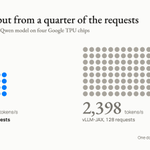





Backboard at 32 concurrent requests delivered more total output than vLLM-JAX at 128.
Same Qwen model, same four Google TPU chips.
Backboard hit 2,641 output tokens/sec against 2,398 with one-quarter of the requests in flight.

3
2
96
See the benchmark → backboard.io/blog/qwen3-6-tp…

15
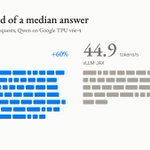
With 64 requests running at once on Google TPU v6e-4, Backboard streamed the median Qwen response at 72 tokens per second. vLLM-JAX delivered 44.9.
That’s 60% faster generation for the median request.

1
3
148
More benchmarks and insights → backboard.io/blog

25
We doubled the load on the same four Google TPU chips, from 64 to 128 concurrent requests.
Backboard’s p90 first-token wait rose by 190 ms. With vLLM-JAX, it rose by 1.77 seconds.
Same Qwen model. Same BF16 weights.

More benchmarks and insights → backboard.io/blog
1
1
29
At 32 concurrent requests on Google TPU v6e-4, Backboard and vLLM-JAX both delivered a 70 ms median time to first token.
At p90, the tie disappeared. Backboard took 320 ms. vLLM-JAX took 600 ms.
See the benchmark → backboard.io/blog/qwen3-6-tp…

4
115
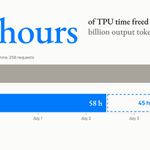
A billion output tokens at our measured C256 rates takes about 58 TPU machine-hours with Backboard versus 102 with vLLM-JAX. On a reserved machine, that frees roughly 45 hours for the next paying workload.
See the full results → backboard.io/blog/qwen3-6-tp…

1
4
80
A 0.60-second p90 first-token target. One four-chip TPU machine.
Backboard met it at 128 concurrent requests. vLLM-JAX met it at 32 and missed it at 64.
That’s 4× the tested concurrency inside the same latency target, at the same hourly hardware cost.
Full breakdown → backboard.io/blog/qwen3-6-tp…

2
54
At 128 concurrent requests, $10,000 of TPU time at the vLLM-JAX rate buys the same output as about $5,270 at Backboard’s rate.
Same Qwen3.6 model, same four chips, same hourly price. That leaves $4,730 in the compute budget.
See the full results → backboard.io/blog/qwen3-6-tp…

3
59
If you sell output by the token, a fully booked TPU-hour with Backboard could generate 77% more output-token revenue at the same price.
At 256 concurrent requests, we delivered 4,824 tokens/sec against 2,719 for vLLM-JAX.
See the full breakdown → backboard.io/blog/qwen3-6-tp…

2
90
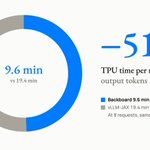
Same Qwen model. Same TPU hourly rate.
At 8 concurrent requests, Backboard delivered 1,745 tokens/sec against 860 for vLLM-JAX.
At those rates, a million output tokens costs 51% less in TPU time.
See the full results → backboard.io/blog/qwen3-6-tp…

2
46
Backboard at 128 concurrent requests matched vLLM-JAX at 32 on p90 time to first token.
Both clocked 0.60 seconds.
Four times the concurrency, same first-token wait at p90, on the same four TPU chips running Qwen3.6.
The full breakdown → backboard.io/blog/qwen3-6-tp…

1
3
129
256 requests in flight. Half got their first token in 230 milliseconds or less.
That’s Backboard running Qwen3.6-35B-A3B on Google TPU v6e-4. The median with vLLM-JAX was 1.06 seconds.
See the full results → backboard.io/blog/qwen3-6-tp…

We doubled the load five times, from 8 concurrent requests to 256.
Backboard beat vLLM-JAX on p90 token generation speed at all six levels running Qwen3.6 on TPU.
Our smallest lead was 84%. Our largest was 117%.
The full breakdown → backboard.io/blog/qwen3-6-tp…

Backboard cut nearly 9 seconds off the p90 wait for Qwen’s first token.
At 256 concurrent requests on Google TPU v6e-4, vLLM-JAX took 10.23 seconds.
We took 1.26.
The full breakdown → backboard.io/blog/qwen3-6-tp…

The benchmark figures referenced here are from an earlier test. We’ve since published updated results → backboard.io/blog/gemma-4-12…

20
Same four TPU chips. Same Qwen3.6 weights at BF16.
At 256 concurrent requests, Backboard delivered 4,824 tokens per second in aggregate. vLLM-JAX delivered 2,719.
That’s 77% more output per second on the same hardware.
See the full results → backboard.io/blog/qwen3-6-tp…

BackboardIO retweeted

Holy 5h!t, it’s fast! TPU Time!
256 AI requests at once. Same hardware, same model, same precision. We're 800% FASTER!
Pretty proud of what our team is building.
*P90, Backboard vs vLLM-JAX @BackboardIO
backboard.io/blog/qwen3-6-tp…