

@LatamCardano DREP | @IntersectMBO Steering Committee & Civics Committee
Joined July 2017
- Tweets1.9K
- Following892
- Followers702
- Likes4.5K






@ATADA_Stakepool well done! It's been 4 years since I first heard about this from @LATINSoporte
This is urgent for SPOs sustainability and for Cardano's decentralization.
Hope it makes it to the next hardfork.

Shout-out to @ATADA_Stakepool who in todays hard fork working group brought up the topic of adding minPoolMargin to the scope of the next hard fork!
While it's currently out of scope I think it makes a lot of sense to add it in!
MinPoolMargin is necessary to actually allow for fairer competition between stake pools.
Pledge aka "skin in the game" has to matter for pools

I don't recommend anyone scramble to move their funds to new wallets today. But we should take the risks to cryptography from AI-accelerated math seriously, and minimize our exposure to not just quantum-vulnerable cryptography, but also potentially AI-vulnerable cryptography.
The core new area of risk from this viewpoint is, unfortunately, ML-DSA / FHE / lattices.
(and it's also another reason, along with quantum, why ECDSA might fall even faster than expected, hence the "fresh address" recommendation)
So far most people have been in the mode of thinking "elliptic curves broken, hashes safe, lattices safe". But there is a good chance that the concrete security of lattices will take serious hits from the next two years of AI math.
The basic threat model is: factoring is something that naively takes 2^(n/2) time, but over decades smart people have found and optimized number field sieves, and degraded that to 2^O(n^(1/3)), which is why RSA keys and signatures need to be ~400 bytes (and not 64 bytes). What if there are skeletons in the closet like that, both for elliptic curves and lattices, that we are simply not smart enough to discover - but bots soon will be?
This is a major part of the reason why for the past year ethereum's lean roadmap has been going in the "hash-only" direction: no lattices, no ML-DSA, no Falcon, no lattice-based commitments inside ZK proofs, etc. Signatures in lean ethereum are all hash-based, either WOTS or SPHINCS-.
For signatures and proofs, we already know how to go hash-only. The bigger challenge is for *public-key encryption* - and this goes far beyond blockchains. Secure communication, anonymizing protocols, lots of things need public-key encryption.
And unfortunately there are long-standing mathematical theorems showing why public-key encryption cannot be done with hashes alone. You have to have some kind of trapdoor object that has at least one form of usable "structure" - either group theory (incl. isogenies) or lattices or code-based or potentially in the future even more newfangled and spooky things (local mixing?). But for anything that has structure, you should assume that AI will make at least some progress in breaking that structure. Here, one reasonable inference is that if you want to make something plausibly long-term secure, multiply the key sizes by 10.
To me that's a very plausible world and something not at all extreme to predict. If AI will bring us 50 years of math in 2 years, then that 50 years of math may very plausibly include a "naive factoring -> GNFS" level of improvement to our ability to break lattices. In that world, lattices will still exist, but they will have to be significantly bigger to guarantee the same level of safety.
And at those new larger sizes, hash-based constructions will beat lattice-based constructions on concrete efficiency in every use case where hash-based constructions are possible at all.
Theoretically, of course it's possible that hashes are broken too (eg. P = NP would imply that). But I think P = NP is very unlikely. And intuitively, it's much more likely that a mathematical object has exactly no exploitable structure (like hashes are intended to), than that a mathematical object has exactly ~3 forms of exploitable structure (for elliptic curves: associativity, Schoof, pairings) and not some secret fourth form of structure we have not yet discovered that greatly degrades its security (for elliptic curves, ECDLP and pairing security). Similar for LWE, SVP, RLWE and the zoo of lattice problems.
For this reason, we do not yet see any reason to worry and start padding the byte size of hashes (if we start to worry more, we would pad the round count first before doing anything to the byte size).
Concrete TLDR, my own personal views:
* Hash-based > lattice-based, in those situations where hash-based is possible at all
* For anything lattice-based, be much more paranoid on param sizes. Remember that blockchains are only a small portion of the cryptography story; this point goes far beyond blockchains and applies to eg. access to websites, secure messaging, Tor / VPNs ...
* For privacy protocols, strongly favor NOT putting encrypted notes onchain. Instead, send them offchain through some third-party mechanism.
* If it's not difficult for you, keeping your funds in addresses which have not yet been used to make a transaction is a good idea. If it's easy for you, do it. **But be careful about migrations; I personally have lost more money in botched migrations than I have lost in all hacks combined**.
* For multisig wallets, doing confirmations offchain is better than onchain, because this way the signatures of signer wallets do not get exposed to the public, so if ECDSA falls to AI much faster than expected, at least the multisig "gracefully degrades" to a 1-of-1 where the 1 is whoever was gathering the signatures - a much better place to be than "anyone can take the money"
firefly.social/post/x/210783…
32
I'm happy to join the race for a @IntersectMBO board seat. Please take a look and consider supporting my candidacy.


To all Dreps and SPOs:
Pls vote and provide a rationale. Even if you don't supported this govaction. It helps the rest of the community to have clarity of sentiment and finding a path forward.
@DRepForum @dreptalkcom

We are now less than a week away from the September 1st deadline for the update CC governance action.
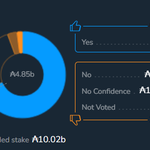
Support has improved to 43.35% Yes from DReps and 15.53% Yes from SPOs, but the action still needs 67% Yes from DReps and 51% Yes from SPOs to pass.
Reaching one threshold alone isn't enough. The action needs to clear both.
So what happens if it doesn't?
When the current members' terms expire, the Constitutional Committee will fall below its required minimum size. At that point, most Cardano governance actions will no longer be able to pass because the required Constitutional Committee approval cannot be obtained.
There is no constitutional workaround that allows governance to simply continue without a functioning committee. Voting is required to restore it.
That means another governance action would be needed to elect or appoint enough members to bring the committee back above the minimum size, and that process itself requires the necessary votes and approvals.
So this isn't just about ratifying an election result. It's about keeping Cardano's governance machinery operational.
DReps and SPOs, please vote before September 1st.
gov.tools/governance_actions…
Thank you for what you guys are doing for my country in a time of need.

Community effort in action.
@WorldMobilers , @ChristianRees and community volunteers have installed the first AirNode at the main relief centre in Darién, Colombia.
The team is working to bring free WiFi online so people can contact family and friends.
5
715
After many months in the oven I'm really happy to see this tool live.
Definetly a step forward in governance.
@dreptalkcom @DRepForum
Thanks to @IntersectCIVICS

The Cardano Constitution belongs to its community. Now there’s a clear place for that community to help shape how it evolves.
The Constitutional Amendment Portal is live for alpha testing.
Read it. Question it. Raise an issue. Propose a change. Help us test it.
🔗 cap.intersectmbo.org
Find out more 👇

Thank you @IntersectMBO!
Not just founding entities, and staff. But to the hundreds the engaged community members that generously have been building for years.
This coordination layer has been and will be the cornerstone of Cardano's hability to thrive.
If you read one thing this week, make it this.
Much of the work that keeps the ecosystem moving happens behind the scenes.
Read in depth our special update on the work that rarely makes headlines, but makes everything else possible.
If you've ever asked "Why Intersect?" 👇️
intersectmbo.org/news/inters…
Two days to go. We need 75% to pass. Make sure you delegate to a dRep who supports this critical change to enhance Cardano Governance resilience.

1
64
You are not wrong. Delegation stickiness is much higher than anticipated and need urgent correction.
One idea is delegation expiration.
Would love to hear everyone's ideas

In any serious ecosystem, Yoroi would already be stepping down as a DRep.
A wallet vulnerability put a significant number of users and millions of ADA at risk. Funds were lost. Trust was damaged.
And somehow, after all that, Yoroi remains the DRep with **the highest voting power on Cardano.**
That should embarrass everyone pretending Cardano governance is working as intended.
When incompetence at this scale brings no real consequence, the problem is no longer isolated to a wallet team.
The rot has reached governance.
#Cardano
Great job materializing this idea!
This is how I initially conceived the NCL when it was incorporated in the constitutional guardrails.
In the sake of time it wasn't included then in the ledger as parameters.


This action does not reduce the size of the constitutional committee which remains with 7 seats. I avoids Cardano Governance from freezing if 1 or 2 members retire and gives the community time to run an election to replace them.


This one is sadly aging well.

💯 I'll say this again: Any reward framework that asks for highly qualified work to be done for free will not be sustainable.
The trilemma: You will get competent people with good intentions for short time. Incompetents with good intentions for long time or competent with bad intentions forever.
1
8
941
I support 110% this initiative by @YoramBenzvi we need this to drive growth in a systematic, scalable and sustainable way.
The proposal is very well though out and the team has the experience and drive necessary to see it through.

1.52M ADA for a Cardano business development network.
@yorambenzvi is proposing a 12-month pilot with 5–8 regional BD teams, 20+ Cardano companies onboarded, and a target of 7–10 enterprise deals closed.
The upside: Cardano needs people who can qualify leads, manage enterprise relationships, and help builders close deals.
The concern: enterprise BD is hard to verify until contracts, users, transactions and revenue show up.
Worth trying, or too soft for treasury funding?
*Not a paid promotion

Congratulations to all elected candidates!
Thank you to all @IntersectMBO members who trusted us with your votes!
Very exciting times and hardwork ahead for Cardano's governance.


We keep contributing to Cardano's growth and adoption to make the world a better place, where trusting each other is exponentially cheaper and enables EVERYONE to move forward.

We've been quietly building.
Today we are proud to announce our "Strategic Institution Management in Latin America" platform is live
crm.latamcardano.org/
Go take a look, let us know what you think. It's free.
@Cardano_CF @IOGroup @emurgo_io @IntersectLatam @IntersectMBO
5
126
Very excited to see proposals in this direction. Looking forward to learning more about it, definetly the direction we need to move in.

We just submitted our budget proposal: "The Marketing-Powered Demand Engine for Cardano."
Here's what it is, what it costs, and why it matters.
THE PROBLEM
Cardano stands on strong technical foundations. Yet for enterprise decision-makers, it's not an obvious "yes" — not because the technology can't deliver, but because they're missing use-case clarity, proof, and engagement paths. The business world sees Cardano as a respected ecosystem. Not yet as first choice for enterprise infrastructure.
THE SOLUTION
A complete enterprise demand generation system that repositions Cardano as "The Blockchain for Serious Business." The system operates through a three-stage funnel: Attention →Proof → Qualified Leads.
Two recommended blueprint verticals: Institutional DeFi and Supply Chain Traceability — final selection to be validated with the GMC. Three pilot markets: UK, Germany, Switzerland. A central Cardano Hub serves as the evidence and engagement environment.
Directly aligned with the Cardano 2030 Strategy Framework — Pillar 2 (Adoption & Utility) and Pillar 4 (Community & Ecosystem Growth), supporting core KPIs: TVL, monthly transactions, and monthly active users.
THE INVESTMENT
12-month pilot. Four milestone-gated work packages — each one only unlocked when the previous one delivers. WP4 (V2 Supply Chain) is only released after the Q3 KPI checkpoint passes. Total investment: €2,978,738 (53% media, 47% agency — within industry benchmark). ADA surplus gets returned to the Treasury.
WHO WE ARE
Serviceplan Group — the only globally ranked agency that has built live Cardano infrastructure, deployed it in production, and holds a formal Cardano Foundation partnership. Official Intersect member. Masumi Network has been on mainnet since November 2024 with 25,000+ on-chain transactions.
Independent Network of the Year at Cannes Lions 2025 (19 Lions). #1 globally on WARC Creative 100 and Media 100. 6,500 people, 40+ countries, €866M revenue.
Full proposal and brochure in the reply below.👇

1
8
258
I agree, we need to amend the constitution with these structural reforms. Let's take what we've learned and make Cardano Governance better.

Cardano has set a budget cap of 350M ADA (~$140M USD) annually, and treasury withdrawal proposals are now flooding in. Yet the top 10 DReps control over 48% of voting power, meaning 10 accounts effectively decide how $140M is allocated, with zero external audit.
To put $140M in perspective:
A mid-cap public company's annual R&D budget
A Series C startup funding round
A small municipality's entire annual budget
Now consider: 10 people control these decisions.
No board of 10 would unilaterally allocate $140M in a publicly traded company without shareholder approval, audit committees, and regulatory oversight.
No municipality of comparable budget would allow 10 officials to spend taxpayer money without council votes, public hearings, and external audits.
Yet Cardano's treasury, of equivalent scale, operates with 10 accounts holding veto power over $140M, answerable to no one.
Daily flow under their control: 960K ADA = $380K USD
The Clarity Act Question:
Under the SEC's new guidance, sufficient decentralization determines whether crypto assets are commodities or securities. How would regulators assess a network where 10 accounts control $140M in capital allocation without oversight?
This isn't just poor governance—it's a regulatory time bomb.
What needs to happen:
Delegation diversification: Break up concentrated voting power
Hard caps on DRep voting power: Structurally prevent re-concentration
Transparency and accountability: External audit mechanisms
For Cardano, decentralization isn't an ideal—it's a survival requirement.
#Target15 #カルダノガバナンス
@IntersectTSC @IntersectCIVICS @IntersectMBO @IntersectCBC have this on the radar.
I will keep a close eye on the progress so we get the NCL as a ledger parameter ASAP

I dont think you find many who disagree with this who have given governace serious thought. I would support NCL on chain as a parameter.
2
64
