

Climate change in the Arctic – North Atlantic region and impacts on the UK (CANARI) is funded by @NERCscience and managed by @AtmosScience
UK
Joined August 2019
- Tweets105
- Following935
- Followers377
- Likes178





Applying for climate science PhDs? Check out the (growing) list of projects currently available with CANARI scientists:
canari.ac.uk/2024/12/11/new-…

Going to #EGU24? Catch up with CANARI science from water resources and sea ice variability to ocean currents and rapid Arctic change. CANARI researchers are also running sessions on career development and policy engagement.
Find out more here:
canari.ac.uk/2024/04/08/cana…


Excited to be kicking off analysis of the CANARI Large Ensemble simulations at our coding SPRINT this week! More updates to come throughout the week.
canari.ac.uk/2024/03/04/cana…

Fantastic to have scientists contributing from @AtmosScience
@NOCnews
@BGSGroundwater
@UK_CEH
@NCEOscience
@CPOM_news
2
139
Interested in a PhD in climate science?
Check out the (growing) list of projects currently available with CANARI scientists:
canari.ac.uk/2023/12/19/new-…
CANARI aims to increase our understanding of how climate change in the Arctic will impact the UK. It will focus on the impacts of climate variability and the potential impacts of extreme weather events @NERCscience

"The Arctic region is at the forefront of climate change and is warming four times faster than the rest of the Earth"
Commons EAC - UK scientists are building increasing evidence that the UK’s climate is affected by changes in the Arctic. @NOCnews @BAS_News @AtmosScience @PlymouthMarine @CPOM_news
Commons EAC - UK scientists are building increasing evidence that the UK’s climate is affected by changes in the Arctic. @NOCnews @BAS_News @AtmosScience @PlymouthMarine @CPOM_news

What happens in the Arctic doesn’t stay in the Arctic. Arctic changes contribute to flooding and changing weather patterns in the UK. Ministers must meet more frequently to coordinate government policy on the Arctic.
❄ Read our report at bit.ly/EACArctic ❄ #EACArctic

In our recent work we uncover the reasons for a substantial sea ice shift around the mid-2000s. Our simulations show that during this unique event Barents Sea Water’s volume reduced, giving less “memory” of previous conditions. doi.org/10.1029/2021JC018280

Can climate models help us understand how European post-tropical storms (such as Storm Ophelia) might change in the future? A new paper authored by Elliott Sainsbury @Sainsbo46
wcd.copernicus.org/articles/…
@reinhardkh @alexbakey @KieranBhatia @Len_Shaffrey

In case you are wondering... ACSIS twitter account has morphed into CANARI, which aims to take an all-in-one view of the Arctic – North Atlantic climate system, to understand the impacts on the UK arising from changes taking place in these regions. @Len_Shaffrey @AtmosScience
And just like that, the ACSIS Final Science Meeting is over! Thanks to all the speakers, participants, organisers and @lmhoxford for a fantastic day showcasing the achievements of the ACSIS programme, and discussing future avenues of research...
3
Chief scientific adviser to @DefraGovUK Prof Gideon Henderson @DefraChiefScien now joins us to give the DEFRA perspective on why understanding the North Atlantic climate system is critical for managing the UK environment and preparing for future change.
1
Thanks @Len_Shaffrey for the great overview of the upcoming @NERCscience project CANARI, aimed at advancing understanding of the impacts on the UK arising from climate variability and change in the Arctic-North Atlantic.

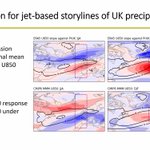
Ben Harvey from @AtmosScience tells us about how we can use the 'storylines approach' to assess future changes in atmospheric circulation, including the influence of the North Atlantic jet on precipitation in the UK.

"Future changes in the North Atlantic Climate System" session has now started, chaired by @TomBracegirdle. First up, Doug Smith from @metofficenews tells us about predictability, and the widespread evidence that climate models underestimate atmospheric circulation.
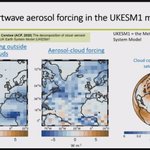
Jon Robson @JonIRobson shows that anthropogenic aerosols (AAs) are a strong driver of change in sea surface temperature in the Atlantic Ocean and in AMOC, likely via changing the surface heat fluxes.


