





ChainflowSol retweeted

What were people searching for on W3V this week? 🔎
🇬🇧 BlockZero 2026 by @ChainflowSol
Held November 15 in London, bringing @solana validators and infrastructure operators together
🤖 AMD Developer Hackathon: ACT II by @AMD
A surprise entry! July's AI hackathon is still bringing viewsmonths later
🔐 Concordium Trusted Agents Hackathon by @Concordium and @encodeclub
Running through December 9, with developers building AI agents around identity, payments and accountability
🛠️ Dev3pack Global Hackathon by @dev3pack
Coming up November 27–29! Students worldwide will build on Solana, with applications closing November 26
🏎️ GGC: GMGN Global Championship by @gmgnai
Held November 16 in London, where seven finalists competed in a live trading showdown for an Aston Martin Vantage.

ChainflowSol retweeted

Congrats to @StakingFac & @pumpkinspool on Most Helpful Validator at Block Zero. Being helpful in the validator community mostly means answering questions at odd hours for people you’ll never meet. A lot of us have been on the receiving end. 🌞


ChainflowSol retweeted
London, done.
At #BlockZero, @nicostery moderated the hardest debate of the week. At #Breakpoint, operators sat down for round three of @Solana Governance Talks.
And somewhere in between, we handed out propolis.
Thank you to everyone who showed up 🐝


ChainflowSol retweeted
Should SFDP continue to exist?
@nicostery is moderating @Bryan_TitanA and @jacobvcreech on the #BlockZero stage
The conversation the operators needed to have in the room, not just on X.
Let’s go 🌞
@SolanaFndn @ChainflowSol


ChainflowSol retweeted
At 3:00 PM, @nicostery moderates the debate the whole validator set is talking about: Should SFDP continue to exist?
Full schedule below 👇


ChainflowSol retweeted
Bees pick a new home by quorum. Scouts vote by dancing, and nobody moves until enough of them agree. The queen gets no say.
That’s basically consensus with better choreography.
We’re bringing their propolis to #BlockZero on Sunday, come find us. 🌞 🐝

ChainflowSol retweeted

Independent validators made Alpenglow happen on the community cluster and are still powering its evolution
#KeepStakeDecentralized

Alpenglow has been live on mainnet for ~3 weeks. On the community test cluster where it was tested, we're already running Agave v4.5 beta.
Next version on the test cluster, proven build on mainnet. That's the job.
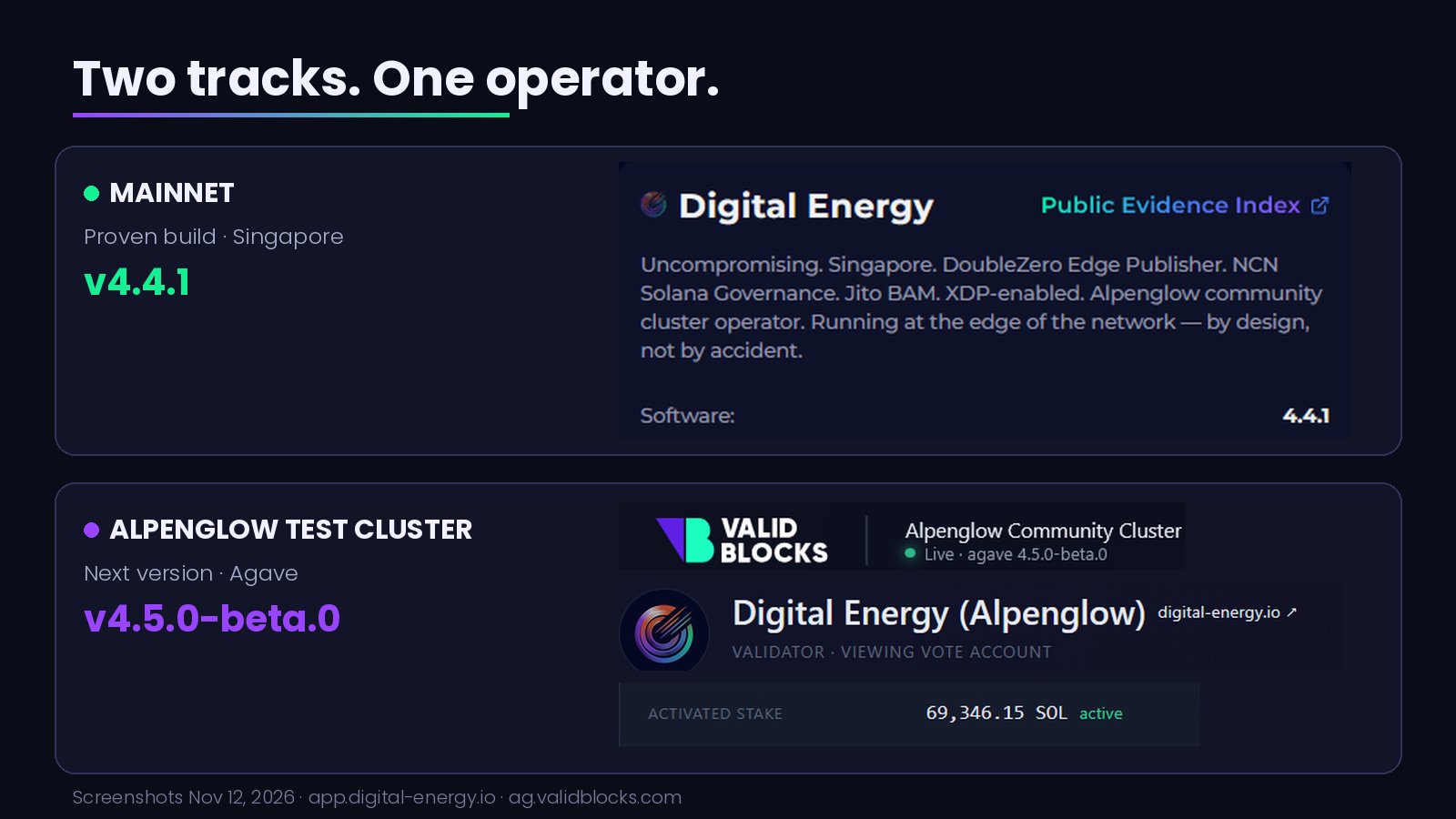
ALT Two screenshots. Mainnet: Digital Energy validator on Agave v4.4.1. Alpenglow community test cluster: Digital Energy (Alpenglow) on agave v4.5.0-beta.0 with 69,346 SOL active stake.
ChainflowSol retweeted
Regarding "why just before Breakpoint"
@ChainflowSol decided to again sponsor Block Zero, this year, in addition to co-organizing it
This expense isn't insignificant to us and we would have had to at least reconsider our sponsorship had we known we'd be losing SFDP stake

A few thoughts on Jacobs response and the SFDP changes.
- SFDP is wildly successful and clearly we need to work on that messaging. I don't work for the Solana Foundation so I don't have all the data but I can already present way more successful examples then Jacob has below.
- "We've had a lot of feedback that SFDP is no longer reactive enough nor provides enough criteria given the ever-changing landscape of Solana." No offense but these people probably have no clue. Based on the inability for the SF to actually communicate the success of their own program... I'm not entirely surprised.
- Removing whitelabels from the program is a HUGE positive. The biggest strength of the SFDP is through its operators and individual humans. White labels destroy that.
- There is a straight 35k sol delegation cut to operators that survive. Currently 85kish, moving to 55k. Big loss. And this is not soley a SFDP issue. If validators lose 30k for any souce, its a huge loss. That's how slim margins are.
- The 12 month automatic retirement feels weird and makes folks instantly feel like they are getting booted to the curb. Annual review feels much better.
- 100 validator max - Feels unnecessarily combatitive. You could probably just hit 100 by implementing the above steps and not need to say "100 validator max".
- Why do this before Breakpoint? There are a ton of indepedent validators coming to Breakpoint who are now told they will no longer be profitable and need to shut down. Some have cancelled tickets. Some are now at a loss. These are the WARM BODIES we want to keep.
- Why do this right after AG testing? Right after 2x voting fees? All of these items compound into just really "feels bad man".
I have a lot more thoughts but I'll end here for now with a two final thoughts...
1) A lot of folks that are upset are probably the very same people who will actually survive the purge. Because they are active and actually care. Versus the 100+ validators who probably haven't even read the announcement yet. But why put them through this? These folks may shut down before the applications for retirement are even processed. I doubt Tim or the Foundation will process the retirement applications any time soon due to Breakpoint. It's a lot of worry and heartache targeting those who were never the targets.
2) Validators are overall NOT software engineers. If we were, we would be working directly for blockchain companies. We are "tech adjacent". That has severely hampered our ability to build next level applications that some folks think validators should be building. But guess what? Indepent validators have VISION, and often sntrepreneurial skills. A bit of that intangible spirit that everyone is searching for. Why ? Because AI is solving the technical moat. We are seeing more and more appliations being built from SFDP recipients throug the use of AI. And its seeing exponential increase. Do not NUKE the warm bodies right when before that exponential curve takes off.
@solana @SolanaFndn @TimGarcia0 @jacobvcreech
ChainflowSol retweeted

Independent validators who say they helped get Alpenglow to mainnet are asking the Solana Foundation to stop retiring them.
Layer33, a collective of independent Solana validators, published an open letter on Monday. It asks the Foundation to pause the weekly retirements under its new delegation program rules.
The Solana Foundation Delegation Program lends Foundation-owned SOL to independent validators, so they can earn rewards while they build a staker base of their own.
New rules took effect on 6 November. Membership now lasts 12 months, and validators retire once they attract more than 300,000 SOL from other sources.
Layer33's members are among the operators who stand to lose that stake. Their sharpest argument is about timing.
Alpenglow, Solana's new consensus upgrade, went live on mainnet on 21 October. Layer33 says independent validators ran most of the community test cluster, paid for extra servers and absorbed higher vote costs along the way.
"Before most of us have earned back a fraction of what that period cost, SFDP is retiring us."
The letter makes five requests:
- pause the weekly retirement tranches until the community is consulted
- six more months of delegation for operators who ran the Alpenglow test cluster
- publish the analysis behind the 100-validator and 12-month figures
- a formal consultation with current members
- a long-term "contributor model" that rewards uptime, client diversity and network spread
Its summary of the stakes: "Churn is not decentralization."
The Foundation describes the program as a starting point. Jacob Creech (@jacobvcreech) of the Solana Foundation wrote on 6 November that one of its goals "is to help these validators onboard," and that validators who want to last have "a lot of objective performance criteria to go after."
The letter's first request is the pause on weekly retirements. Neither Creech nor the Foundation had responded to it by Monday night.

An open letter to the Solana Foundation on the new SFDP rules
On November 6, the Solana Foundation announced new rules for the Solana Foundation Delegation Program: a twelve-month membership term, graduation at 300k SOL of external stake, a hard cap of 100 validators, and the retirement of existing members in weekly tranches.
We are writing because we believe these changes work against decentralization, and because they will push out many of the hardest working and best-faith operators Solana has ever had. These are the quiet ones. They do not run marketing campaigns or pick fights on X for impressions. They run nodes, they run them well, and they make valuable contributions to the network while doing it.
◆ The incubator model has not worked ◆
SFDP was built as a launchpad for new validators, and that was the right goal when the validator set needed bootstrapping. That job is done. The goal posts need to move.
On paper, twelve months of delegation followed by forced graduation is a sink-or-swim model: incubate new operators, let natural selection remove the ones who cannot make it. In practice it will play out differently. Validators will join, collect earnings for twelve months, and leave. That is not a net new independent operator. It is a short-term tenant.
The deeper problem is that attracting stake outside SFDP is close to impossible unless you are already in the superminority. The highest-staked validators keep attracting even more stake, so the superminority is shrinking in count while growing in share. Under these rules it sits on top of a constantly churning set of 100 SFDP nodes. Churn is not decentralization. It is a revolving door with an ever-smaller group of ever-larger operators on the other side.
Meanwhile, the operators who actually push the network forward are the ones being cut. The people who tirelessly tested the new governance system before it went live. The people who moved their nodes to different ASNs, at their own cost, because ASN diversity mattered. The people who lose sleep for urgent upgrades. The people who carried Alpenglow to mainnet, which we come back to below. Those are the operators this program is now designed to remove. The longer you have been on Solana, the worse this program is for you.
◆ The Teraswitch outage is the case study ◆
When Teraswitch went down, the network did not halt. It stayed up because enough stake was spread across enough independent validators on enough different ASNs to keep consensus alive. That distribution did not happen by accident. It existed because SFDP supported the number of validators it did and because SFDP created the ASN rule. And stake on Solana increased after the outage. The market saw a network absorb a major provider failure without blinking, and rewarded it.
Shrink the program to 100 validators and concentrate the rest with a handful of operators, and the next provider outage ends very differently. The Foundation is dismantling the exact safety margin that kept the chain from halting.
The numbers are not abstract. At the operator level, Solana's Nakamoto coefficient is 8 today. It was 6 until Alpenglow raised the liveness threshold from 33% to 40%. At the 20% safety threshold, the coefficient is 3. That is a long way from the 18 or so that gets repeated in marketing. These rules push every one of those figures the wrong way.
◆ Alpenglow was carried by independents, and independents are paying for it ◆
Alpenglow did not reach mainnet on its own. It got there because of the community cluster, and the community cluster was run almost entirely by independent validators. Not a single operator from the superminority participated. The largest validators on the network, the ones about to receive the stake being taken from us, contributed nothing to the most important upgrade Solana has shipped.
The history matters. When independent validators raised concerns about 200ms block times and the operational/financial load it put on smaller operators, the Foundation's answer was to participate in the Alpenglow community cluster and accelerate the migration. So we did. We paid for the extra servers. We stayed up until 2 and 4 AM through dozens of regenesis’s. We absorbed weeks of accelerated block times and accompanying doubling vote costs, on the understanding that Alpenglow would make it worth it.
Alpenglow migrated to mainnet a few weeks ago. Before most of us have earned back a fraction of what that period cost, SFDP is retiring us.
The entire burden of 200ms and the Alpenglow migration on independent validators, and the moment the work was done, the Foundation moved to cut us. At minimum, the operators who carried that upgrade should be allowed to run on Alpenglow mainnet under existing delegation for six months before any retirement takes effect. That way they can recover their costs.
◆ Who actually contributes to the network ◆
Measured against stake, lower-staked validators contribute far more back to the network than their higher-staked counterparts. This is not a matter of character. It is structural.
Large operators have investors and shareholders who expect profit to be maximized. Testnet participation, client diversity work, community infrastructure, and governance testing do not make money. The largest operators are therefore discouraged from doing any of it, and for the most part they do not. Alpenglow is the clearest example.
Independent operators are the opposite. We are expected to contribute, we are judged on it, and we do. SFDP spent years building that expectation into its own criteria. The new rules now retire the operators who met the bar and hand the stake to operators who are built not to.
◆ Institutional delegation is moving stake in the wrong direction ◆
Our understanding is that the Foundation intends to redirect stake toward institutional validators. Institutions outsource risk; that is what they do. We expect the long-term result to be institutions white-labelling through a small number of existing superminority operators. Stake taken from independent validators will end up concentrated with the operators who already hold the most of it.
That is centralization in its purest form. There is a harder truth underneath this. The independent validator set was the proof point. Early community operators were what made Solana credible enough for the people in suits to start paying attention and writing checks. Decentralization was the pitch. Now that the money has started to arrive, the operators who were the pitch are being shown the door to make room for it.
People who gave Solana their everything deserve better than being used as leverage and then being thrown away.
Decentralization is not a vanity metric. It is not a position to take the moral high ground from when criticizing a competitor like Hyperliquid, and it is not a narrative to be respun each time compliance requirements get clarified. Decentralization is why this industry exists in the first place.
Institutions are not bad actors (usually). But they are not network stewards. They have no mandate to care about client diversity, ASN spread, or testnet participation, and no operational capacity to contribute to any of it even if they wanted to. The better outcome for everyone is to route that stake to the independent operators who have already proven they will protect it.
◆ SFDP needs a purpose again ◆
If the program no longer exists to support independent operators or diversity, and the incubator model does not work in practice, it is fair to ask what the program exists for.
We propose it becomes a long-term independent contributor program, where the contribution being measured is network health itself: uptime through upgrades, client diversity, ASN and geographic diversity, supporting new innovative initiatives like community cluster participation, governance testing, etc. The operators who carried Alpenglow testing are exactly the people such a program should be rewarding. Inactivity means removal. Operators who do this work should be rewarded for as long as they keep doing it, not retired on a calendar, and not asked to become something other than validators to stay eligible.
That model aligns the program's incentives with the long-term success of the network. Arbitrarily picking 100 validators and churning them once a year aligns them with nothing.
◆ What we are asking for ◆
1. Pause the weekly retirement tranches until the community has been consulted.
2. Give current members who participated in the Alpenglow community cluster a minimum of six months of continued delegation on Alpenglow mainnet before any retirement takes effect.
3. Publish the analysis behind the arbitrary 100-validator cap, and twelve-month figures.
4. Open a formal consultation with current SFDP members before the rules are finalized.
5. Adopt the contributor model above as a replacement for, or alongside, the incubator model.
Solana's resilience was built by people who showed up when it was hard and did not expect to be thanked. We are asking the Foundation not to design them out of the network.
◆ This is what the independent set actually does ◆
The independent validator set, even within Layer33, has been able to achieve many things. Across this group alone, we have:
◆ Supported the official Solana testnet faucet with validator rewards from over 33 million testnet SOL delegated across more than 5k stake accounts, replenishing roughly 450k testnet SOL per month so new validators and developers can deploy before touching mainnet
◆ Built the devnet faucet and the Solana Hardware Compatibility List that operators use to spec machines
◆ Been among the first mainnet validators to run Frankendancer, and later to adopt full Firedancer, on our own hardware, before client diversity was a talking point
◆ Made open source contributions to solana-program, Firedancer, and DoubleZero, plus open source tooling that lets operators switch clients and handle updates automatically
◆ Built a free public API and chart suite for validator and network data that powers dozens of tools and sites across the ecosystem
◆ Built public dashboards that have repeatedly exposed malicious validator behavior around delayed blocks and held bad actors accountable
◆ Shipped the first UI for diagnosing skipped block issues, and staking tools for tip harvesting and stake account cleanup
◆ Co-authored the Validator Voting Behavior Study
Built Nakaflow, which tracks Solana's Nakamoto coefficient against other chains
◆ Contributed to governance design from the beginning, and are key contributors to the new governance platform launching in 2026
◆ Run the monthly validator community call continuously for more than three years
◆ Co-founded the Block Zero validator conference, and organized and sponsored every edition since inception
◆ Built validator infrastructure in underserved regions, including the only major validator between Dallas and Miami and the oldest Brazil-based validator, both on dedicated hardware
◆ Won multiple Solana hackathons
◆ Still host multiple hackathons across Solana every year
◆ Created one of the first Solana-native transaction indexing platforms, used by consumers and teams to understand on-chain activity at scale
◆ Built early DAO and governance tooling adopted by BONK and other Solana-native projects
◆ Built stake pools and delegation tooling that route stake toward performance and decentralization
◆ Reinvested validator revenue into Solana-native startups, hackathon track sponsorships, free web3 security education, and ongoing donations to animal welfare, clean energy, and men's health charities
◆ Kept genesis validators running on our own fleets across multiple locations, delegating our own stake to other operators who contribute to network health
◆ Made up the bulk of the Alpenglow community cluster, on our own servers and our own time, to get the upgrade to mainnet faster
Several of these have been running for three years or more with no end date. That is what a long-term contributor looks like. A twelve-month clock does not describe it.
None of this was required. None of it counts under the new rules. With these changes actioned, institutions like Figment get propped up and the independent validator set gets dismantled. Under that model, none of the above would have existed, and the next round of contributions like these will not exist either.
The independent validator set is normally quiet. We work siloed in our own day-to-day operations. Decentralized, you might say. We focus on validator and network performance, not for ourselves, but so that Solana thrives. For all of us to come together and speak out against a single change means something is truly broken.
This letter may disappear into the void as the Foundation moves to support the large institutional players, the ones who do not care about Solana, at the expense of the people who do. Even so, we wanted our position on the record.
L33
ChainflowSol retweeted
Achieving exceptional technical performance, according to objective criteria, isn't enough to attract stake outside of the SFDP
While I wish it wasn't true, our experience @ChainflowSol running a mainnet validator since genesis, trying to prove this thesis wrong, tells us it is

ChainflowSol retweeted

We're not done shilling London events:
The day before Breakpoint doors open, in the same building: BlockZero, a community-led validator summit run by @ChainflowPOS and friends.
Small, high-signal, built around what it actually takes to run the network. Validators, request your seat.
ChainflowSol retweeted

If you're not feeling the Breakpoint hype yet, you're simply not registering to enough side events
The thrill you get when you get accepted on Luma is sensational, it’s unbeatable
Get your dopamine hit now
luma.com/BP-SideEvents

ChainflowSol retweeted
REMINDER: the @solana validator community call we moved is this Thursday, Oct 29, 2:00 PM ET.
Agenda and sign-up: hackmd.io/1DFauFMWTZG37-U7CX…
P.S. Anyone can join & it isn’t recorded.

ChainflowSol retweeted

Alpenglow is live! It's been a crazy grind over the past 20 months bringing this to mainnet.
Huge shoutout to the Anza engineering team, @TheWattenhofer and the research team, the Anza security team, all our auditors and bug bounty participants.
And of course the validator operators who spent countless hours with their own hardware to help us test and bring this to mainnet.
We couldn't have done this without you all! Lets AlpenGO.

ChainflowSol retweeted
And @ChainflowSol was there, just like we were for the original genesis block on March 16, 2020
While a lot has changed since then, we're
Still here
Still contributing
Still independent
🌞
Alpenglow genesis block formed and the legacy TowerBFT is retired.
Genesis slot: 459,653,000
Activation epoch: 1064
Validators participated: 654
Handoff time: 900ms
explorer.solana.com/block/45…


ChainflowSol retweeted

Validators be prepared; some guidance is making its way around.
Update to v4.3.2
No Firedancer/Frankendancer, we should only be running agave.
ART3MIS will be switching in a few hours 🫡
@Solana's Roadster moment happens in epoch 1064.