

Connecting Data, People & Ideas since 2016. Using relationships, meaning, context in Data to achieve great things #KnowledgeGraph #GraphDB #AI #SemTech
The World
Joined April 2016
- Tweets6.4K
- Following2.5K
- Followers7.1K
- Likes2.4K



Pinned Tweet
“If you are in the AI industry, you need to come here to see how the work we are doing is going to help you.”
These words from Tara Raafat, Head of Metadata Strategy at Bloomberg, capture something important about Connected Data London.
Tara has been part of this community since its early days. At #CDL26, she reminded us why the work of the connected data community matters well beyond its own boundaries.
As AI moves into the enterprise mainstream, the need for meaningful data, context, knowledge and trusted connections becomes increasingly important.
That's what this community has been working on for a decade.
Connected Data London celebrated its 10th anniversary in 2026, bringing together practitioners, researchers, technology leaders and innovators for two days of knowledge sharing, technical discussions and, perhaps most importantly, genuine community.
And the conversations went well beyond the sessions.
From Knowledge Graphs, Graph AI and Semantic Technology to the emerging role of graphs in enterprise AI, our speakers and participants brought decades of experience, fresh perspectives and practical insights to the table.
But don't just take our word for it.
Hear from Tara and other members of the community, including William Tunstall-Pedoe, Nicole Moldovan, Gurpinder S. Dhillon, Vinay Balasubramaniam, Jessica Talisman and George Anadiotis.
🎬 Watch the Connected Data London 2026 highlights:
youtube.com/watch?v=8V3UEo2j…
Missed a talk at #CDL26? Or missed the whole thing?
✅ Attended? Replay access is included in your ticket.
🎟 Couldn't make it? Get the All Access Remote Pass for permanent on-demand access to the recordings and materials from both days:
2026.connected-data.london/
Ten years of connecting data, people and ideas. And a lot more to explore together.
Thank you to everyone who made #CDL26 what it was, and to our speakers, sponsors and community partners for being part of the journey.
#KnowledgeGraphs #GraphAI #GraphRAG #AgenticAI #SemanticTechnology #EnterpriseAI #ConnectedData
Knowledge Graphs Can Change How Organizations Share Meaning. Building and Maintaining Them Is the Hard Part
The enterprise challenge is to make explicit the conceptual models already scattered across schemas, taxonomies, data dictionaries, reference tables, and spreadsheets that only one person trusts.
The goal: systems and people that stop arguing over what "customer", "product" or "contract" means.
LLM-driven chat, search and agents can now make semantic structure useful well beyond data teams. A good knowledge graph acts as semantic reference data, describing:
• What things are
• How they relate
• What they are called in different systems
• Which rules matter
The conversation can then move from "Where is the data?" to "What does the business mean by this?", "Which systems disagree?" and "What is the impact if we change this?"
The groundwork is decisive. Given a chaotic underlying model, an LLM will produce fluent chaos: confident, plausible and wrong.
The work that often goes unbudgeted:
• Reconciling competing definitions across teams
• Understanding data oddities that reflect business history
• Recording the reasons behind modeling choices on identity, state, time and synonyms
• Keeping mappings current as the business evolves
• Maintaining privacy, security and contractual guardrails
A unified model is a living agreement between humans.
For enterprises, the pragmatic route is rarely one model for everything. It is usually semantic agreement where it pays off most, plus explicit mapping elsewhere. For startups, early investment in a coherent domain model can create a compounding advantage.
Two questions to ask at the outset:
1. What pain is being removed right now?
2. Who will still care enough to maintain this in two years?
By Thilo Hermann
Knowledge Graphs: The Real Game Changer … but Hard to Build and Maintain sbee.link/vfucky4qjg
#EnterpriseArchitecture #SemanticTechnology #LLM #DataGovernance #DataManagement
--
Missed a talk at #CDL26? Or missed the whole thing?
All talk recordings are now available.
With so many ideas and speakers, nobody could catch them all live. We’ve got you covered.
✅ Were you there? Replays are already included in your ticket.
🎟 Couldn’t make it? Get a remote ticket for permanent on-demand access to every talk.
👉 sbee.link/6rdejcnbt4?utm_sou…
Recorded live at Connected Data London 2026 | 11–12 November | Leonardo Royal Hotel London Tower Bridge
#CDL26 #KnowledgeGraph #GraphRAG #Ontology #AI

🎥 The recordings from Connected Data London 2026 are now available on demand
This is the opportunity for the global community to watch the full programme, and for in-person attendees to catch every parallel Masterclass, Lightning Talk, and Presentation they missed.
Across two days of practitioner-led sessions, four core themes defined the conversation:
1. Grounding AI in Deterministic Reality
Moving past naive vector search and ungrounded models toward Neurosymbolic AI, GraphRAG, Model Context Protocol (MCP) servers, and verifiable reasoning.
2. The Semantic Renaissance & Data Engineering
Bridging the historic divide between data pipelines and formal meaning—from our opening 25 Years of the Semantic Web fireside chat to modern RDF standards and agent-oriented ontologies.
3. Scaling and Governing Enterprise Knowledge
Practical lessons on crossing the chasm from isolated pilots to governed semantic layers across finance, life sciences, manufacturing, and hyperscale cloud infrastructure.
4. Frontier Architectures & Honest Benchmarks
Unvarnished looks at local agent memory, physical robotics assembly graphs, just-in-time entity resolution, legal-grade provenance, and empirical RDF framework benchmarks.
🔓 Why watch on demand?
• Catch every parallel track: Gain full access to all 4 Masterclass stages, 15 Rapid Insights lightning talks, the Plenary Keynotes, and the Nodes, Edges, and Educational tracks.
• Learn at your own pace: Your All-Access Replay Pass grants lifetime access to all session recordings, alongside shared Masterclass materials so you can revisit complex architectures and implement them with your team.
• Built for depth: Pause, review technical workflows, and share specific briefings across your engineering and data leadership teams.
Already attended Connected Data London 2026? Sign in via the event portal to access your replay library.
👉 Missed it in London? Claim your All-Access Replay Pass here:
2026.connected-data.london/
🤖 Made with AI


What is an Ontology? South Park has a working answer 🎬
Marvin is Randy's parent. Randy is Stan's parent. No fact anywhere says Marvin is Stan's grandparent, yet a reasoner reaches that conclusion by applying one rule to two statements.
That is an ontology at work: shared definitions and rules, written clearly enough for a computer to use.
A primer built on the Marsh family and South Park Elementary walks through the anatomy:
Triples: Stan → attends → South Park Elementary. Subject, predicate, object. Eight of them cover family, friendship, school, age and grade.
Identifiers: South Park has two boys named Kyle, a friend and a cousin from Connecticut. A string cannot separate them. An IRI can.
Classes and properties: Person is a class, has grade level is a property. Stan moves from fourth grade to fifth and remains the same Stan.
Rules: inverse, symmetric, transitive and property chains, plus RDFS domains and ranges. A rule can follow the data faithfully and still return an answer nobody wanted.
Validation: SHACL rejects "grade level banana." Grade 5 passes the same check and can still be wrong. The computer has checked the record, not watched the episode.
Provenance: every conclusion traces back to the facts and the rule that produced it.
Three review questions close it: is the model consistent, coherent, valid?
The primer traces to a talk. At Connected Data London 2026, Joe Reis presented "Respect My Ontology: Why Data Engineering and Knowledge Graphs are Doing a W.T.F.", also staged through South Park.
Two camps work on how things relate to one another, in different languages. The data camp is professional wrestling, flashy. The knowledge camp is traditional wrestling, foundational technique.
Labels such as goth and emo, and the LPG vs RDF debate, show how tribes form around names. The Underpants Gnomes cover the AI phase: add context, ?, profit, with a semantic swamp as the risk.
The call to action: end the infighting and bring outsiders in. Many data engineers rebuild what RDF and schema.org already offer because nobody introduced them. The Q&A put the cause down to sales and marketing, and proposed baseline material such as "ontologies for executives."
Jessica Talisman, who attended alongside Joe Reis, took the same cartoon and made it the modeling material. An interactive South Park ontology webapp lets readers change a grade or an identifier and watch the graph respond.
Read the primer. Then watch the talk for the wrestling, the gnomes and the Q&A.
By Jessica Talisman & Joe Reis
What is an Ontology? A basic ontology explainer as told through South Park sbee.link/c4wrmbjfne
South Park facts form a knowledge graph sbee.link/mpugwjq9ac
Respect My Ontology: Why Data Engineering and Knowledge Graphs are Doing a "W.T.F." sbee.link/k79dnr3pjq
#SemanticWeb #RDF #SHACL #OWL #DataEngineering
--
Missed a talk at #CDL26? Or missed the whole thing?
All talk recordings are now available
With so many ideas and speakers, nobody could catch them all live. We’ve got you covered.
✅ Were you there? Replays are already included in your ticket.
🎟 Couldn’t make it? Get a remote ticket for permanent on-demand access to every talk.
👉 sbee.link/wkdbv3fjpc
Recorded live at Connected Data London 2026 | 11–12 November | Leonardo Royal Hotel London Tower Bridge
#CDL26 #KnowledgeGraph #GraphRAG #Ontology #AI

Can we make AI more trustworthy without sacrificing its scale and capabilities?
In this short interview, William Tunstall-Pedoe, Founder of UnlikelyAI and creator of the technology behind Amazon Alexa, explains why the future of trustworthy AI depends on combining Large Language Models (LLMs) with symbolic AI, knowledge graphs, and semantic technologies.
His message is clear: LLMs bring scale and help process complex data, while symbolic methods and semantic representations provide the accuracy, explainability, and auditability needed to build AI systems we can truly trust.
William also highlights a major challenge facing organizations today: failing to adopt semantic technologies is holding them back from unlocking the full value of their data.
Recorded at Connected Data London 2026, following his keynote:
🎤 Breaking the Trust Ceiling: From Evi and Alexa to Neurosymbolic AI
Learn more about the keynote:
2026.connected-data.london/t…
About William Tunstall-Pedoe:
William is a British entrepreneur and AI expert, Founder of UnlikelyAI and previously founder of Evi, whose technology became the foundation of Amazon Alexa.
#TrustworthyAI #NeurosymbolicAI #KnowledgeGraphs #SemanticTechnology #ArtificialIntelligence #LLM #ConnectedDataLondon #UnlikelyAI #Alexa #ai
--
Welcome to Connected Data London's #TeaserTuesday
Every Tuesday, we share teasers from #CDL26 on our channels
Connected Data London 2025 brought together leaders and innovators. Were you there?
🎥 Watch the sessions: 2026.connected-data.london/
📩 Join the community: connected-data.london
Tune in and learn from leaders and innovators; subscribe and watch premieres as they are released!
Join community legends and new voices in #CDL25 for all things #KnowledgeGraph #Graph #analytics #datascience #AI #graphDB #SemTech #Ontology
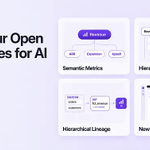
The Semantic Layer Platforms Landscape, Q4 2026: where meaning gets defined for AI agents
Forrester maps a market moving from dashboards to agents. A Forrester Wave follows in Q1 2027.
Storage and compute are the shelf. The semantic layer is the catalogue card
It fixes what "revenue" means, so a BI assistant, a copilot and a domain agent read the same number.
What an agent needs beyond it
• Semantics: what the metric means
• Lineage: where the number came from
• Quality signals: whether to trust it today
• Ownership and policies: what it may do for the person asking
Forrester's proposed name for the whole is a context layer, the next step after semantic layers and knowledge graphs. It joins business semantics and governance with ontological modeling and live runtime context: events, decisions, actions, outcomes.
Four shifts
1. Governed metrics and access controls reach agents through MCP, replacing unguided text-to-SQL
2. The semantic layer becomes one part of a broader context layer
3. Platform-native semantics (Snowflake, Databricks, LookML, Power BI) sit beside standalone tools (Cube, dbt Semantic Layer/MetricFlow, AtScale, Actian)
4. Portable definitions advance through Open Semantic Interchange and Apache Ossie
The map moves too. In 7WData's read of practitioner articles (July to October 2026), the field set against Snowflake now sits a floor above the warehouse: governance, catalogs, semantic layers, BI. Several of those names are also partners.
Open questions
• Vocabulary: semantics, ontology, semantic layer, knowledge graph and context layer are used interchangeably. Forrester's definition is an attempt to separate them
• Architecture: the market does not yet map to one pattern. Vendors reach similar use cases from different heritages and assumptions
• Coopetition: portable definitions are written by companies that also compete. Salesforce, Snowflake and dbt Labs co-founded Open Semantic Interchange, and Salesforce is also named a rival semantic layer
• Consumption: Forrester expects five patterns to coexist, from visual analytics to agent-based subscriptions, all needing one layer beneath: enterprise infrastructure, not an analytics feature
By Boris Evelson, Indranil Bandyopadhyay, Sriharsha Chintalapani, Karthik Pasupathy
The Semantic Layer Platforms Landscape, Q4 2026 sbee.link/6rf87493vb
Semantic layer platforms in 2026: How to evaluate one for AI agents sbee.link/hty8uc6xag
Is the Semantic Layer Dead? Where Business Meaning Lives Now sbee.link/96a3qpdcyw
Snowflake’s real fight is not on its competitor list sbee.link/g7eqv4hjyf
#SemanticLayer #ContextLayer #AgenticAI #DataGovernance #MCP
--
Missed a talk at #CDL26? Or missed the whole thing?
All talk recordings are being processed and will be available in the next few days.
With so many ideas and speakers, nobody could catch them all live. We’ve got you covered.
✅ Were you there? Replays are already included in your ticket.
🎟 Couldn’t make it? Get a remote ticket for permanent on-demand access to every talk.
👉 sbee.link/vhtre4umqn
Recorded live at Connected Data London 2026 | 11–12 November | Leonardo Royal Hotel London Tower Bridge
#CDL26 #KnowledgeGraph #GraphRAG #Ontology #AI

Can an AI model use a billion-fact knowledge graph without a search step in front of it? 🔎
Most AI systems answer questions about your data with retrieval-augmented generation (RAG): a search step finds relevant facts and pastes them into the prompt.
AtlasKV, a new ICLR 2026 paper from HKUST and Huawei Theory Lab, loads the knowledge graph into the model itself. The model finds the facts it needs while it reads the question.
The memory result is real: a billion facts in under 20GB of GPU memory.
But accuracy was only measured up to 10,000 facts.
"No search step" means the lookup moved inside the model.
Ready for prime time? Not yet. Research code, one 8B-parameter model, no public production use found.
A plausible first role: fuzzy recall in front of a governed knowledge graph, not a RAG replacement.
- How it works
Each knowledge graph triple becomes a lookup entry: a question-like key and an answer-like value. Entries are grouped in three levels of clusters. As the model reads a question, its attention layers (which decide what matters in the input) score top clusters, then narrower groups, then single facts. Only the winners move to the GPU (pruning). Per the authors, new facts can be added without retraining.
- What the numbers measure
At 10,000 facts, the right fact was the model's top pick 16% to 40% of the time with pruning on, and 27% to 62% with it off. Pruning also slowed answers from 2.1 to 6.2 seconds. "Accuracy" means where attention lands in one layer, not a verified answer. Compared against pasting everything into the prompt and Microsoft's earlier KBLaM method, not against a tuned RAG pipeline.
- The knowledge graph angle
The graph is flattened on entry. Every triple is an independent fact, which the authors say blocks multi-hop reasoning. Clusters group facts by text similarity, not by ontology or graph structure.
Questions the paper leaves open
• Correcting or retracting a fact that sits inside a cluster
• Per-user permissions
• Which fact an answer came from: selection is layer by layer, and the paper's own example came back reworded
• Joins, paths and aggregations
• Memory beyond the GPU: roughly 1.5TB for a billion facts (384 dimensions, 16-bit), our estimate
Would you keep facts in the graph, or in the model?
By Haoyu Huang, Hong Ting Tsang, Jiaxin Bai, Xi Peng, Gong Zhang and Yangqiu Song. Link in comments
#RAG #LLM #EnterpriseAI #AIResearch #Provenance
--
Missed a talk at #CDL26? Or missed the whole thing?
All talk recordings are being processed and will be available in the next few days.
With so many ideas and speakers, nobody could catch them all live. We’ve got you covered.
✅ Were you there? Replays are already included in your ticket.
🎟 Couldn’t make it? Get a remote ticket for permanent on-demand access to every talk.
👉 2026.connected-data.london?u…
Recorded live at Connected Data London 2026 | 11–12 November | Leonardo Royal Hotel London Tower Bridge
#CDL26 #KnowledgeGraph #GraphRAG #Ontology #AI
From spreadsheet to ontology: the architecture review that starts in Excel
Every architecture review opens the same way. Someone draws a context diagram. Everyone squints at it.
Which connection is encrypted? Does that flow carry customer data? What happens when the queue backs up? The diagram shows the shape of a system. The facts live in heads, wikis and spreadsheets.
First, the tool underneath.
Relationship Visualizer is a free, open source (MIT) Excel workbook. Enter rows such as “A is related to B” and Graphviz diagrams draw as the data changes. The same rows export as a typed JSON knowledge graph, so an AI reads the structure itself instead of interpreting a picture of it.
Now the newest layer: the Context Diagram Toolkit.
Describe a system in one workbook: actors, applications, data stores, the connections between them, and facts about each, from data classification and PII to authentication and lifecycle. Two outputs follow:
A context diagram with connections colored by governance status. Green approved, amber conditional or deprecated, red prohibited. Dashed means a better alternative exists.
An RV-KGF knowledge graph in JSON holding every entity, relationship and fact.
Add the included review prompt and an AI returns a component inventory, ratings across security, scalability, resilience and more, a risk register and proposed mitigations.
The workbook quietly holds the layers of a formal knowledge graph project:
Ontology: the styles worksheet, 100+ connection types from REST to SFTP to Kafka
Semantic model: the sql worksheet, deciding which rows become entities, relationships and typed facts
Knowledge graph: the self-describing JSON export
Reasoning layer: the review prompt, applying rules such as flagging any connection that may be unencrypted, crosses a trust boundary and carries PII
It does not replace an enterprise architecture platform. It serves the earlier moments: design discussions, solution reviews, “can you draw me what this looks like?”
Free and MIT licensed. Requires Relationship Visualizer 11.1 or later, on Windows. 🔎
By Jeffrey J. Long sbee.link/ugrh8wmqpf
#SemanticModel #Graphviz #EnterpriseArchitecture #OpenSource #ContextDiagram
--
Missed a talk at #CDL26? Or missed the whole thing?
All talk recordings are being processed and will be available in the next few days.
With so many ideas and speakers, nobody could catch them all live. We’ve got you covered.
✅ Were you there? Replays are already included in your ticket.
🎟 Couldn’t make it? Get a remote ticket for permanent on-demand access to every talk.
👉 sbee.link/tp8fdewguy?utm_sou…
Recorded live at Connected Data London 2026 | 11–12 November | Leonardo Royal Hotel London Tower Bridge
#CDL26 #KnowledgeGraph #GraphRAG #Ontology #AI

Shapes Constraint Language Masterclass
The Shape Constraint Language (SHACL) is a W3C standardization for validating our semantic knowledge graphs by defining a set of constraints. By constraining RDF using SHACL we gain the possibility of exactly this—validating semantic knowledge graphs under a closed world assumption!
This masterclass introduces you to the SHACL Core constraints, demonstrate how to constrain your data and what happens if the data conforms false (or true for that matter!).
Key topics of this tutorial:
- Terminology and concepts of semantic knowledge graphs
- Comparing SHACL and the Web Ontology Language (OWL)
- Introduction to SHACL
- How we can use SHACL as a modelling language, and not only as a validation language.
With hands-on live coding:
- Building shapes for ABoxes
- Validation and validation errors
You would need some experience in RDF before attending this tutorial, but no prior experience with SHACL is needed. We will use a web based SHACL engine that can be accessed through any browser. No installation required. However, a brief demonstration of RDF4J's SHACL engine will also be given through a Java application, that will be accessible for anyone through GitHub.
After attending this tutorial you should expect to have gained knowledge about how to constraint your RDF data using SHACL, perform validation, and be able to interpret the validation result.
Key Topics
- Shapes Constraint Language
- Introduction
- RDF validation
- Hands-on live coding
Target Audience
- Information architects
- Knowledge Graph practitioners
Goals
Get a glimpse of the SHACL validation capabilities
Session outline:
sbee.link/nry6apbkqc
Format
The Masterclass is built up as a traditional lecture including real-life use cases and live coding
Level
Beginner
Prerequisite Knowledge
Some understanding and knowledge of RDF
sbee.link/bu4nrcaxhe
--
Veronika Heimsbakk. Knowledge Graph Lead, Capgemini
Veronika, Knowledge Graph Lead at Capgemini, is a dedicated and enthusiastic outreach of the wonders of semantic knowledge graphs. Recently awarded among Norway’s Top 50 Women in Tech. Her main niche within the space is everything SHACL
--
Welcome to Connected Data London's #ThrowbackThursday
Every Thursday at 3pm GMT, we are releasing gems from our vault on #YouTube
Tune in and learn from leaders and innovators; subscribe to our channel and watch premieres as they are released!
#knowledgegraph #graphdatabase #graph #AI #datascience #analytics #semtech #ontology

"Which definition of revenue are we talking about?"
As AI moves into everyday work, that question keeps coming up. An ontology is how the answer gets written down in a form agents can read: which business concepts matter, how they relate, which rules apply, and which data implements them.
One more signal added to the long list showing how ontology adoption is growing:
One year ago, Steve Wooledge, Collate CMO, couldn't tell what an ontology is. Today, Collate is announcing Ontology Studio as part of the Collate 2.1 release.
📈 Gartner (press release, May 11, 2026) predicts that by 2027, organizations that prioritize semantics in AI-ready data will raise agentic AI accuracy by up to 80% and cut costs by up to 60%.
🏠 Scout24, the company behind ImmoScout24, runs internal AI agents on a shared data foundation that links business knowledge to data. Angelita Frozza Sanches, Head of Data, describes agents as only as useful as the context behind their answers, with confidence scores and expert feedback driving continuous improvement.
The announcement, Ontology Studio in Collate 2.1, also puts weight on portability.
Jessica Talisman, Semantic Engineer and author of Ontology Pipeline, frames the test simply: "An ontology you can't take with you belongs to your vendor." Can it be inspected, validated and exported in open standards?
🏢 Several Fortune 500 companies contacted the Collate team directly after a webinar with Jessica Talisman on ontologies, context and why they matter.
Collate is the platform built on OpenMetadata: an open-source metadata and context platform for data discovery, lineage, governance and AI agents, built schema-first on JSON Schema and RDF/OWL. OpenMetadata is Apache 2.0 licensed, and it is primarily driven and maintained by Collate.
Metadata, meaning, and memory belong in one context platform. Metadata tells an agent what data exists. Meaning tells it what the data represents. Memory tells it what your organization has learned. If they are spread across separate tools, agents get partial views that disagree.
OpenMetadata keeps all three on one graph, and 2.1 gives AI agents a deeper understanding of business meaning. Collate 2.1 release is synced with OpenMetadata 2.1 release.
Ontology Studio is built on OWL and SKOS, imports and exports OWL, Turtle, RDF/XML and JSON-LD, and ships starter packs from standards such as FIBO, HL7 FHIR, GS1, EPCIS, ISA-95 and HR Open.
Whether or not you work with Collate or OpenMetadata, the point stands: business meaning written down in open standards improves what agents can do, and stays portable.
Collate Launches Ontology Studio for AI Agents getcollate.io/blog/announcin…
Announcing OpenMetadata 2.1: Your Business Definitions in the Context Graph blog.open-metadata.org/annou…
#OpenMetadata #OWL #SKOS #AIAgents #DataGovernance
--
Missed a talk at #CDL26? Or missed the whole thing?
All talk recordings will be available in the next few days.
With this many ideas and speakers, nobody could catch them all live
✅ Were you there? Replays included in your ticket
🎟 Couldn’t make it? Get a remote ticket for permanent on-demand access
2026.connected-data.london?u…

Connected Data London post-event goodies: Photo Gallery
CDL26 has been a blast, and apparently what's on everyone's minds (and in our inboxes) right now some variation of the following:
- Do you have an official gallery?
- Can we get access to the speaker slides?
- When will the recordings be available?
- What's your next event going to be?
The answers are yes, yes, any day now, and you'll hear about that one soon!
Our AV crew has been roaming the event and is still working on getting all the material processed.
In the meanwhile, here's a first taste: the official CDL26 Photo Gallery
Look back on your Connected Data London 2026 event experience and get ready for next year! View our tenth anniversary highlights to see how our community collaborated, inspired and rejoiced - our gallery gives you a glimpse of what to expect in 2027.
2026.connected-data.london/g…
Stay tuned for slides, videos, and more news!


1
171
Ontologies for AI in practice: Do LLMs need ontologies, or are text definitions good enough?
A three-part experiment on a small, deliberately ambiguous genealogy dataset (fictional people) tested what changes when an LLM is given progressively more semantics.
The task: count a person’s ancestors. The evidence is anecdotal by design, but practical.
🔎 Part I: adding semantics step by step
Data alone: many errors, and a correct count only by chance
Cleaner dates: no change
Plain-text definitions: a substantial improvement
RDF knowledge graph: the same answer, but it exposed hidden assumptions, including an imprecise question (“how many ancestors in this dataset?”)
Curated graph: more precise and consistent answers
Ontology: the correct count
🧪 Part II: model size and stability
Small local models (4B to 8B) could not use added semantics
Impact started to appear at 32B parameters
Text definitions produced high variability across runs
Knowledge graphs with ontologies matched or beat definitions and were more consistent
Removing the text definitions from context improved graph-based results
🧩 Part III: how to provide semantics
OWL axioms only, OWL with definitions, OWL with operational directives, Apache Ossie (OSI) and Google’s OKF were compared.
Takeaways:
- Axioms alone were not enough, and the natural-language definitions inside ontologies did most of the work
- With a capable model, the format mattered little. Opus reached perfect results across representations, while DeepSeek-R1:32B used none of them
- Ontology plus knowledge graph was the most effective and consistent option
- Among approaches that annotate data directly, OKF ranked highest
Definitions alone are not enough. Results were strongest when context-specific meaning is connected to the data elements themselves, as in a knowledge graph.
By Andrea Splendiani
Ontologies for AI in practice / part I sbee.link/gkx3nd6rec
Ontologies for AI in practice / part II sbee.link/erhmudfwc6
Ontologies for AI in practice / part III sbee.link/3d7xhwbnm4
#LLM #FAIRData #OWL #SemanticLayer #DataGovernance
--
Missed a talk at #CDL26? Or missed the whole thing?
All talk recordings will be available in the next few days.
With this many ideas and speakers, nobody could catch them all live
✅ Were you there? Replays included in your ticket
🎟 Couldn’t make it? Get a remote ticket for permanent on-demand access
sbee.link/pqwxhda3n4

SPARQL: The RDF Query Language
Demystifying Knowledge Graphs, Semantic Technologies and Labelled Property Graphs: A Beginners Hands-On Exploration for making the right choice
Knowledge graphs have long underpinned enterprise data strategies, implemented through diverse paradigms ranging from RDF-based semantic technologies to labelled property graphs (LPGs).
While these frameworks have often operated quietly in the background, the rise of large language models (LLMs) has reignited interest in knowledge graphs, bringing long-overdue recognition to their strategic value.
Knowledge graphs not only enhance LLM training and deployment but also offer unmatched capabilities for optimizing data integration, governance, and analytics.
Yet, fundamental questions remain: What exactly constitutes a knowledge graph? When should RDF, OWL, or LPGs be applied? Are these technologies interchangeable, complementary, or competitive?
This tutorial seeks to demystify these approaches through a pragmatic, hands-on lens. Presenters—bringing distinct perspectives from both RDF and LPG traditions—will guide participants through real-world scenarios, comparative exercises, and applied case studies.
Attendees will gain a nuanced understanding of the trade-offs, synergies, and integration pathways across semantic technologies, property graphs, and their integration with LLMs, equipping them to make informed architectural choices in enterprise and research settings.
Participants will explore:
- The core principles and unique capabilities of semantic technologies and property graphs.
- Practical decision-making frameworks for selecting the right approach for specific use cases.
- Insights into emerging trends where these approaches converge to unlock new opportunities.
- Considerations to take into account when choosing the tools in order to ensure a smooth implementation.
Learn about some high level strategies for leveraging graph technologies to augment LLMs and drive business value.
By the end of the session, attendees will have a deeper understanding of the strengths, limitations and synergies of these graph based approaches, enabling them to make informed decisions that align with their organizational goals when solving different challenges.
Target Audience
Whether you're a technical leader, data scientist, engineer or enterprise strategist, this tutorial will equip you with actionable insights to harness the full potential of graphs in relevance to your use case.
▶️ 2025.connected-data.london/t…
--
Tara Raafat. Head of Metadata and Knowledge Graph Strategy, Bloomberg
Dr. Tara Raafat is the head of Metadata and Knowledge Graph Strategy in Bloomberg’s CTO Office, where she leads the development of Bloomberg’s enterprise Knowledge Graph and semantic metadata strategy, aligning it with AI and data integration initiatives.
Petra Selmer. Query Language Architect, Bloomberg
Dr. Petra Selmer is Bloomberg's Query Language (BQL) Architect and a leading expert in graph query languages.
--
Welcome to Connected Data London's #TeaserTuesday
Every Tuesday, we share teasers from #CDL25 on our channels
Connected Data London 2025 brought together leaders and innovators. Were you there?
🎥 Watch the sessions: sbee.link/rwav6dcngt
📩 Join the community: sbee.link/nh6wb7cdqj
Tune in and learn from leaders and innovators; subscribe and watch premieres as they are released!
Join community legends and new voices in #CDL25 for all things #KnowledgeGraph #Graph #analytics #datascience #AI #graphDB #SemTech #Ontology
Connected Data London 2026 takeaways: From AI-ready data to agent-ready enterprise
Connected Data London 2026 is a wrap. A massive thank you to the Connected Data London community: the speakers, chairs, panelists and attendees who define the agenda with care, push the field forward and turn ideas into applied innovation.
These are some initial takeaways from the 10th edition, 11-12 November. Five attendee write-ups, read side by side, kept landing on the same ground. 🧭
Neural for perception, symbolic for trust
LLMs read, translate and structure messy material. Ontologies, rules and shapes cover whatever must be exact, repeatable and explainable. Examples ran from robots learning what a plug entering a socket means, to IKEA's rule that generation never invents a recipe, to a keynote where "don't know" counts as a real output.
From AI-ready data to agent-ready enterprise
The conversation moved from preparing data for AI to agent memory, context graphs, provenance, evaluation and auditability. Identity, permissions and delegation between agents are questions the community has modelled before: PROV-O has described provenance since 2013. Several voices asked for more working demos that connect semantics to the AI engineering stack.
Trust needs identity
Governance and human in the loop were reframed as trust and judgement. A decision trace built on a false match is perfectly logged and still leads to a wrong outcome.
Knowledge apart from data
AstraZeneca separates the model (T-box), reference data (C-box) and data (A-box), mints a unit like eGFR once, and resolves one study carried under five identifier schemes. Juan Sequeda's lessons point the same way, and an ontology derived straight from a database schema can inherit that schema's silos.
Standards are hardening
SHACL 1.2 is tracked closely. Named graphs are back, with TriG replacing plain Turtle and urn-based partition names. RDF 1.2 reifiers are becoming referenceable. Tooling is maturing too: a package manager for ontologies built on DCAT profiles, and a benchmark of 11 RDF frameworks.
People and architecture
IKEA's multi-year journey: start small, think big, frame the work as a capability. A younger, AI-native cohort treats ontologies as AI-generated and expert-refined, with competency questions back in focus. Holons appeared in Amazon's session and in life sciences, Markdown with YAML-LD headers is emerging as a messaging format, and most company knowledge still sits in documents.
By Kurt Cagle, Jonathan Foxwell, Kerstin Forsberg, Juan Sequeda and Katariina Kari
Back home after 36 hours at Connected Data London. A few takeaways based on conversations and talks sbee.link/vnqey6tcku
Two days at Connected Data London 2026, co-chairing the Edges track and moderating a panel. These are the ideas I brought home. sbee.link/6bpe9mxft8
Connected Data London 2026 – early report sbee.link/ytf986uv3c
Connected Data London 2026: From AI-Ready Data to Agentic Systems sbee.link/n6ved83ukr
Home from CDL 2026: The Next Era of the Semantic Stack sbee.link/3kx7wyqvhu
Slides and replays coming soon!
#CDL2026 #Neurosymbolic #SHACL #ContextGraphs #SemanticWeb
--
Missed a talk at #CDL26? Or missed the whole thing?
All talk recordings are being processed and will be available in the next few days.
With this many ideas and speakers, nobody could catch them all live. We’ve got you covered.
✅ Were you there? Replays are already included in your ticket.
🎟 Couldn’t make it? Get a remote ticket for permanent on-demand access to every talk.
👉 sbee.link/9wbg6arkdp
Recorded live at Connected Data London 2026 | 11–12 November | Leonardo Royal Hotel London Tower Bridge
#CDL26 #KnowledgeGraph #GraphRAG #Ontology #AI

2
7
579
25 years later, the Semantic Web is being reinvented and co-opted..and that's a good thing
They say imitation is the sincerest form of flattery.
They also say timing is everything.
25 years ago, the Semantic Web gave the world a set of principles and standards that help add meaning and grounding to data.
For a long time, the world was more concerned about quantity than quality.
Meaning and semantics was overlooked while pipelines and big data were top of mind.
Knowledge Graphs and Ontologies, while universally applicable, were reserved for a select few.
Today, the world is waking up to the importance of the principles and standards established by the Semantic Web.
The technology stack has matured and evolved significantly, with rising adoption driving a new wave of evolution.
While the journey has not been easy or flawless, the destination is in sight.
James Hendler is one of the authors of the original Semantic Web paper.
Juan Sequeda is one of the people who has spent the last 2 decades bringing the Semantic Web principles, standards and technology to life in the real world.
In this welcome address of the Connected Data London's 2026 Community Dinner, they put things into perspective, using both facts and a fun sketch.
It's funny because it's true.
All talk recordings from the event are being processed and will be available in the next few days.
With so many amazing ideas and speakers at #CDL26, nobody could possibly catch them all in real-time.
We've got you covered.
✅ If you were there, your ticket already includes replays.
🎟 If you did not make it, you can still get your remote ticket for perpetual on-demand access.
👉 sbee.link/dup3wm9c6f
Recorded live at Connected Data London 2026 | 11–12 November | Leonardo Royal Hotel London Tower Bridge
#CDL26 #KnowledgeGraph #GraphRAG #Ontology #Graph #AI #DataScience #GraphDB #SemTech
Tomorrow, one of the authors of the original Semantic Web paper will speak at Connected Data London 2026 about what 25 years of linked data means for AI.
You can be in the room at the Leonardo Royal Hotel, Tower Bridge.
Over the next two days you'll also hear:
🎤 William Tunstall-Pedoe, founder of Evi (now part of Alexa), on breaking AI's trust ceiling
🎤 Joe Reis on why data engineers and knowledge graph people need each other
🎤 Juan Sequeda of ServiceNow with 20 lessons from 20 years of building ontologies
🎤 Tara Raafat (Bloomberg), Dagmar Beyer (Siemens) and Google's BigQuery Graph team on knowledge graphs and agents in production
Plus, there are 12 hands-on masterclasses on Wednesday and a Community Dinner that evening.
⭐ Passes are still available, but not for long: lnkd.in/dSqXyC8T?utm_source=…
#CDL26 #KnowledgeGraphs #AgenticAI #SemanticWeb #AI

1
232
Joining the Dots: Knowledge Graphs for Investigators and Analysts
A detective’s wall has cards and red string. The cards matter. The string matters more.
In most newsrooms and think tanks, the cards sit in spreadsheets, PDFs and timelines. The string lives in somebody’s head.
The article reframes investigative work as a supply chain, and each knowledge graph technology maps onto a stage:
🔹 Parts: facts recorded as RDF triples (subject, verb, object), with each person, company and address given its own identifier. “Strings to things.”
🔹 Catalogue: an ontology works as a style guide for data. FollowTheMoney, Open Ownership and GLEIF already publish reusable ones.
🔹 Goods-in inspection: SHACL checks that every claim has a source and every date is coherent.
🔹 Assembly: Datalog rules trace control through layers of shell companies, as in the US Treasury’s 50 Percent Rule, and every conclusion can be traced back to its parts.
🔹 Bill of materials: named graphs and PROV record who said what, and when.
The payoff is the manufacturer’s recall question turned round. If a source proves unreliable, which facts, arguments and published pieces relied on it?
The limits are stated plainly too. A graph cannot tell whether a source is lying, and deciding that two records describe the same person is an editorial judgement.
The suggested way in: write down the five questions you wish you could ask, reuse an existing vocabulary, and begin with one investigation and a few hundred statements.
Every published story has a bill of materials, whether or not anyone writes it down. Knowledge graphs offer a rigorous way to write it down. 🔗
By Peter Winstanley
sbee.link/uec6xvjf3y
#SPARQL #RDF #SHACL #Datalog #InvestigativeJournalism
--
Connected Data London 2026 | 11–12 November | Leonardo Royal Hotel London Tower Bridge
🎟 Tickets on sale now - 🔔 Full programme announced
sbee.link/4jvebdmk96
📺 Sponsorship opportunities available. Contact [email protected] for details.
#KnowledgeGraph #GraphRAG #Ontology #Graph #AI #DataScience #GraphDB #SemTech

Norway's railway, Tripadvisor and TUI all depend on huge networks of data that never stop changing. This week at Connected Data London 2026, three people building knowledge graphs for them will show how they do it:
The Travel Intent Graph: Joining Demand to Supply When One Experience Is Sold Many Times Over
🎤 Dennis Irorere, Tripadvisor
The same tour or experience can turn up in many different listings. Dennis explains how a travel intent graph connects what people are searching for with what's actually available to book.
📅 Wed 11 Nov, 1:45 PM · Rapid Insights (Ludgate Suite)
Build Your Own Enterprise Architecture Intelligence Pipeline with Ontology-Guided Conversational AI
🎤 Kalin Maldzhanski, TUI
A hands-on masterclass for anyone who has to explain how a large organisation's systems fit together. Kalin walks through building a pipeline that answers enterprise architecture questions in plain language, with an ontology keeping the answers grounded.
📅 Wed 11 Nov, 3:30 PM · Masterclass (Warwick Suite)
Building the Norwegian Railway Knowledge Graph: Where the Semantic Web Stack Runs Off the Track
🎤 Mathias Vanden Auweele, Matdata
Mathias has been building a knowledge graph for Norway's railway. He'll be honest about where standard semantic web tools did the job, and where they fell short.
📅 Thu 12 Nov, 1:40 PM · Educational (Bartholomew Suite)
Dennis and Kalin are both on Wednesday afternoon, so travel and transport teams can catch both in one afternoon!
⭐ The event starts tomorrow! Book your CDL26 pass and plan your sessions before it's too late: sbee.link/cjuar6dpye
#CDL26 #KnowledgeGraphs #TravelTech #Rail #EnterpriseArchitecture #Ontology


1
159
Everyone is talking about agent memory and enterprise knowledge graphs, but very few people have noticed they’re turning into the same thing. At Connected Data London 2026, three sessions show what that means for anyone building AI agents:
Context Graphs, Context Layers, and the Semantic Renaissance
🎤 Jessica Talisman, Ontology Pipeline
Software engineers and data teams are both racing to give agents better context, from different directions. Jessica explains why they’re converging on knowledge graphs, and what each side can learn from the other.
📅 Thu 12 Nov, 11:00 AM · Edges (Salisbury Suite)
When the LLM Wiki Meets Linked Data: Local Agent Memory That Scales
🎤 Tony Seale, The Knowledge Graph Guys
A folder of markdown notes is the simplest agent memory there is, and builders love it, but it doesn’t scale. Tony shows how adding linked-data structure keeps it simple while making it work across an enterprise.
📅 Thu 12 Nov, 11:35 AM · Edges (Salisbury Suite)
The Context Layer: From Semantics to Memory
🎤 Afraz Jaffri (Gartner), Atanas Kiryakov (Graphwise) & Mark Hahnel (Digital Science), moderated by Maya Natarajan
What the context layer really contains, how trusted context reaches an agent, and what to ask any vendor who says they can deliver it.
📅 Thu 12 Nov, 3:50 PM · Nodes (Warwick Suite)
The first two sessions run back-to-back in the Salisbury Suite on Thursday morning, so you can stay put for both!
⭐ 2 days to go! Book your pass and plan your sessions now: sbee.link/p8kd9vwqet
#CDL26 #AgenticAI #AIagents #AgentMemory #KnowledgeGraphs #ContextLayer


Only 2 days to go until Connected Data London 2026; our 10th anniversary is almost here!
If you’ve been waiting for the right moment to book, this is your sign. This Wednesday and Thursday, data & AI leaders, architects and practitioners are uniting at the Leonardo Royal Hotel London Tower Bridge for:
🎤 A keynote from William Tunstall-Pedoe, founder of the technology behind Amazon’s Alexa
📜 Prof. James Hendler & Sir Nigel Shadbolt marking 25 years of the Semantic Web
🏢 Real stories from AstraZeneca, Bloomberg, Roche, Google, Gartner and IKEA
🧭 Nine tracks, including hands-on masterclasses where you build as you learn
Once Wednesday morning comes, the conversations start, and they only happen once a year.
🌟 Register now and join us at #CDL26: 2026.connected-data.london/c…
Can’t take two days out? Book a Community Dinner Pass and join Sir Nigel Shadbolt and the community on Wednesday evening.
#ConnectedData #KnowledgeGraphs #AI #SemanticWeb #TechEvents

2
236