

hacker-in-residence/ principal devrel engineer. data curation for physical and visual ai systems. in my physical ai era
I ship daily
Joined April 2020
- Tweets7.2K
- Following1.7K
- Followers8.2K
- Likes33.8K





Pinned Tweet
a robot can recognize every object in a room and still not know how to open a single drawer
knowing there's a cabinet is scene understanding. knowing which handle to grab, which direction to pull, and that it's a drawer not a door is affordance understanding
almost no dataset has it in 3D
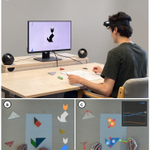
SceneFun3D: 14,800+ functional elements across 710 laser-scanned indoor scenes. every handle, knob, button, and switch labeled with its affordance, motion axis, motion type, and a natural language task description
each scene's 3D point cloud with its iPad video recordings in fiftyone. the affordance annotations live in 3D and project into the video frames
check it out here huggingface.co/datasets/Voxe…
a UAV searching for people in the water has to detect small targets through motion blur, and longer exposures in low light make it worse.
this Event-Based RVT-T Maritime Detector runs the RVT-T recurrent vision transformer on synthetic event streams generated with v2e from public MOBDrone rescue videos.
on 843 test samples at 100 ms it hits 15.63% person AP50:95 against 6.89% for YOLOv8n and 9.44% for RT-DETR-R18. on a Jetson Orin Nano it takes about 136 ms and 2.02 J per sample.
a reference for event-camera detection on UAVs.
arxiv.org/abs/2611.23088
#PhysicalAI #Robotics

1
2
109
autonomous driving and indoor robotics got large datasets. forestry is still waiting on one.
FinnWoodlands from Tampere University has 4,226 manually annotated objects from Finnish forests, and 2,562 of them (60.6%) are tree trunks labeled Spruce Tree, Birch Tree, or Pine Tree. 250 samples of RGB stereo images with Lake, Ground, and Track regions.
i parsed it into FiftyOne so you can filter to Pine Tree or Obstacles and check how your model handles unstructured forest scenes.
huggingface.co/datasets/Voxe…
#PhysicalAI #Robotics
1
3
237
forest caretakers in Västergötland, Sweden need to spot larch casebearer damage before it spreads.
Larch Casebearer has 1,536 drone images over five forest areas, with about 101,878 tree boxes. batches 1 to 5 add Healthy, Light Damage, and High Damage labels on about 44,500 of them.
i parsed it into FiftyOne so you can filter trees by damage label and view the radio_heatmap over each image.
huggingface.co/datasets/Voxe…
#PhysicalAI #ComputerVision
1
189
a hint that arrives after the wrong piece is placed comes too late, especially when you choose the build order.
TanCRAFT is a four-stage real-time system. it tracks the scene, reasons about the partial assembly, forecasts the near-future motion of manipulated pieces, and intervenes when the predicted placement is incompatible with the target.
in a within-subject tangram study, predictive feedback significantly reduced mistakes versus unguided and reactive sessions.
read it if you design assistance for human-robot workcells.
arxiv.org/abs/2611.14470
#PhysicalAI #Robotics

1
5
277
a teleoperation dataset with no success filtering means you sort the failed demos out yourself.
intern shiguan tactile has 51 GELLO-teleoperated test tube insertions, 26,665 frames at 30 fps, two RGB views, two tactile image streams, and force and torque channels.
i parsed it into FiftyOne so you can sort episodes from 11.0 to 26.0 seconds and check the tactile streams against the RGB views.
huggingface.co/datasets/Voxe…
#PhysicalAI #Robotics
this gripper feels a white cube through two grids of integers, one 6x6 and one 4x8.
grabette tactile has 48 episodes of picking up the cube and putting it in the correct cup. 19,353 frames at 50 fps, two 960x720 cameras per frame.
i parsed it into FiftyOne so you can filter episodes by length and watch both camera streams. the tactile grids stay in the parquet files.
huggingface.co/datasets/Voxe…
#PhysicalAI #Robotics
1
137
harpreet retweeted

Good robot data starts with a robot that doesn't break.
5,464 two-handed episodes on our Vega for T-Rex, by @Dantong_Niu and team (Berkeley, NVIDIA, Stanford).
Thanks @DataScienceHarp for making it browsable!

most browsers can't decode the 20 tactile video streams in this two-handed robot dataset.
T-Rex was teleoperated on a Dexmate Vega-1 with two Sharpa Wave hands at 30 fps, logging 58 state values and 60 force readings per frame. this subset is 23 of 5,464 episodes.
i parsed it into FiftyOne so you can scrub the RGB and tactile video next to joint trajectories and force readings.
huggingface.co/datasets/Voxe…
#PhysicalAI #Robotics
six cameras, GNSS, road weather readings, and CAN bus traffic, all from one 27-minute urban drive.
WMU AD Assurance Lab Multi-Sensor Drives is the lab's set of smaller recordings from 2019 to 2025. it also has radar test drives, ZED 2i campus drives, 13 static 2D LiDAR runs in four weather conditions, and 4 phone videos of snowy highways.
use it to line up camera, CAN, and weather data on the same drive. the Ouster point clouds for these recordings are in the companion Ouster LiDAR Drives dataset.
huggingface.co/datasets/AD-A…
#PhysicalAI #AutonomousDriving

a folder of independently posed drone frames won't show you where GPS and COLMAP disagree about the camera.
PIVOT-MCAP has 103 MCAP episodes across 5 scenes, one per drone trajectory. each pairs RGB frames with a GPS/IMU/gimbal pose, a COLMAP-optimized pose, per-frame pose error, and the scene's sparse point cloud.
i parsed it into FiftyOne so you can scrub a trajectory in 3D and watch both poses move against the point cloud.
huggingface.co/datasets/Voxe…
#PhysicalAI #ComputerVision
most browsers can't decode the 20 tactile video streams in this two-handed robot dataset.
T-Rex was teleoperated on a Dexmate Vega-1 with two Sharpa Wave hands at 30 fps, logging 58 state values and 60 force readings per frame. this subset is 23 of 5,464 episodes.
i parsed it into FiftyOne so you can scrub the RGB and tactile video next to joint trajectories and force readings.
huggingface.co/datasets/Voxe…
#PhysicalAI #Robotics
multi-sensor localization gets hard at night, with degraded GNSS, and moving between indoors and outdoors.
the RoboFusion Dataset was self-collected at Shanghai University on a Robotnik mobile platform. the campus_0.bag sequence has RGB and two infrared streams at 30 Hz, a 200 Hz IMU, 3D LiDAR at 10 Hz, and raw u-blox GNSS observables.
the repo has calibration files, parameters, and ground-truth trajectories for testing sensor fusion. the large test set is hosted separately.
github.com/zhangx297/RoboFus…
#PhysicalAI #Robotics

1
5
308
harpreet retweeted

i fine-tuned qwen3-vl 8b to watch a video and tell you how the shot was made. i'm calling it shot reader.
camera height, lens, angle, how the camera moves. who's in frame, where they stand, where they walk.
turns out that's hard for ai. even opus 5.5 and gemini 4, with a prompt written specifically to reverse-engineer shots, get the camera height and move both right less than half the time. open models out of the box: 5%.
shot reader gets 69%. it's 2.4x faster than opus, ~30x cheaper, and small enough to run on your own gpu.
why it matters: ai can already write blender. getting a shot right starts with reading it.
see a shot → get the plan → rebuild it in 3d, reshoot it, remix it.
open weights on hugging face, link below.
existing 3D crop datasets were too narrow and too simple for a perception model to handle a real field.
Crops3D has 1,180 point clouds of 8 crop types, from maize (225) to tomato (83), captured in agricultural research fields in China with multi-view stereo and structured light.
i parsed it into FiftyOne so you can filter by crop type and inspect each plant in the 3D viewer.
huggingface.co/datasets/Voxe…
#PhysicalAI #ComputerVision
disaster responders need verifiable evidence behind a damage report, and VLMs struggle to provide it.
DisasterAgent builds a Spatiotemporal Perception Graph from bitemporal optical imagery, then writes the report with inline citations that tie each statement to its supporting visual evidence.
compared with the original model, it improves the average disaster report score on DisasterM3 by 13.5% and ST5-SCS on RSCC by 15.34%.
read it if you generate remote sensing reports that someone has to verify. the paper says code will be available.
arxiv.org/abs/2611.13776
#ComputerVision #AI

1
7
403
one spherical camera, 360 degrees around the car, has to be enough to draw a bird's-eye-view map.
Dur360BEV-Extended adds 15,400 synchronized frames to Dur360BEV. each pairs a dual-fisheye image with a 128-channel Ouster LiDAR scan and RTK GPS/IMU, with 3D boxes in a 100 m by 100 m area.
i parsed it into FiftyOne so you can scrub the image and LiDAR with 3D box wireframes on both.
huggingface.co/datasets/Voxe…
#PhysicalAI #AutonomousDriving
26
1,479
before you point a data loader at droid_3d's 58,201 episodes and ~1.3 TB, you want a small slice to test it on.
this 68-episode subset keeps the RGB streams only: a wrist camera, 2 external cameras, 8-dim actions, and a language task description per episode at 15 fps.
i parsed it into FiftyOne so you can filter episodes by task text and watch all 3 camera views together.
huggingface.co/datasets/Voxe…
#PhysicalAI #Robotics
simulated deformable objects usually come with visual diversity but no physical properties you can execute.
RFW-S has 83,365 simulation-verified assets across 485 everyday categories in five structural families: soft solids, cloth sheets, shells, garments, and bags.
an independent verification step checks behavior under interactions different from those used for calibration. grasping is scored on task success and object integrity.
a library for testing grasping on deformable objects.
arxiv.org/abs/2611.23056
#PhysicalAI #Robotics

4
290
a detector that finds the cabinet still leaves the robot looking for the handle.
SceneFun3D (CVPR 2024 Oral) labels 14,867 handles, knobs, and buttons across 710 indoor scenes, with 9 affordance categories, motion parameters, and tasks like "open the drawer next to the sink".
i parsed 10 scenes from each split into FiftyOne so you can spin the laser scan with its functional elements next to the iPad video and its depth.
huggingface.co/datasets/Voxe…
#PhysicalAI #ComputerVision
prototyping on egocentric factory video is slow when you start from the full dataset.
Egocentric 10K subset keeps Factory 51: 8 workers and 416 samples at 1920x1080 and 30 fps, from a head camera with a 128 degree horizontal field of view. no audio.
i parsed it into FiftyOne so you can filter by worker_id and watch hand-object interactions play back.
huggingface.co/datasets/Voxe…
#PhysicalAI #ComputerVision
cone-beam CT is tuned for bone, so soft-tissue problems hide under photon noise and usually need a second MRI scan.
BertsWin + PhysLoss is a 3D masked autoencoder pre-trained on 6,550 unlabeled CBCT volumes, with a loss that steers gradient flow into the [-300, 300] HU soft-tissue window.
on 212 paired CBCT-MRI joints it reaches ROC AUC 0.793 for MRI-verified synovial effusion. the same architecture pre-trained with standard L2 loss collapses to random guessing.
a recipe for opportunistic screening from routine scans.
arxiv.org/abs/2611.23042
#PhysicalAI #MedicalAI

3
192