

Global macro investor. 30+ years across cycles. PM at DecodeMarkets AMC. I like great businesses. Especially when the market doesn’t
🇦🇷 🇨🇷 🇻🇪 🇺🇸 🇨🇭 🇦🇪
Joined April 2014
- Tweets23.5K
- Following2K
- Followers18K
- Likes46.9K



The ticker is $ETH

They’re putting in the work. Is this enough to get institutions to buy $ETH? No. But it’s a start.
Show a portfolio manager how a bond could settle on Ethereum on Thanksgiving Day, and “world computer” starts to mean something. Imagine a global financial system that runs like that 24/7.
I think $ETH could become a store of value in that system. That’s one reason I’m glad Ethereum developers are already working on quantum resistance.
My bet is that the family offices and hedge funds that do the homework now will buy well before the crowd.
From what I see in wealth management, most portfolios still own ZERO $ETH
Happy Thanksgiving 🦃

Introducing the Ethereum Institutional Platform.
The Platform is the hub for institutions to learn, connect, build, deploy and scale products on Ethereum.
What it gives institutions:
→ Learn: Ethereum and what is possible across the EVM ecosystem
→ Connect: the institutions, ecosystem teams and enablers building on Ethereum
→ Coordinate: shared problems worked through together, with common standards as the goal
→ Build: an accelerated path to onchain products and use cases
For everyone from senior leaders exploring the opportunity to digital asset teams shaping strategy and developers building solutions, the hub brings together research, reference architectures and working code to turn ideas into deployments. Explore use cases from onchain cash, including stablecoins and tokenized deposits, to bonds, private credit and public equities.
The Platform launches in the coming weeks.
Join the waitlist: ethereuminstitutional.org/pl…
There are opportunities in this market mess. I think $OKLO deserves a second look.
In October 2025, the market valued Oklo at over $20 Bn. This morning? $3.44 Bn.
Oklo ended Q3 with $3.13 Bn in cash and marketable securities. That leaves roughly $300 Mn above that balance for Aurora, the fuel business + radioisotopes.
And at the last count, 40.5 Mn shares were sold short. Nearly 25% of the float 👀
My take? At $20 Bn, investors were paying for almost everything to go right. At $3.4 Bn, I think they’re pricing in too much going wrong.
I get it. That cash has a job. Getting Aurora built and producing power comes first.
Still, I’d love to ask the board one question. In January, you SOLD 12.4 Mn shares at an average of $96.95 and raised $1.2 Bn. This morning, those same shares traded around $17.60.
At what price would you start BUYING some of them back?
Just saying….

Markets have a way of getting the Fed to change its tone.
Oil sold off. Nasdaq just turned red for the year. Now Hassett is asking Warsh to take another look at the Fed’s models.
How confident would you be in a December hike?

*HASSETT: ONE WOULD HOPE WARSH REEVAULATES FED'S MODELS
*HASSETT: INFLATION IS NOT ACCELERATING AT ALL
*HASSETT: INFLATION MAYBE A LITTLE BIT ABOVE TARGET
1
5
1,207
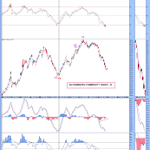
These amazing charts from Stefano Bottaioli bring me back to the questions I raised about USD in my last tweet.
$DXY keeps pushing higher, but momentum is no longer fully confirming the move. Similar setups appeared around previous USD tops, often followed by significant recoveries in $SLV
Now look at the second chart.
Broad commodities $BCI are moving in the opposite direction. Deeply oversold, with a fresh 13 exhaustion signal and early signs that selling pressure may be running out of steam.
𝘛𝘸𝘰 𝘤𝘩𝘢𝘳𝘵𝘴. 𝘛𝘸𝘰 𝘱𝘰𝘵𝘦𝘯𝘵𝘪𝘢𝘭𝘭𝘺 𝘰𝘱𝘱𝘰𝘴𝘪𝘵𝘦 𝘵𝘶𝘳𝘯𝘪𝘯𝘨 𝘱𝘰𝘪𝘯𝘵𝘴.
I also looked back at previous USD reversals. Several familiar forces appeared... changing Fed expectations, easing energy pressure + shifts in the relative appeal of USD. The mix was different each time.
One thing is clear, at least to me.... USD did not always wait for the Fed to act before turning.
I do not need a perfect double top or every technical indicator to line up before making the call.
𝗙𝗼𝗿 𝗺𝗲, 𝘁𝗵𝗲 𝗨𝗦𝗗 𝘁𝗼𝗽 𝗶𝘀 𝗮𝗹𝗿𝗲𝗮𝗱𝘆 𝗶𝗻.
And if I am right, commodities may be approaching a major turning point. 𝗖𝗿𝘆𝗽𝘁𝗼 𝗰𝗼𝘂𝗹𝗱 𝗯𝗲 𝗮𝗻 𝗲𝘃𝗲𝗻 𝗯𝗶𝗴𝗴𝗲𝗿 𝗯𝗲𝗻𝗲𝗳𝗶𝗰𝗶𝗮𝗿𝘆 𝗶𝗳 𝗹𝗶𝗾𝘂𝗶𝗱𝗶𝘁𝘆 𝗮𝗻𝗱 𝗿𝗶𝘀𝗸 𝗮𝗽𝗽𝗲𝘁𝗶𝘁𝗲 𝗿𝗲𝘁𝘂𝗿𝗻.


Could $DXY be approaching a major inflection point?
Beyond this technical setup, let me raise some macro questions worth asking…
1) Could falling oil prices bring inflation down faster than the Fed expects?
2) How much more support can the USD get from a Dec hike if markets already expect it?
3) Are Treasury yields sending a warning that the USD has yet to acknowledge?
4) Could the delayed impact of tighter financial conditions weaken the case for further Fed hikes?
5) Would further BoJ tightening -or FX intervention- finally reverse the Yen weakness?
6) Can cheaper oil support the Euro and Yen by reducing Europe and Japan energy import bills?
7) Will Germany infrastructure and defense spending lift European growth and attract more capital into euro assets?
8) Could sticky European inflation keep the ECB tighter than markets expect, giving the Euro additional support?
9) If global risk appetite recovers, does the dollar lose some of its appeal as a safe haven?
10) Would a narrower US interest-rate advantage make currency hedging cheaper, encouraging foreign investors to sell more USD forward against their US holdings?
What if peak Fed hawkishness coincides with peak USD strength?
Sometimes charts provide answers before the fundamentals become obvious.
USD days of strength may be numbered

DXY : US$ index : There was a clear textbook 5 wave pattern up form 70 to 115. The A wave correction was from 115 to 95. We are completing the B wave corrective bounce here at 104.40/105 now. The C wave move is thus likely to run from 104.40/105 down to 80/84. This is extremely bullish for gold, silver & commodities. US$ 41 trillion of debt plus interest at 5% p.a. and additional borrowings of $170 billion a month weigh too much on "strong $" over next 12-18 months.

AI may become Ethereum most unexpected catalyst
Joe Lubin argument…. as cyberattacks become cheaper and easier to scale, concentrating assets and control becomes a growing liability.
When one institution holds the keys for millions, one breach can put them all at risk.
Decentralization doesn’t eliminate risk. It can reduce dependence on a single intermediary + give people more control over their assets.
That adds another dimension to the $ETH thesis… the economic value of open financial infrastructure designed to withstand individual failures.
The more powerful AI becomes, the more valuable that resilience could become.
Excellent piece by @ethereumJoseph


I’ve always believed that the shadow of what we don’t yet know is already being traded somewhere in the market.
Perhaps someone knew about Jensen over the weekend, hence crypto being so well bid. Now the cat is out of the bag.
But here’s the bigger picture.
$NVDA remains relatively cheap across several valuation metrics. What was killing the stock was not its business, but the potentially irreparable loss of its founder and CEO.
If Jensen unexpected comeback helps restore market confidence and reignites a broader risk-on environment, the equation changes dramatically for both $BTC + $ETH and alts
Today’s fading crypto rally might be noise. The restoration of risk appetite is what really matters
Same playbook?
Different Fed Chair. Same risk of a policy mistake.
What if the biggest surprise of 2027 is not how high rates go, but how quickly the Fed is forced to reverse course?

The Fed hiked in December 2018, right into the market low. Then it cut three times in 2019.
SPY rose 29% that year and QQQ 38%. Both were back above their September 2018 level by April.
An analogy worth knowing, not a forecast. $SPY
3
960


Oil: −22% since Oct. 25
S&P 500 tech forward P/E back near pandemic lows.
Yet markets overwhelmingly expect a December Fed rate HIKE
What does this feel like to you? Poll below 👇

$NVDA earnings call made Jensen absence painfully obvious. Going from him to Colette Kress felt like replacing a rock star with a LEGO brick reading guidance.
I believe part of the post-earnings selloff may be the market digesting that charisma downgrade. My base case is still that Jensen returns.
But look at this @fundstrat chart.
Tim Cook didn’t need to become Steve Jobs for $AAPL shareholders to make serious money.
The numbers are already doing the talking. If NVIDIA keeps delivering like this, I expect stock to follow
Do your DD

The bleeding will stop when investors start doing their homework.
Apparently, reading the data is still a contrarian strategy.

I assume JPMorgan, Citi, HSBC, UBS, Standard Chartered, Visa, Mastercard, SWIFT and the World Bank are all sending their junior analysts to Singapore for a little Ethereum field trip
Because otherwise, someone will have to explain why most institutional portfolios still own ZERO $ETH
And that explanation is getting harder by the day

The biggest financial risk may be the one we’ve been taught not to question.
Ethereum has been running 24/7 for over 11 years without a complete network shutdown. An extraordinary record that somehow counts for less than the logo on a bank’s building.
But uptime is only the beginning.
Q-Day will force the world to reconsider what financial security actually means.
Every asset, every custodian, every bank, every blockchain will eventually be judged by its ability to protect ownership, transactions and wealth.
For decades, we have confused institutional size with safety, reputation with resilience and familiarity with trust.
The next great repricing may not simply be about WHAT you own.
It may be about WHETHER the system that says you own it can still be trusted.
And yet, most portfolios still own ZERO $ETH
One day, many investors may complain that they never had the chance to buy it at these prices.
They did. The opportunity was there. The conviction wasn’t
Do YOUR DD
It’s YOUR MONEY


What if this isn't entirely an Ethereum problem, but partly a LIQUIDITY problem?
Tom Lee raises an interesting possibility. Two remarkably similar drawdowns ahead of major IPOs. This time, $ANT
Markets often sell what they CAN sell, not necessarily what they SHOULD sell
Does that mean $ETH has bottomed?
I don't know. And neither does anyone else.
But understanding WHY an asset is being sold matters just as much as watching its price
Especially when fear is taking over

