Educurious (@Educurious) header
Educurious (@Educurious) profile picture

Education change-makers. #PBL curriculum that empowers young people to take charge of their learning. Powerful tools for teachers.

Seattle, WA
Joined December 2011
Photo by Educurious (@Educurious)Photo by Educurious (@Educurious)Photo by Educurious (@Educurious)Photo by Educurious (@Educurious)Photo by Educurious (@Educurious)Photo by Educurious (@Educurious)Photo by Educurious (@Educurious)Photo by Educurious (@Educurious)Photo by Educurious (@Educurious)Photo by Educurious (@Educurious)
We hope you enjoy the Thanksgiving break and the rest and rejuvenation it can bring.
5
A few more pics from the two-day Teacher Design Intensives in Boise and Coeur d’Alene, ID! By the end, educators had transformed their initial ideas into clear, actionable PBL unit plans, complete with learning sequences, opportunities for assessment, and next steps for implementation in their classrooms and communities. 🎉 This opportunity was made possible by the Idaho Workforce Development Council—thank you for your partnership!
16
Our team will be at the National Council for the Social Studies annual conference in December—looking forward to joining educators for meaningful conversations and connection. bit.ly/4eMMDiX @NCSSNetwork
1
1
84
In our work designing PBL curriculum and supporting implementation with schools, we kept returning to the same challenge: making the arc of learning visible. Not just the individual elements, but how they build on one another. This framework organizes research-backed design elements, showing how different learning experiences connect across a project and create the conditions for meaningful student engagement. We hope it serves as a useful resource for educators, school leaders, and curriculum designers. 👉 Download the PBL Design Framework: bit.ly/4tkRDj8
1
19
NCEE's Sara Nachtigal and Drey Baez-Alicea were recently alongside Idaho Workforce Development Council's Sherawn Reberry and Branzell Porchia, bringing together nearly 50 educators from across the state of Idaho for a two-day Teacher Design Intensives in Boise and Coeur d’Alene, ID. Drey’s reflection on this experience says it all→ “What an incredible mix of educators! From K–12 classrooms and adult education programs to Girl Scouts and fully virtual learning environments, participants brought perspectives from just about every corner of education. Science, humanities, math, and everything in between were represented. With the PBL Design Framework and custom planning templates, educators rolled up their sleeves and got to work. Through hands-on design activities, collaboration, and lots of creative brainstorming, they developed authentic driving questions, meaningful final products, and learning experiences that connect academic standards, Idaho's Career Readiness Competencies, and their students' lives. The best part? Educators arrived with an idea and left with a plan! By the end of two days, participants had transformed their initial ideas into clear, actionable PBL unit plans, complete with learning sequences, opportunities for assessment, and next steps for implementation in their own classrooms and communities. Two cities, dozens of creative minds, LOTS of sticky notes, and so many exciting projects coming to life! We can't wait to see where these projects go next!” This opportunity was made possible by the Idaho Workforce Development Council—thank you for your partnership.
1
83
Teachers Ashley, Leo, and Tyler’s reflections shared a common thread: project-based learning can be challenging, but it is also energizing, adaptable, and worth the effort. What would you add? Explore PBL for your classroom → bit.ly/4cGkeux
1
14
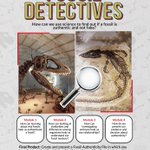
When career exploration is woven into everyday learning, students discover new interests, build practical skills, and see where their learning could take them. In our middle school science unit, Fossil Detectives, students take on the role of paleontologists to investigate a challenge: How can we use science to determine whether a fossil is authentic or fake? In the first module, students explore fossil auctions and the real-world problem of fake fossils. They investigate a fossil that is about to be auctioned that the seller claims is from the oldest common ancestor of three unlikely relatives: elephants, Sirenia (dugongs and manatees), and rock hyraxes. In following modules, students → look at similarities and differences among organisms to help understand fossil mysteries. → investigate how embryos can help us understand different relationships. → decide how they present their evidence and decisions about fossil authenticity. Finally, students create and present a Fossil Authenticity File in which they investigate and authenticate a fossil ancestor and fossils going to auction. Take a closer look at the learning experience with a free sample unit. bit.ly/4gpoOiU
22
We’re proud to continue our partnership with the One8 Foundation to bring inquiry-based, high-quality social studies learning to classrooms across Massachusetts. Through this collaboration, Educurious has supported the expansion and full release of the state’s Investigating History curriculum to reach grades 3–7. Together with the Massachusetts Department of Education and the dedicated team at One8, we’ve helped hundreds of teachers bring history to life through primary sources, critical questions, and authentic inquiry experiences. bit.ly/4zU3msH Thank you, teachers, for another engaging workshop this month. Photographs by Melissa Blackall @MASchoolsK12
23
Introducing Gaze: Portraiture and the African Diaspora, a new open educational unit in our Library of Congress Teaching with Primary Sources series! The unit will debut during a free professional learning session in late November, where educators can also explore all seven project-based learning (PBL) units in the series. Across the series, students use art and creative expression—from portraiture, street art, and music to food, poetry, graphic storytelling, and entrepreneurship—as ways to explore history, culture, identity, and their connections to the world around them. In Gaze, students analyze portraits from the @librarycongress to explore how individuals and communities in the African diaspora have used portraiture to shape how they are seen and to record their lives for posterity. They examine how Frederick Douglass and Sojourner Truth self-fashioned their own images and how W. E. B. Du Bois curated a collective portrait of Black America. They also study how Arturo Schomburg preserved Black history during the Harlem Renaissance, and how contemporary artist Bisa Butler reimagines historical images today. Students then follow the process of visual artist Sam Singh to create their own portraits that reimagine a historical figure or document a community of their choosing. All participants in this professional learning will receive full access to this OER unit and the six others in this collection. Apply Here: forms.gle/jVP9o6a2xdoZ1uQG6 Hope to see some new and familiar faces! Please spread the word to your colleagues and educator friends!
32
In Decoding Ancient Egypt, students create future archeological sites with items that might help future societies understand our world today. Kudos to 6th graders in @tacomaschools who crafted these pieces as part of the culminating project! Students work collaboratively to design and present their own archaeological sites based on the seven elements of civilization. They begin by exploring an Egyptian archaeological site and analyzing artifacts to understand ancient Egyptian society. Students then brainstorm ideas for their team’s site, selecting artifacts that reflect what they want future archaeologists to know about their own community. They research their chosen artifacts, draft site plans, and develop individual site statements. Finally, students take on the role of future archaeologists, interpreting their peers’ sites and reflecting on the significance of archaeology in understanding past and present civilizations. Contact us to learn more about Decoding Ancient Egypt or any other PBL unit→ bit.ly/490RwSL
17
Ongoing, low-stakes assessments allow teachers to adjust instruction, provide targeted support, and ensure students are progressing toward learning goals while empowering them to reflect on and revise their thinking and work. PBL incorporates both assessment for learning (formative feedback that guides instruction) and assessment as learning (student self-monitoring and metacognitive reflection). When students engage in self-assessment and peer feedback throughout the project, they develop agency over their learning process. See how the PBL Design Framework might help instruction and assessment in your classroom. bit.ly/4cGkeux
2
69
Our Life Science course brings biology off the page and into students’ hands. Through engaging investigations, learners explore evolution, ecosystems, genetics, and cellular processes while solving real-world problems. From analyzing fossils and designing species habitats to examining DNA damage and tackling algal blooms, students think and work like scientists. Three-dimensional assessments capture their growing ability to model, argue from evidence, and design meaningful solutions. Take a closer look: ncee.org/project-based-learn…
31
Middle schoolers act as anthropologists in The Next Renaissance, a unit that explores how ideas and innovations from the Renaissance have transformed people’s lives around the world. They research a field of interest, create a mini photo essay, and refine their ideas through debate, peer feedback, and reflection culminating in a compelling photo essay that answers the question: What will spark the next Renaissance? Real-world connections are an integral part of project-based learning. ➡️ ncee.org/project-based-learn…
18
The technologies we rely on require metals. But what happens when getting them means mining the deep ocean? Depths of Discovery puts students in the role of scientists and explorers, connecting classroom learning to real-world challenges, experts, and careers. ncee.org/project-based-learn… We talk a lot about this curriculum, with good reason. This partnership with @EVNautilus is bringing exciting opportunities for teachers and students—see the mission in action. Contact us about Depths of Discovery curriculum: ncee.org/contact-us/
30
Sustained attention, deep reading, interpretation, and the ability to make sense of multiple and sometimes competing sources—Eric Jones (NCEE) reflected on the importance of these skills while digging into the PISA 2025 findings with Andreas Schleicher from the OECD and other panelists. We immediately thought of project-based learning, where students build these skills through sustained, meaningful inquiry. Read the PBL Design Framework and watch the OECD discussion for a deeper look at PISA results, beyond the headlines. ncee.org/project-based-learn… ncee.org/thriving-in-a-compl… @OECDEduSkills @CtrEdEcon
1
35
A major investment in Idaho is reshaping the state’s workforce and creating an opportunity to think differently about how students prepare for what comes next. We are happy to support the Idaho Workforce Development Council, school leaders, community leaders, and teachers who are imagining how project-based learning intersects with career-readiness and gives students pathways into the opportunities growing around them. stem.idaho.gov/project-based… These photos are from the Future Pathways Leader Cohort—looking forward to being back in Idaho soon for the Teacher Design Intensive!
1
45
The ocean floor is largely unexplored. What might your students discover? Depths of Discovery puts students in the role of scientists and explorers, connecting classroom learning to real-world challenges, experts, and careers. ncee.org/project-based-learn… We talk a lot about this curriculum, with good reason. This partnership with @EVNautilus is bringing exciting opportunities for teachers and students—see the mission in action. Contact us about Depths of Discovery curriculum: ncee.org/contact-us/
27
The latest results from the OECD’s Programme for International Student Assessment (PISA), the world’s largest education survey of 15-year-old students, have been all over the headlines. One takeaway that stands out to us is favoring "depth over breadth," a principle at the heart of project-based learning. We invite you to: ➡️ Take a look at the PBL Design Framework and see what comes to mind for you and your students, particularly in this moment of thinking about how education systems and deeper learning can support future-ready learners. ncee.org/project-based-learn… ➡️ Hear directly from Andreas Schleicher (OECD) and other panelists about what these PISA results mean for U.S. students. ncee.org/thriving-in-a-compl… @CtrEdEcon @OECDEduSkills #PISA2025
1
1
22
In this middle school social studies PBL unit, students think like anthropologists. Their challenge: How do artifacts help us understand the belief systems that shaped ancient Maya civilization? ➡️ They analyze artifacts, art, and legends for clues about Maya beliefs and values. ➡️ They explore the rise and fall of Maya cities and the culture’s lasting legacy, building skills in observation and evidence-based storytelling. ➡️ Then they put the evidence together, creating a comic inspired by a Maya codex to show what artifacts reveal about Maya belief systems. Along the way, students practice observing closely, interpreting evidence, and using what they discover to tell a story about the past. Take a closer look at the learning experience with a free sample unit. ncee.org/project-based-learn…
40
Educurious retweeted
Legendary ocean explorer Dr. Robert Ballard was featured on @CBSSunday reflecting on the discovery of the Titanic and the continuing mission of the EV Nautilus to explore and map the largely unknown world beneath the sea. Kids ask him what his next great discovery will be. His response: "I don't know. I'm just gonna bump into it." I love that answer. It's a good description of how discovery often works and captures habits of mind we should cultivate in young people: the curiosity to go looking before you know what you’ll find, and the determination to keep going long enough to find it. My colleagues are developing a three-part graphic novel series on Ballard's life and work. Walking on the Ocean Floor takes young readers beneath the surface, following Ballard's groundbreaking discoveries, the science and technology that made them possible, and the persistence behind it all. I love the idea of Ballard’s story inspiring a new generation to stay curious, keep exploring, and see what they might bump into. cbsnews.com/video/shipwrecks… @Educurious @EVNautilus
1
2
202