

scaling compute on your context
San Francisco
Joined April 2026
- Tweets38
- Following1
- Followers8.6K
- Likes208
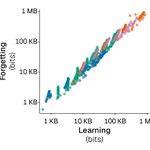




Our blog provides the full derivation and an explanation of the method we used to predict rank.
We also provide a short explanation of the connection between language modeling and information theory. Best of all, it's fully human-written!
Read more:
engram.com/blog/lora-size

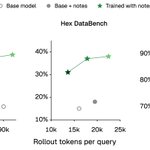
In our new blog, we share some new science investigating how RL complements text-based memory by letting models learn how to use their notes.
It turns out that training can be cheap compared to building notes, and stays surprisingly robust even through millions of tokens of edits.
With good infrastructure, training is surprisingly cost-effective.
A short RL phase on GLM 5.3 Flash adapts the model to use its notes, driving performance while costing 5-10x less than building the notes in the first place.
After all, training is just inference with a backwards pass.

This post is a simple snapshot of the kind of work we’re doing at Engram.
Read more on our blog:
engram.com/blog/learning-in-…

There's a world in which the most useful model for a lawyer is not the generalist model that knows how to solve math theorems and write Rust pipelines, but one that's designed to be useful just for them.
We're starting to see what that could look like. Incredibly cool to see Harvey blowing the frontier models out of the water with their first post-train on very hard economically valuable tasks (2x'ing performance on Legal Agent Bench). We're proud to be working alongside them towards this vision.


The full post is available on our website:
engram.com/blog/legal-agents…

A big thank you to our friends at @harvey for an awesome collaborative effort: @ItsJulioPereyra @nikogrupen @gabepereyra @spencerpoff ❤️🚀
22
4,098
In collaboration with @harvey, we’re excited to build a new kind of agent environment to reflect realistic knowledge work: an entire synthetic law firm, Calderwood & Harkness, with over 100M (!) tokens of documents and 250 client cases. 💼
Today’s AI models know a lot about the law, but don’t understand how the law is practiced, because this information remains proprietary within firms. Unlike how agents are benchmarked today – starting each task from scratch with a new set of context — lawyers accumulate knowledge over time, building on years of experience.
Calderwood & Harkness makes it possible for agents to do the same. Legal agents do many tasks in the same environment, making it possible to leverage memory and experience to do better work over time.
We’ve had a great time co-developing this benchmark with Harvey’s research team, partnering @ItsJulioPereyra @nikogrupen @gabepereyra. We’ll share more results on this soon.


Our founder @jxmnop recently issued some unfounded claims that got community noted. We deeply apologize for the confusion caused by his original post, the follow-up post, and the follow-up to the follow-up post.
Nevertheless, we stand by his conviction in his own takes---and in strong open-source models like Inkling.
Congrats to our friends at @thinkymachines !

people are underestimating what a big deal this is
this is the ONLY open-weight model that's trained without distilling from OpenAI or Anthropic
• Kimi distills
• GLM distills
• Qwen distills
• Nemotron distills (Kimi & DeepSeek, which counts)
basically a fully different tech stack. the first pure open frontier coding model. very exciting
Readers added context they thought people might want to know
Per its announcement, Inkling was pretrained from scratch but used a small SFT bootstrap on synthetic data from open models incl. Kimi K2.5. Other models like Llama 3.1 were also trained from scratch without OpenAI/Anthropic distillation.
thinkingmachines.ai/news/introduci…
ai.meta.com/blog/meta-llam…
Our CEO @dan_biderman might be the best in the world in the niche intersection of leading an AI lab and cooking delicious food.
We're rolling out our m̶e̶a̶t̶b̶a̶l̶l̶s̶ models to some early customers. Let us know if you want a taste!

In this episode, @EngramLab co-founder and CEO @dan_biderman joins @allenpark to cook Mediterranean meatballs with yellow rice and talk about building AI that actually learns from you: why long context, RAG, and compaction eventually break down, how Engram compresses knowledge into cartridges and model weights, what continual learning could unlock for long-horizon agents, why token efficiency is inseparable from intelligence, how personal models could improve like Tamagotchis, and what it takes to build the research and infrastructure for millions of continuously updated AI memories.
Timestamps:
0:00 Intro
0:26 Engram’s $98M Launch and Meatballs
1:45 From Naval Special Operations to AI Research
4:32 Israeli Military Culture and Founder Maturity
7:12 Why Engram Is Betting on Context and Continual Learning
9:14 Knowledge Cartridges, Compression, and Model Intuition
14:10 Trillion-Token Company Knowledge and Context Rot
18:05 Long-Context Limits, Compaction, and Neural Memory
22:20 Test-Time Training and “Destroying Prefill”
24:31 Harvey and Holistic Enterprise Queries Beyond RAG
27:02 Personal AI Models and Tamagotchi Weights
30:00 What Belongs in Weights vs. Text
32:25 Autonomous Memory and User-Specific Feedback Loops
34:20 Token Efficiency, Model Routing, and Harder Tasks
38:03 Engram’s Research Team and Product Culture
43:02 Hiring Researchers and Infrastructure Engineers
45:25 Doing More With Less
47:41 Where to Find Engram
48:19 Final Taste Test
We are thrilled to announce Engram's pivot to dairy farming. Our primary activity will be fostering 🐐s like @jxmnop -- who recently won an ICML outstanding paper award for his work on language model memorization and capacity!
We're incredibly proud to work with Jack every day, and you can too. Come join the farm 🌾
my paper won an award at icml 😁
some thoughts:
• this work was rejected from NeurIPS. i cleaned it up a small amount and it got great reviews from ICML! don't give up
• ICML received 24k submissions and only gives out 7 awards, which is crazy. feeling grateful
• i distinctly remember sitting at my desk two winters ago wondering if i would ever finish this project. most of all this is the product of sitting down and forcing myself to keep working for several months straight. the results emerged from running the experiments over and over and fixing a long sequence of tiny details. eventually, the curves looked like that 👇
• also happy that the insights in this paper are becoming more widely accepted: 3.3 bits/param, thinking about capacity "LLM as flashdrive" mentality
• the method here is used successfully for selecting midtraining data at least one frontier lab, which is cool!
• i am grateful to my collaborators, but Meta is no longer a great place for academic research imo and this almost never got published for a number of reasons. i shall not elaborate further
• for future work, i think analyzing the implications of on-policy algorithms on capacity, as well as LoRA and things like it, are fruitful potential research directions
• sadly i'm not in Korea but am following the conference online from california and happy to chat!
a nice end to one phase of my research career :)
3
108
14,266