




Equidem's research, 'Shattered Dreams, Hidden Trauma,' documents the widespread exploitation and abuse faced by East African women migrant domestic workers in the Gulf, including unpaid wages, excessive working hours, restrictions on movement, and physical and sexual violence.
📍 On November 27, Equidem will join the First Africa Conference on Women's Shelters in Nairobi, Kenya, to discuss the urgent need for safe shelters and stronger protection systems for African migrant domestic workers in the Gulf.
Martha Waithira, a former migrant domestic worker and member of the Equidem team, will draw on both her lived experiences and Equidem's research in a panel moderated by Equidem CEO @Mustafa_Qadri.
The discussion will explore what a survivor-centered approach to shelter provision and migrant worker protection should look like in practice, with a focus on:
🤝 Cross-border partnerships: How governments, civil society, and other stakeholders can coordinate to provide safe shelters, repatriation assistance, and reintegration support.
⚖️ Policy and legal protections: Strengthening frameworks that ensure migrant women can access safety, exercise their rights, and seek justice without fear of retaliation.
🏠 Sustainable investment: Building long-term, adequately resourced shelter systems that prioritize women's safety, agency, dignity, and access to justice.
As we strengthen shelter systems across Africa, we must also recognize that protecting women migrant workers requires coordinated action across borders, from the countries where they work to the communities to which they return.
🔗 Read Equidem's research, Shattered Dreams, Hidden Trauma: equidem.org/reports/shattere…
#MigrantWorkers #DomesticWorkers #WomensRights #16DaysOfActivism #EndGBV #Equidem

In Kenya, former content moderators working for #Meta continue to fight for justice after experiencing extreme labor exploitation, psychological harm, and inadequate mental health support.
🎥 Equidem's Geoffrey Stephen joined the growing #MetaMustPay campaign, calling for accountability and justice for Kenya's digital workers.
These concerns reflect the findings of Equidem's investigation, 'Scroll. Click. Suffer: The Hidden Human Cost of Content Moderation and Data Labelling', based on interviews with 113 workers across Colombia, Ghana, Kenya, and the Philippines.
Our research documented:
🔴 Psychological harm: Repeated exposure to violent and disturbing content, with inadequate mental health support.
🔴 Exploitative working conditions: Excessive workloads, unrealistic performance targets, unpaid overtime, and wage deductions.
🔴 Misuse of non-disclosure agreements (NDAs): Confidentiality provisions that discourage workers from speaking out about abuse or organizing collectively.
🔴 Opaque outsourcing arrangements: Complex subcontracting relationships that obscure responsibility for working conditions and make it harder for workers to seek remedy.
These findings highlight the urgent need for stronger regulation of labor practices across technology supply chains, including clear and enforceable accountability for both technology companies and their outsourcing partners.
We stand in solidarity with Kenyan content moderators in their fight for justice, meaningful remedy, and corporate accountability.
🔗 Read Equidem's investigation: equidem.org/reports/scroll-c…
#MetaMustPay #TheOversightLab #ContentModerators #DataWorkers #LabourRights #DigitalLabour #Equidem
A new report by ALQST for Human Rights raises serious concerns about the continuing exploitation of migrant workers in Saudi Arabia, despite years of announced labor reforms.
In ALQST's survey of migrant workers:
🔴 2 in 3 respondents reported going months without receiving their wages.
🔴 More than 1 in 4 respondents said they had been falsely reported as absent from work, leaving them vulnerable to deportation.
These findings echo Equidem's own investigation, 'Broken Promises: Forced Labour in Saudi Arabia and the Fast Tracked World Cup Bid', which documented deceptive recruitment, wage-related exploitation, discrimination, physical abuse, and indicators of forced labor among migrant workers in the country.
The message from these investigations is clear: reforms on paper are not enough.
As Saudi Arabia prepares to host the 2034 FIFA World Cup, there is an urgent need for meaningful enforcement of labor protections, an end to employer-controlled systems that enable extreme labour exploitation, and effective access to justice and remedy for migrant workers.
We stand alongside ALQST in calling for reforms that deliver real, measurable improvements in workers' lives.
🔗 Read ALQST's new findings: alqst.org/en/post/years-of-l…
🔗 Read Equidem's Broken Promises investigation: equidem.org/reports/broken-p…
#MigrantWorkers #SaudiArabia #LabourRights #ForcedLabour #HumanRights #BusinessAndHumanRights #DecentWork

55
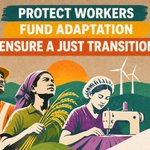
As world leaders gather for #COP31 to discuss climate finance, adaptation, and a just transition, one critical question continues to receive far too little attention: What is being done to protect the millions of workers, particularly in the Global South, who are already bearing the consequences of climate change?
From migrant workers in the Gulf and garment workers in Bangladesh to workers building and preparing stadiums for the FIFA World Cup, Equidem's research reveals a consistent reality: low-wage and marginalized workers are among those most exposed to climate risks, while existing inequalities and labor exploitative practices make them even more vulnerable.
Perhaps most concerning is that the transition to renewable energy, intended to address the climate crisis, is itself creating new risks of labor exploitation, as Equidem's joint report with the @BizHumanRights, 'Rush to Renewables', highlighted.
At COP31, Equidem calls on governments, businesses, and investors to make three concrete commitments:
🌱 Ensure a genuinely just transition. From nickel mining and mineral extraction to the construction of solar and wind energy infrastructure, every stage of the renewable energy transition must uphold international labor standards, protect workers' rights, and hold companies accountable for abuses.
🤝 Put workers and trade unions at the center of climate action. Governments and employers must engage meaningfully with trade unions and worker representatives, including through collective bargaining agreements that establish enforceable protections against climate-related workplace risks.
💰 Make climate finance work for workers. Climate finance must translate into tangible improvements in workers' lives by funding safer workplaces, decent work, social protections, and effective access to remedy.
The workers who have contributed the least to the climate crisis are often the ones paying its highest price. The success of COP31 must be measured by whether its commitments make a tangible difference to their lives.
📚 Explore Equidem's research on climate change and workers' rights:
• Climate Change in the World of Work: Violence at the Systemic Edge
equidem.org/reports/climate-…
• Rush to Renewables: Toward Migrant Worker Rights and a Just Energy Transition in the Gulf
equidem.org/reports/rush-to-…
• FIFA 2026 Heat Risk Observatory
equidem.org/reports/fifa-202…
#COP31 #ClimateJustice #JustTransition #WorkersRights #MigrantWorkers #ClimateFinance
🤖 Made with AI

Bangladesh’s garment sector generates billions in export earnings, yet the workers whose labour sustains the industry continue to struggle for fair wages, safe working conditions and meaningful representation.
In a new opinion piece for India Dossier, Equidem’s Syed Zainul Abedin raises a critical question: Does having a seat at the negotiating table necessarily mean workers have the power to shape decisions affecting their lives?
Against the backdrop of discussions around Bangladesh’s new minimum wage board and the garment workers’ protests over wages that have rocked the country, the article examines:
🔹 The limitations of representation without genuine bargaining power.
🔹 The importance of independent trade unions
🔹 The responsibilities of governments, employers and international fashion brands in protecting workers’ rights.
Read the full article: indiadossier.com/standpoint/…
#Bangladesh #GarmentWorkers #WorkersRights #FreedomOfAssociation #CollectiveBargaining #LabourRights

1
58
It’s been 15 years since the adoption of the UN Guiding Principles on Business and Human Rights, but how much has really changed for workers and communities across the Middle East and North Africa?
Join us at the 2026 UN Forum on Business and Human Rights, where Equidem’s CEO, @Mustafa_Qadri, will speak on a panel examining the progress made, the gaps that persist, and what must change to turn corporate human rights commitments into meaningful protections for workers and communities.
From labour exploitation and barriers to justice to the responsibilities of businesses operating in conflict-affected settings and the growing threats posed by climate change, the discussion will explore what it will take to move beyond policy commitments towards genuine accountability, effective implementation and access to remedy.
📅 Wednesday, 25 November 2026
🕚 11:40 AM – 1:00 PM CET
📍 Tempus, Palais des Nations, Geneva
💻 In-person and online participation
🔗 Register here: indico.un.org/event/1019874/
#UNForumBHR #BusinessAndHumanRights #CorporateAccountability #HumanRights #UNGPs

“They provide food, but I am only allowed to eat their leftovers.”
These are the words of a Kenyan domestic worker in Saudi Arabia, who shared her experience with Equidem researchers.
A woman employed to care for others, yet denied even the basic dignity of having enough food to eat. This should never be normalised.
On this International Day of Care and Support, we must ask: Who cares for the workers who care for everyone else?
Across the world, millions of care workers, many of them migrant women, sustain households, families and healthcare systems.
Yet Equidem's research has documented wage theft, excessive working hours, restrictions on movement, discrimination and violence, often with little access to justice.
Our research has also revealed how climate-related economic insecurity is driving women to seek work abroad, including in the Gulf's care economy, where exploitative recruitment and migration systems can leave them highly vulnerable.
Despite their essential contributions, many care workers remain excluded from fundamental labour protections, including the right to organise and bargain collectively.
Fifteen years after the adoption of ILO Convention 189 on decent work for domestic workers, only 40 countries have ratified it.
Recognising care work must mean more than celebrating its contribution. It requires three fundamental commitments:
⭕ Recognition: Care work is work. Care workers deserve fair wages, social protection, opportunities for training and career advancement, and equal recognition under labour laws.
⭕ Protection: Governments and employers must guarantee safe working conditions, freedom of movement, fair recruitment, protection from violence and harassment, and meaningful access to justice, regardless of nationality or migration status.
⭕ Collective power: Care workers must have the freedom to organise, join trade unions, bargain collectively and have a meaningful voice in shaping the policies and systems that govern their lives and work.
As domestic workers' unions around the world have demanded, governments must move beyond promises to action: ratify and effectively implement ILO Conventions 189 and 190, end exploitative employer-tied migration systems, and ensure that care workers and their unions are at the centre of shaping care policies.
On this International Day of Care and Support, Equidem stands in solidarity with care workers, trade unions and grassroots organisers fighting for a care economy built on dignity, decent work and collective power.
Read Equidem's research:
Shattered Dreams, Hidden Trauma : equidem.org/reports/shattere…
Decent Work & the Care Economy: Migrant Care Work Corridors from Ethiopia, Uganda and Kenya to Saudi Arabia and the UAE : equidem.org/reports/decent-w…
#InternationalDayOfCareAndSupport #CareWorkers #DecentWork #MigrantWorkers #WorkersRights

🌍 Equidem will be at the 2026 UN Forum on Business and Human Rights in Geneva!
Our Founder and CEO, Mustafa Qadri, will be attending this year's Forum, taking place from 23–25 November 2026.
He will also be speaking at a session on 25 November exploring the implementation of the UN Guiding Principles on Business and Human Rights in the Middle East and North Africa, with a focus on labour rights, conflict and climate change.
We'll be sharing more details about the session soon!
We look forward to connecting with fellow human rights advocates, trade unions, civil society organisations and other stakeholders to exchange ideas on strengthening corporate accountability, protecting workers' rights and advancing access to remedy.
Will you be attending the Forum? We'd love to connect!
If you're interested in meeting Mustafa to exchange ideas, discuss shared priorities or explore opportunities for collaboration, please send him a direct message on LinkedIn.
He'd be happy to coordinate a time to meet in Geneva!
Looking forward to seeing you there!
#UNBHR2026 #BusinessAndHumanRights #WorkersRights #CorporateAccountability #HumanRights

Who is accountable for the workers behind AI?
Behind every AI system and social media platform is a global workforce of content moderators, data labellers and other digital workers whose labour is essential, yet whose rights and working conditions often remain invisible.
On 18 December 2026, Equidem's researcher Jason Nemerovski will join an international, interdisciplinary conference at the French Senate in Paris, titled 'Accountability in AI Global Value Chains: Data, Labour, and Environment.'
Drawing on Equidem's research, including our report 'Scroll. Click. Suffer: The Hidden Human Cost of Content Moderation and Data Labelling', Jason will contribute to discussions on the legal, policy and practical solutions needed to strengthen corporate accountability and ensure greater protection for workers across global AI value chains.
Based on interviews with 113 workers across Colombia, Ghana, Kenya and the Philippines, our investigation documented serious psychological harms, exploitative working conditions, restrictions on workers' ability to organise, and how outsourcing arrangements involving technology companies such as Meta can obscure responsibility for labour rights violations.
As AI continues to expand, we must ask: Who bears the human and environmental costs of technological progress? How can we ensure that companies benefiting from these global value chains are held accountable?
We look forward to joining researchers, legal experts and advocates for this important conversation on advancing corporate accountability and building a more responsible and rights-respecting AI industry.
📍 French Senate, Paris
📅 Friday, 18 December 2026 | 9:00–17:30
The event is free to attend, with prior registration required. Simultaneous French–English interpretation will be available.
🔗 Register here: billetweb.fr/colloque-sur-le…
📖 Read Equidem's research: equidem.org/reports/scroll-c…
#AIAccountability #LabourRights #HumanRights #DigitalLabour #CorporateAccountability #ResponsibleAI

⚽ A new report by the @Sport_Rights and @FansEurope raises serious concerns about FIFA's failure to uphold its human rights commitments during the 2026 Mens World Cup.
The report documents a wide range of human rights concerns affecting fans, athletes, journalists, migrant workers and local communities, including discriminatory immigration policies, restrictions on fundamental freedoms, barriers to participation and inadequate access to remedy.
These findings echo concerns #Equidem has also raised through years of investigations into the human rights and labour conditions associated with FIFA tournaments, from Qatar 2022 to the 2026 World Cup and preparations for Saudi Arabia 2034.
Across these investigations, we have documented how migrant workers face exploitation, discrimination, unsafe working conditions and significant barriers to accessing justice, often within complex contracting and subcontracting arrangements where accountability remains weak.
Together, these findings point to a persistent failure to translate FIFAs human rights commitments into meaningful protections for the workers and communities affected by its tournaments.
For an organisation with FIFA's global influence, financial resources and immense commercial reach, the continued failure to safeguard fundamental human rights raises serious questions about its accountability mechanisms. These are not new or unforeseeable risks. They have been documented repeatedly, and the measures needed to address them are well established.
It is time for FIFA to move beyond commitments and demonstrate concrete action through enforceable human rights safeguards, independent oversight, meaningful engagement with affected workers and communities, and effective access to remedy.
The scale and influence of global sporting events must be matched by an equally serious commitment to protecting the rights of the people who make them possible.
🔗 Read the report: sportandrightsalliance.org/f…
#FIFAWorldCup #HumanRights #MigrantWorkers #LabourRights #Accountability

🌡️ From garment factories to workers producing for global sporting events like the FIFA World Cup, we are seeing again and again how rising temperatures and extreme heat are putting workers' lives and livelihoods at risk.
As Equidem's research has shown, climate change deepens existing vulnerabilities, exacerbates exploitation and violence, and creates a vicious cycle in which workers with the least protection are often the most exposed to its consequences.
🤝 It is time to move beyond documenting these problems towards collective action and practical solutions developed in close consultation with workers, trade unions, communities, and other stakeholders on the ground.
Meaningful solutions do not always require enormous resources. Practical, low-cost interventions can make a real difference when workers and communities are genuinely involved in shaping them. But these efforts must also address the underlying conditions that make workers vulnerable in the first place, including restrictions on freedom of association and collective bargaining, and inadequate labour protections.
🌍 Without recognising the intersection of climate change, labour rights, and human rights, we risk addressing the symptoms while leaving the structures that perpetuate exploitation untouched.
📖 Read Equidem's research:
Climate Change in the World of Work: Violence at the Systemic Edge
equidem.org/reports/climate-…
Playing with Lives: Heat Risk, Labour Rights and Accountability at the FIFA World Cup 2026
equidem.org/reports/playing-…
Read the latest article by Lucianne Tonti in Marie Claire, exploring how rising temperatures and extreme heat are affecting garment workers: marieclaire.co.uk/fashion/hu…

Equidem CEO Mustafa Qadri Calls for Worker-Centred Approach to Irregular Migration at Bali Process Workshop
At a Bali Process workshop on 'Addressing Irregular Migration: Perspectives and Lessons Learned from Regularisation Programmes’, Equidem Founder and CEO Mustafa Qadri spoke about why irregular migration cannot be understood or addressed only through an enforcement lens.
Drawing on Equidem’s work with migrant workers across major migration corridors, Mustafa highlighted three critical issues:
🔴 Irregularity is often produced by the migration and labour system itself.
Workers may set out to migrate through regular channels, but recruitment abuse, excessive fees or barriers to changing employers can push them into undocumented situations.
🔴 Irregular status can create conditions in which exploitation thrives.
Fear of detention, deportation or losing a livelihood can make it much harder for workers to challenge wage theft, unsafe conditions and other abuses.
🔴 Enforcement alone does not address the demand for migrant labour.
Many industries continue to depend heavily on migrant workers, while enforcement-focused responses can leave the underlying labour demand and exploitative practices untouched.
As Mustafa stressed, migrant workers should not be seen as peripheral to our economies — they sustain essential services and industries across countries.
What is needed is a more effective and humane approach that protects their rights and asks a more fundamental question: how do we shift power away from systems that profit from worker vulnerability and towards workers themselves?


What happens when private actors exercise powers once associated primarily with states?
On 2 October, Equidem Director Mustafa Qadri will speak at the London Conference on International Law 2026, joining the panel “Non-State Actors and International Law: Accounting for Plural Power.”
As corporations and digital labour platforms increasingly shape access to work, pay and working conditions across borders, often through contracts, data and algorithms, important questions arise about how international law responds to these forms of private power.
Drawing on Equidem’s work with workers across global supply chains and the platform economy, Mustafa will explore what this means for worker rights, collective agency, accountability and the enforcement of rights across borders and how international law can better respond to new forms of corporate power while protecting workers’ ability to organise and act collectively.
The discussion will bring together perspectives from international law, business, human rights and governance to ask a fundamental question: how should international law adapt when power is no longer exercised by states alone?
📍 QEII Centre, London
📅 Friday, 2 October 2026
🕑 14:15–15:45
Learn more and register: thelondonconference.org/
#InternationalLaw #HumanRights #LabourRights #PlatformWork #WorkerRights #BusinessAndHumanRights #Equidem
