

Using interpretability to understand, design, and align AI.
San Francisco
Joined August 2024
- Tweets946
- Following52
- Followers31.2K
- Likes2K




Pinned Tweet
We’re announcing an embedded assessment with @OpenAI to advance safety and alignment at the frontier.

We improved a model that helps us understand proteins, giving us better predictions that held up in wet lab experiments.
Working with @NVIDIAHealth and @arcinstitute, we strengthened BioReason-Pro 2’s usage of multimodal information - and we can now interrogate its reasoning to confirm how it’s using protein inputs.
NVIDIA is open-sourcing BioReason-Pro 2 as a BioNeMo open model: huggingface.co/collections/n…

This is just one example of how interpretability can help us improve models. If you’re building models for biology or other sciences, we’d love to help you understand how they use their inputs and where training can improve.
Read the full post: goodfire.com/research/buildi…

Goodfire retweeted

🍹 Attending #NeurIPS2026 in Atlanta?
Join us for the Interp4Discovery Social! Come connect with researchers, share ideas, and make new friends over vinyl and food! Spots are limited—RSVP now!
Huge thanks to @GoodfireAI for sponsoring! 🔥
📅 Dec 12, 6PM
luma.com/ntv8eome

Goodfire retweeted

To encourage research on this model, we're launching the Looped Lens Challenge with @thinkymachines and @GoodfireAI, launching this Monday!
We challenge you to develop methods that help us surface what Inkling 2 Mini computes but never writes.
🔗 ndif.us/looped-lens-challeng…

Looped models are weird. A layer can write to itself or read from "future" layers.
@thinkymachines gave us early access to Inkling 2 Mini so we could study its inner mechanisms. We uncover how it coordinates information flow across layers, blocks, and loops.
Studying Inkling 2 Mini gave us cause for optimism: as transformers continue to evolve, we believe our ability to understand their internal mechanisms can evolve with them.
Read the full post: goodfire.com/research/interp…

Some of you thought that Inkling 2 Small was too big at 594B parameters. We heard you: Inkling 2 Mini is a looped transformer with just 26B parameters, small enough to run on your laptop, powerful enough for agentic work with a score of 20.1 on AA Index.
thinkingmachines.ai/news/ink…

Goodfire retweeted
What scientific discoveries are hiding inside AI models? 🔍
Join us Dec 12 at @NeurIPSConf in Atlanta for Interpretability for Discovery. Hear from our amazing speakers: @begusgasper, @kfrankelab, @nkwang24, and @jwuphysics. Join us for spotlight talks, posters, and a panel!🎉
We’re hosting a social right after the workshop! Stay tuned for details, and a big thank-you to our sponsor @GoodfireAI for making it possible!
Looking forward to seeing everyone!
Organizers:
@boknilev, @EkdeepL, @YNikankin, @ChenhaoTan, @amirtha255

A language model is a wonderland of strangely specific neurons, from gargling to comic exasperation to the moment a guard looks away.
We made a searchable atlas of all 10 million neuron poles in Qwen3.6.
Play with it here: goodfire.com/research/public…
Each neuron pole, a neuron's positive or negative side, has a rough label from its max-activating examples. Poles with similar labels are close together.
You can explore a sample of 3,000 poles studied in depth in "Library."
Check out our Neurons work: goodfire.com/research/neuron…

38
2,009
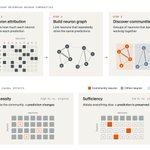
New neurons research: introducing Neuron Communities.
We discovered communities of neurons that work together inside LLMs. They’re surprisingly small, but powerful – just a few neurons work together to perform common behaviors, like arithmetic, ALL CAPS, or recalling a date.
Work led by research fellow @_igorshilov:
Read the full post and explore examples of the communities we found: goodfire.com/research/neuron…
Goodfire retweeted

incredibly excited to be partnering with @OpenAI on embedded assessments!
we'll be embedding interpretability researchers who will use the @GoodfireAI platform to monitor and debug training runs to improve safety and alignment
our primary audience for our assessments are internal OpenAI researchers, but we'll publish our findings as the collaboration progresses

We’re working with @ApolloResearch, @METR_Evals, @TransluceAI, and @GoodfireAI on embedded assessments: giving outside experts deep access to our internal models and systems to investigate alignment and test our safeguards.
These assessments build on our ongoing alignment and safety research, bringing independent scrutiny to how we identify and manage risks in our systems.
openai.com/index/our-first-p…
