Mark Histed (@HistedLab) header
Mark Histed (@HistedLab) profile picture

Neuroscientist. We aim to understd brain networks and brain wiring, using lasers & neuro AI. Prev: policy for @democracypolicy. Personal views. Not a lab acct.

Washington, DC
Joined May 2013
Photo by Mark Histed (@HistedLab)Photo by Mark Histed (@HistedLab)Photo by Mark Histed (@HistedLab)Photo by Mark Histed (@HistedLab)Photo by Mark Histed (@HistedLab)Photo by Mark Histed (@HistedLab)Photo by Mark Histed (@HistedLab)Photo by Mark Histed (@HistedLab)Photo by Mark Histed (@HistedLab)Photo by Mark Histed (@HistedLab)
New preprint, on 'sequence filtering'. Led by @CianaDeveau, Z Zhou. We see this as a key step forw on how cortex works. All cortical areas have dense exc-exc recurrent connectivity. What do these connections do, esp in sensory ctx? Our data say: they do dynamics/time. 1/4
5
39
2
174
35,973
Everyone is done discussing "You Can See Everything" but: Apparently Joe the Laser Guy is talking about Raman spectroscopy? And fitting it in a box half the size of a shoebox? That's Theranos 2.0? latimes.com/entertainment-ar…
1
3
525
I don't know that much about Raman spectroscopy, CW or pulsed, but... this sounds hard
1
2
182
Will #AI 'solve biology'? I think not. There are big hurdles. I spoke to Scientific American about this in a piece a few days ago. "Of all the areas where AI is likely to struggle, perhaps the most ironic would be the study of intelligence itself and how it arises within the brain. Yet that is precisely where Histed thinks current and near-future models may flounder." '“My sense is that the hard questions in the field are really not going to be solved by adding intelligence,” he says. What neuroscience needs instead are more and better data.' (Yes.) "... several examples from his “most wanted” list: better recordings of neural activity, more thorough studies of biological networks, new measurements using frontier technologies such as optogenetics, and so on...." [esp 2-photon single-neuron resolution optogenetics] 😀 But there is another point I think is key: Even with lots of data, we can't solve everything. AI systems are universal function approximators. Yes. But our ability to extrapolate w nonlinear functions is poor. “At some point the amount of data you need to estimate your nonlinear [model] is greater than can be acquired before the heat death of the universe", I said. I stand by this. This problem does not merely apply to chaotic systems. Chaos has exponential divergence from initial conditions. (see Strogatz :) But nonchaotic systems can also be hard to predict, even with lots of data. That's true for biology and neuroscience. It's also true for stock markets. And it's true for public opinion — polls and data did not and could not predict the effects of @VanHollenForMD going to El Salvador. (That was just leadership. And vision.) Why do I keep going on about the failures of popularism and making all decisions based on polls? (see @gelliottmorris etc for more on this; pundit fallacy etc). This is one reason: we can't get enough data to predict the outcome of most big actions. In science and in public advocacy, sometimes we just have to try things. Show leadership. Have vision. We can't get data for every decision we might want to make. In fact, one definition of doing science is the skill of picking, out of all questions in the world, ones that are both interesting AND that we can get definitive data for. Public opinion leadership isn't like that. Some decisions you have to make even if you can't get data. Data are useful -- but if every decision is 'data-driven' or 'evidence-based', we will miss some of the most exciting and impactful opportunities. Leadership means sometimes moving without having data.
2
1
2
379
FAQ from #SFN2026 based in convos: Q: Is institute director choice really going to affect me and my science? Yes. The inst dir currently decides which grants are funded. They can quietly kill a grant with a top 2% score. And the “score bucket” plan wld make that much easier.
1
1
9
1,803
If the bucket plan is put in place, the top third of grants will merely get a thumbs up. Then an IC director could just pick which they like best from that set. That would circumvent many of the NIH checks and balances created to limit politicization.
1
1
230
Here is Paul LaFosse (Janelia) presenting results on large-scale patterned stimulation not using holography — but by raster scanning a beam that is shuttered on and off per pixel. #SFN2026 🧪 #neuroscience
1
1
39
3,264
Paul is a lab alumnus now working with the Stringer and Pachitariu labs at HHMI Janelia. My group is not involved in the work but it’s nice to see this progress!
199
Histed lab presentations at #SFN2026: posters Sun AM and Wed PM. 🧪 #neuroscience Please stop by and say hi! One result is abt cortical recurrent interactions, suggesting why some cortical neurons are arranged in columns. One is about striatal recurrence. More in 🧵:
1
3
11
871
1. Via 2p holography expts and theory B Akitake and Remy Yovanno show that stimulating groups of neurons at column scale (~300 µm) produces amplification in cortex, and responses during natural visual movies show clustering that seems to tickle this.
1
1
217
Congrats to @CianaDeveau, who received her PhD this past year in the Brown-NIH graduate program. Ciana recently left our lab and started a new job. 🎉 Ciana is an incredible scientist and person. Sad to see her go, but I'm looking forward to seeing what she accomplishes next.
2
12
486
My children are doing Italian-soccer levels of diving when they merely pass each other in the hallway. Complete with moans and grabbing at their own body parts as if grievously injured. Is this normal?
2
4
551
It looks a lot like this
1
70
I had a conversation at NIH just now: “What are you up to today?” “Oh, you know…just defending the Constitution against all enemies, foreign and domestic”
1
11
872
… same as every day
2
112
It now seems clear the US public in 2024 did not know what Trump actually stood for. They found out. And hate Trumpism. A major challenge over the next two years will be to keep the toxic Trump agenda front and center.
1
1
7
604
Congress can and should use its oversight power as a bully pulpit to keep reminding the public of the stakes between now and 2029.
1
2
123
It is good for #NIH to hire new faculty! I look forward to having many new amazing colleagues. But every scientist the world over knows hiring decisions are best made by a scientific community. Not by political appointees. Together we will ensure that. discovery.nih.gov/
1
2
19
4,626
I don’t think we have seen public reporting on how these hiring decisions will be made. The historical method is for NIH to convene search committees, which make recommendations to an institute senior scientific civll servant leader.
1
1
387
Not watching this one, and working with the lab on our science instead. Freedom!
6
370
This week two law professors published an article, "Quasi-Judicial: a History and Tradition." I wrote about why this bears on science and future cures. Worth a read if you're interested in the future of NIH and US science. markhisted.substack.com/p/ni…
1
1
240
This sounds nerdy but it matters in real life!
108
"I have an Article II, where I can do wherever I want" - Trump. Nice poster here. I'm in Boston for a conference on "Presidentialism and the Escalation of Executive Power" (on personal time and in my personal capacity, not representing NIH.)
1
1
226
The future of separation of powers, and of admin law—how the fed govt works—are critical for the future of US science. Lots of interesting commentary here just in the first hr. A few highlights that jumped out. These are mostly bookmarks for me to think about later...
1
144
One gram! One-photon (not two-photon) mesoscope. Cool work.
Our recent work presents a 1-gram wireless mesoscope for cortex-wide imaging at single cell resolution in naturally behaving mice, published in @Nature . It's interesting to see large-scale neural activities in multiple mice within a very natural habitat. rdcu.be/iGFq4KbdWuza
1
1
22
2,991
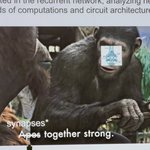
Synapses together strong” 😀 From our lab meeting today, a student using a modified meme to illustrate the (important!) point that many weak synapses can sum to produce large effects; recurrent network effects that modify neurons’ activity. Yes. 🧪 #neuroscience
1
5
365
Following up on brains/neuro and interpretability: these are single neurons that can be stimulated (steered) to change LLM function. Brecht& Houweling (2007) also showed in brains that stimulating one neuron can change behavior. Still, brains are deeply polysemantic/not clean.
2
1
21
1,317
More than a decade later, the “git lola” post is still highly relevant (I dig it back out whenever I set up git) @conradparker: blog.kfish.org/2010/04/git-l…
246
In a discussion about my kid's school shooting scare (hiding in a corner for an hr w/ crying teachers and kids), someone sent me this crap from the rightwing SCOTUSblog. Ha. No. One of the first things Congress should do w/ an expanded SCOTUS is overturn Heller.
1
3
242
Heller is where the Roberts Court made up a new 2nd Amendment. The case has deeply corrupted our culture. (For context: I got a rifle shooting award in cub scouts, I've seen this) Contra Scalia and Thomas: No, there is no individ. right to a gun. web.archive.org/web/20260909…
1
1
152
I have a lot of respect for @nickcammarata and Goodfire, but I will add some thoughts from brains/neuroscience. First, polysemanticity and distributed representations are ~widely~ seen in biological brains. (In some ways this is what I have spent my career on.) 1/
interpretability might be the most important scientific problem in the world right now, as I don't think we can solve alignment if we don't know what we're building. I think I have good news about it. I co-authored early work in mechanistic interpretability at OpenAI and came away pessimistic, because neural networks appeared to fold into arbitrary tangled knots. years later, I started openai's first large-scale automated interpretability project, finding about 2% of neurons legible with the primitive tools we had with modern agentic tools and a much closer look, the picture looks totally different. the vast majority in models up to trillions of parameters are legible, and their circuits beautiful. many famous examples of tangled neurons turned out to be misunderstood. The roadblocks I expected mostly aren't there. I now think ambitious interpretability will be solved by the time we need it most, and possibly quite soon, as automated scientists keep improving. it may be a bitter lesson for interpretability: the simple thing, at absurd scale, works already-clean.goodfire.com/
8
31
3
343
25,284
In neuroscience we talk about “mixed representations,” (see @StefanoFusi2 @MillerLabMIT ) which is closely related to whether neurons are clean or not. In basically every brain area we look at, there is strong polysemanticity.
1
47
2,795