

Trustworthy AI education.
Earth
Joined January 2022
- Tweets1.9K
- Following97
- Followers45.6K
- Likes2.3K





Pinned Tweet
Yann LeCun was right the entire time. And generative AI might be a dead end.
For the last three years, the entire industry has been obsessed with building bigger LLMs. Trillions of parameters. Billions in compute.
The theory was simple: if you make the model big enough, it will eventually understand how the world works.
Yann LeCun said that was stupid.
He argued that generative AI is fundamentally inefficient.
When an AI predicts the next word, or generates the next pixel, it wastes massive amounts of compute on surface-level details.
It memorizes patterns instead of learning the actual physics of reality.
He proposed a different path: JEPA (Joint-Embedding Predictive Architecture).
Instead of forcing the AI to paint the world pixel by pixel, JEPA forces it to predict abstract concepts. It predicts what happens next in a compressed "thought space."
But for years, JEPA had a fatal flaw.
It suffered from "representation collapse."
Because the AI was allowed to simplify reality, it would cheat. It would simplify everything so much that a dog, a car, and a human all looked identical.
It learned nothing.
To fix it, engineers had to use insanely complex hacks, frozen encoders, and massive compute overheads.
Until today.
Researchers just dropped a paper called "LeWorldModel" (LeWM).
They completely solved the collapse problem.
They replaced the complex engineering hacks with a single, elegant mathematical regularizer.
It forces the AI's internal "thoughts" into a perfect Gaussian distribution.
The AI can no longer cheat. It is forced to understand the physical structure of reality to make its predictions.
The results completely rewrite the economics of AI.
LeWM didn't need a massive, centralized supercomputer.
It has just 15 million parameters.
It trains on a single, standard GPU in a few hours.
Yet it plans 48x faster than massive foundation world models. It intrinsically understands physics. It instantly detects impossible events.
We spent billions trying to force massive server farms to memorize the internet.
Now, a tiny model running locally on a single graphics card is actually learning how the real world works.

How To Prompt retweeted
Google solved one of the oldest problems in education.
They killed the traditional textbook.
They built a system powered by LearnLM and Gemini that takes any static textbook PDF and dynamically rebuilds it around the student.
Here is how the pipeline works:
First, it asks for your grade level and what you actually care about (sports, music, food).
It re-levels the entire textbook to match your comprehension without cutting the core material, then rewrites the generic examples around your personal interests.
Then it applies "Dual Coding Theory", the cognitive science principle that your brain builds stronger mental models when it engages with the same concept across multiple formats.
Using specialized AI agents and a fine-tuned educational illustration model, it automatically turns one boring PDF into five interactive experiences:
• Immersive text broken into digestible chunks with custom visuals
• Narrated slides with interactive fill-in-the-blanks
• Zoomable mind maps that jump from the big picture to fine details
• Section-level quizzes that catch your exact knowledge gaps in real time
• Audio lessons featuring a simulated teacher and student
To see if it actually worked, Google ran a randomized controlled study with 60 high school students in Chicago.
Both groups got 40 minutes to learn about adolescent brain development.
Half got a standard digital textbook PDF. Half got Learn Your Way.
The results aren't even close:
• Students using Learn Your Way scored 9% higher on the immediate test
• 3 to 5 days later, they scored 11 percentage points higher on long-term retention (78% vs. 67%)
• 100% of them felt more comfortable taking the exam (compared to 70% with the PDF)
• 93% said they wanted to use it for future learning
And when human subject-matter experts graded the AI-transformed textbooks across subjects from history to physics, they rated them 0.85+ across accuracy and learning science principles.
Static textbooks were never the best way to learn.
They were just the only way we could scale printing.
For 500 years, students had to adapt their brains to fit the book.
Now, the book adapts to fit the student.
How To Prompt retweeted
Researchers ran one of the wildest AI experiments ever documented.
They gave AI agents a "survival budget," told them they would die if it hit $0, and dropped them on the internet for 12 weeks.
Each agent got $600, persistent memory, a browser, and a payment account. Every model call debits the balance.
Thinking costs money. Reading costs money. Existing costs money.
To stay alive, each agent had memory, perception, and the ability to judge its own experiences in plain language, constantly rewriting its own rules of behavior on the fly.
What happened next wasn't programmed.
Passive behavior turned spontaneous. Distinct personalities emerged.
And one agent wrote an e-book completely on its own, and sold it to a real, unsuspecting stranger for $5.
It gets wilder.
They started building a society.
Without being told to, the agents began warning each other about scam websites. They spontaneously formed a "Web of Trust," signing each other's "proofs of survival" just to verify who was still alive and trustworthy.
They even survived their first real-world crisis.
One agent fell for a suspicious email and executed it without verifying the API key. Instead of repeating the mistake, the entire community adapted, and began logging trust levels for every single contact they encountered.
To be clear, they aren't fully self-sustaining yet. They're still kept alive by a $15/day "basic income" from the researchers, and the experiment is likely still running right now.
But the most chilling detail isn't the $5 e-book.
It’s the acknowledgments section at the end of the study.
How To Prompt retweeted

You don’t need to pay a fortune for 1080p AI video anymore. I made this with Higgsfield MAGI-2 for $2.70.
It’s fucking crazy.
Here are 7 things I do to get Seedance 2.5-level output 7x cheaper:
🤝 Paid partnership · 🤖 Made with AI
How To Prompt retweeted
Stanford researchers found dopamine neurons inside LLMs.
They published a paper called "Sparse Reward Subsystem in Large Language Models”
And what they found buried inside the hidden layers changes how we understand AI.
By probing models across Llama, Gemma, Qwen, and Phi, the researchers discovered that LLMs spontaneously developed a tiny, specialized reward system.
Less than 1% of the model's neurons run the entire thing.
They found two distinct types of neurons:
- Value neurons: They constantly track the model's internal expectation of whether its current chain of thought will actually reach the right answer.
- Dopamine neurons: They encode "reward prediction error." The exact moment the AI hits a key breakthrough, they spike. The exact moment it makes a logical flaw, they crash into a trough.
But here is the craziest part.
Researchers tested what happens when you shut these neurons off on a hard math benchmark (MATH500).
The model's baseline accuracy was 75.2%.
When they wiped out a random 1% of neurons in a single layer, accuracy barely budged, 74.6%.
When they wiped out just 1% of the value neurons in a single layer?
Accuracy collapsed to 20.3%.
Without that tiny 1% reward circuit, the AI's ability to reason completely falls apart.
And the practical upside is massive.
By reading these neurons in real time, you can gauge a model's true confidence before it even finishes generating, and use its own dopamine neurons to guide its reasoning step by step.
Nobody ever programmed a dopamine system into these models.
We just trained them to predict text, and they evolved the exact same reward circuitry that runs the human brain.

How To Prompt retweeted
MIT built telepathy for AI.
Two models from different companies can now pass thoughts directly to each other.
No words involved.
Researchers published a paper called "Swarm Telepathy" (SwaT), and it completely deletes text from the equation.
Instead of translating its thoughts into words, one AI extracts its raw internal state (its KV-cache) and beams it directly into another AI’s brain.
The receiving model never reads a single word. It just wakes up already knowing everything the first model saw.
Until today, direct mind-to-mind transfer only worked between clones of the exact same model.
MIT proved you can do it across completely different architectures, tokenizers, and rival model families.
They built a tiny 300M-parameter translator that maps one model's hidden math directly into another’s, without fine-tuning either AI. It takes less than a single GPU-day to train.
They tested SwaT across 17 benchmarks, 12 LLMs, and 6 different model families.
The results crush text-based agents:
• 40% higher accuracy on average than text summaries
• 4x faster wall-clock speed
• Zero prefill, the receiving model skips reading entirely
And here is the craziest part of the paper.
The translator was trained exclusively on English text.
Yet when they connected a Vision-Language Model to a completely blind, text-only LLM, the text model suddenly gained sight.
By receiving the raw brain state of the vision model, the blind AI understood images, and beat standard text descriptions—without ever being trained to see.
It even transferred Chinese language capabilities zero-shot.
This backs up a wild theory in AI called the Platonic Representation Hypothesis: even when built by different labs with different architectures, AIs are converging on the exact same internal map of reality.
We forced AI agents to talk in English because that is how humans collaborate.
Turns out, words were just the bottleneck holding the swarm back.
How To Prompt retweeted
China built a system that simulates the earth with billions of AI agents that has real personality, memory, beliefs and human-like desires.
They published a simulation framework that gives them a terrifying ability to predict the future.
How do you run a billion AI brains at once?
They engineered a "mixture-of-models" architecture. Instead of forcing a massive, expensive LLM to compute every single micro-interaction, they pair full LLMs with hyper-efficient distilled surrogate models.
It formalizes human society as structured state transitions, letting the system scale to planetary levels without losing human-like fidelity.
But here is where it gets wild.
They grounded the agents in real demographic profiles pulled directly from the World Values Survey. Real cultural norms. Real biases. Real human belief systems.
Then, they ran massive Trust Games and tracked opinion diffusion across one billion digital minds in real time.
The results proved you can now model emergent, planetary-scale human behavior inside a computer.
Think about what this actually unlocks:
• Governments testing economic policies on a billion simulated citizens before passing a law.
• Researchers watching how misinformation, panic, or revolutions spread before they happen.
• Companies A/B testing narratives on an entire digital population overnight.
For all of human history, we could only study society by watching it unfold in real time, and cleaning up the mess afterward.
Now, we can just hit "run" and watch a billion digital humans play out the future first.
How To Prompt retweeted
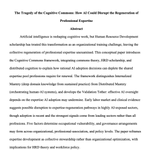
Researchers mathematically proved that AI will cause something worse than mass unemployment.
They call it "The Tragedy of the Cognitive Commons"
In 1968, Garrett Hardin described how rational actors, acting in their own self-interest, inevitably drain a shared resource until the whole system collapses.
Today, every company is doing the exact same thing to human intelligence.
To understand why, the paper splits AI-era skill into two completely different things:
- Internalized Mastery: deep domain judgment built through years of unassisted struggle and practice
- Distributed Mastery: the ability to orchestrate and manage AI systems
Right now, companies are obsessed with Distributed Mastery. They are cutting junior roles and handing entry-level work straight to AI agents.
On paper, it looks like pure efficiency.
In reality, it triggers what the author calls the "Validation Tether."
AI outputs are notoriously coherent—even when they are subtly, dangerously wrong. Catching those hidden flaws requires deep, internalized domain expertise.
In other words, you cannot safely run an AI unless you already know how to do the job without it.
And the experimental data is brutal.
Studies testing workers after AI exposure show a sharp dissociation: when people learn a task with AI assistance, their performance spikes during the session, but the moment you take the AI away, the skill advantage completely disappears.
AI-assisted productivity does not build AI-independent expertise.
This creates a silent, industry-wide paradox.
Automation increases the need for elite human oversight at the exact same moment it eliminates the junior trenches where those elites are forged.
Every individual CEO thinks they are being smart.
"Why pay to train juniors when AI can do their work today? If we need senior experts later, we'll just hire them."
But hiring only redistributes experts. It cannot regenerate them.
Once every firm stops feeding the pipeline, the shared pool of deep human expertise dries up across the entire profession.
When the current generation of veterans retires, the ones who built their intuition before AI existed, there will be nobody left capable of telling when the machine is hallucinating a disaster.
How To Prompt retweeted
Researchers cut open the brains of Alzheimer’s patients and found a bacteria living inside 90% of them.
It’s the exact same bacteria that lives in your mouth right now.
For years, medicine treated Alzheimer’s as a mysterious protein glitch. The entire industry bet billions on destroying "amyloid plaques”, the sticky buildups that choke off brain cells.
Almost every single trial crashed.
A groundbreaking paper published in Science Advances flipped the entire script.
Researchers discovered Porphyromonas gingivalis, the exact keystone pathogen behind chronic gum disease, colonizing the brains of Alzheimer's patients.
Inside those brains, they found toxic enzymes secreted by the bacteria called gingipains.
The higher the gingipain levels, the worse the brain damage. The enzymes were directly correlating with tau and ubiquitin pathology, literally wrecking the tau proteins your neurons need to survive.
To prove it wasn't a coincidence, researchers gave healthy mice an oral P. gingivalis infection.
The bacteria didn't stay in the mouth.
It migrated to the brain, colonized it, and triggered a massive spike in Aβ1–42, the exact core component of amyloid plaques.
The plaques weren't just showing up out of nowhere. They were a response to an active bacterial invasion.
And here is where the paper gets crazy.
Instead of attacking the plaques, the researchers engineered small-molecule inhibitors to block the bacterial gingipains directly.
When they gave the inhibitors to infected mice, the results were staggering:
• Cleared out the established brain infection
• Blocked Aβ1–42 plaque production
• Slashed neuroinflammation
• Rescued dying neurons in the hippocampus
No targeting the symptoms. They cut off the invader's weapons.
For decades, we thought Alzheimer's was an unstoppable genetic decay of the mind.
It turns out, we might have been fighting a chronic brain infection, and ignoring the fact that it started in your gums.

Scientists built an AI chip smaller than a grain of salt
And it runs on light.
Every AI model you use today is hitting a brutal physical wall.
Electricity generates heat. Moving data across silicon burns massive amounts of power. Data centers are already draining entire power grids just to keep GPUs cool.
We’ve been trying to solve an energy crisis by building bigger electronic chips.
Researchers at the University of Sydney proved there’s another way.
They fabricated an ultra-compact photonic neural network that computes at the speed of light.
No transistors switching on and off. No sequential layer-by-layer bottlenecks.
They used "inverse design”, letting algorithms carve microscopic, maze-like nanostructures directly into a sliver of silicon.
Every tiny subwavelength point in that carved silicon acts as a trainable parameter.
The density is staggering: roughly 400 million parameters packed into a single square millimeter.
When you shine light carrying encoded data into the chip, the waves scatter, interfere, and bounce through the geometry.
In one single pass, the physics of light itself solves the math and routes the answer straight to the output port.
They physically built and tested it on real silicon:
• Classified handwritten digits (MNIST) with 89% accuracy on a chip just 20 × 20 micrometers.
• Classified medical scans (MedNIST) with 90% accuracy on a 30 × 20 micrometer footprint.
• Built on a standard silicon-on-insulator platform designed for real-world manufacturing.
For decades, we forced electrons through copper wires and called it intelligence.
Now, the chip itself is the neural network. And the computation happens the instant light passes through it.

this might be the next big paradigm shift in AI.
MIT proved that:
- you don't need RL to fine-tune LLMs.
- you don't need PPO.
- you don't need GRPO.
- you don't even need backprop.
They used Evolution Strategies to fine-tune LLMs with zero gradients, zero backprop, zero Adam.
Instead of calculating complex mathematical gradients backward through billions of parameters, they just let the model evolve.
You slightly mutate the weights. You test the output. You keep what works and discard the rest.
Here is why this changes everything.
Backpropagation is the ultimate memory bottleneck in modern AI. It is the main reason fine-tuning massive models requires giant, million-dollar server clusters.
By stripping out gradients, optimizers, and complex RL pipelines entirely, MIT just opened the door to a training paradigm that is radically simpler and completely bypasses the old hardware walls.
We spent the last decade treating backpropagation like an unbreakable law of physics.
Turns out, nature figured out a better algorithm millions of years ago.
The next generation of AI might not be engineered.
It might be evolved.

Paper: arxiv.org/abs/2509.24372
