

Our group at @LMU_Muenchen and @MPI_Biochem uses DNA nanotechnology to develop next-generation super-resolution microscopy techniques. #DNAPAINT
Munich, Germany
Joined May 2023
- Tweets153
- Following56
- Followers1K
- Likes127
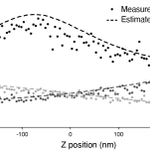

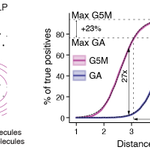

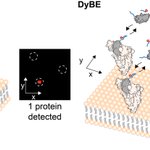


In DNA-PAINT, nearby proteins create overlapping localizations. You may see two by eye, but analysis often misses them, wasting precious precision. G5M solves this. Now in @NatureComms: doi.org/10.1038/s41467-026-7… 1/7


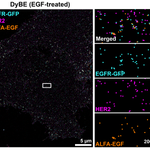
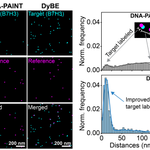
Up to 15-fold improvement in protein labeling for DNA-PAINT 🧬🔬. We are excited to present our latest work published in @angew_chem! onlinelibrary.wiley.com/doi/…


Highly efficient 12-color multiplexing with speed-optimized DNA-PAINT. We are excited to share our latest publication in @NatureComms, using left-handed DNA to extend speed-optimized DNA-PAINT to 12 targets in a simple and straightforward way! 🧬👈🚀nature.com/articles/s41467-0…

Ever wondered what happens when therapeutic antibodies bind to cancer cells? In our latest study, we used multiplexed 3D-RESI to directly visualize how anti-CD20 antibodies interact with their receptors, revealing their precise arrangement at single-protein resolution. (1/6)


We're excited that the study is now out in Nature Nanotechnology @NatureNano nature.com/articles/s41565-0…


ÅNGSTRÖM-RESOLUTION IMAGING OF CELL-SURFACE GLYCANS 🧬🎨🍬
The glycocalyx, our cells' sugar coat, holds secrets in immunology, cancer, viral infections, and more. Visualizing its molecular architecture was impossible… until now. #glycotime #microscopy
biorxiv.org/content/10.1101/…

Spatial and stoichiometric in situ analysis of biomolecular oligomerization at single-protein resolution
We are excited to present our latest work published in @NatureComms
nature.com/articles/s41467-0…

Are you struggling to achieve high multiplexing at single-protein resolution and the methods section of publications leaves you puzzled? Look no further! We present our SUM-PAINT spatial proteomic imaging protocol, now published in STAR Protocols. star-protocols.cell.com/prot…

ÅNGSTRÖM-RESOLUTION IMAGING OF CELL-SURFACE GLYCANS 🧬🎨🍬
The glycocalyx, our cells' sugar coat, holds secrets in immunology, cancer, viral infections, and more. Visualizing its molecular architecture was impossible… until now. #glycotime #microscopy
biorxiv.org/content/10.1101/…

What makes for a great DNA-PAINT experiment? How does the fluorescent dye affect the image quality? And how can we use this to extract the most out of our samples?
Check out our paper in @NatureMethods to see what state-of-the-art DNA-PAINT can do for you!
doi.org/10.1038/s41592-024-0…

Exciting news! Our work "Quantification of absolute labeling efficiency at the single-protein level" is out in @NatureMethods. Great effort led by Joschka Hellmeier and Sebastian Strauss, molecular-resolution quantification of labeling efficiency.
1/7
nature.com/articles/s41592-0…
30-COLOR DNA-PAINT at 3D sub-15 nm RESOLUTION. We are overly excited to announce the publication of our latest work “Spatial proteomics in neurons at single-protein resolution” in @CellCellPress. Huge collaborative effort led by @EduardUnterauer. 1/9
cell.com/cell/fulltext/S0092…

Excited to have RESI (nature.com/articles/s41586-0…) featured as part of the "Seven Technologies to Watch in 2024" in @Nature


Advances in artificial intelligence are at the heart of many of this year’s most exciting areas of technological innovation go.nature.com/48Zri0o
Check out our recent work “Comparing divisome organization between vegetative and sporulating Bacillus subtilis at the nanoscale using DNA-PAINT” in @ScienceAdvances
#DNAPAINT @kimbercram @SusanneReinhar3
science.org/doi/10.1126/scia…
Big congrats to Luciano @l_masu for being awarded the 2023 "Rising Stars of Light Award" in the "Before Faculty Track category" by @LightSciAppl. Very well deserved!!!

Big congrats to @SusanneReinhar3 and @PhilippSteen for winning the Student Award at this year’s PicoQuant single molecule workshop #WS28. Terrific job, very proud of both of you!!!


Spatial proteomics in neurons at single-protein resolution biorxiv.org/content/10.1101/…
2
301