

The Migration Observatory at the University of Oxford provides independent, authoritative, evidence-based analysis on UK migration. Based at @COMPAS_oxford
Oxford
Joined November 2010
- Tweets7.1K
- Following531
- Followers30.9K
- Likes206


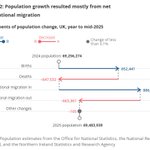



Net migration down to 77,000 - a massive shift in just three years, and there may be further to fall. Does it matter to UK public finances? Possibly, but "bums on seats" is much less important than the characteristics of people arriving/leaving.

We are honoured to host the UK launch of the @OECD’s 2026 International Migration Outlook (IMO). The IMO is one of the cornerstones of global migration analysis, providing the most recent insights on global trends and their implications in OECD countries.
Panelists will include @OECD's Mark Pearson, @MigObs' own @M_Sumption, and @instituteforgov's @jillongovt. It will be chaired by @MigObs' Rob McNeil.
Register now to tune in online on 12 November at 12:30 – 1:30 (GMT): meetoecd1.zoom.us/webinar/re…

The EU Commission has asked member states to wait until after the November summit to pursue lower tuition fees for EU students at UK unis, according to the FT.
Instead, the UK would be asked to commit to reaching an agreement on fees within 6 months.
ft.com/content/47777033-6a91…

In the year ending June 2026, 157,000 work visas were granted, less than half the number granted in 2023.
Our updated work visas briefing looks at the routes work migrants used to come to the UK, the jobs they do once they're here, and how many stay.


Why are more people applying for British citizenship than ever before?
Our updated briefing explores how many citizenship applications have been made and granted, who is more likely to naturalise, and some possible reasons for the recent rise. Check it out 👉
migrationobservatory.ox.ac.u…
3
470

This month, small boat arrivals reached their lowest level since December 2021. There were 27,900 arrivals in the last year.
In our new commentary, we explore why arrivals have fallen, including how much of the decline may be due to policy.
migrationobservatory.ox.ac.u…

The event of the year is back on Thursday 10th December!
The Migration Statistics User Forum is your opportunity to find out what ONS, Home Office and other government data teams are planning on migration, and to tell them what stats you need.
eventbrite.co.uk/e/migration…


Our Director Madeleine Sumption joins @HelenMiller_IFS and @MaxWarnerIFS to discuss how immigration affects the public finances, and what falling net migration could mean for the UK economy. Check it out 👉 ifs.org.uk/articles/how-does…

Small boat arrivals reached the lowest level since December 2021 today. There were 27,900 arrivals in the last 365 days.
So far in 2026, arrivals are down by 47% compared to the same period of 2025. We explore why in our commentary:
migrationobservatory.ox.ac.u…
UPDATED BRIEFING: Public opinion has become less supportive of immigration recently, but the picture is nuanced, and the UK is still more positive than many European neighbours
UK Public Opinion toward Immigration: Overall Attitudes and Level of Concern migrationobservatory.ox.ac.u…


📊New migration stats: asylum applications are down, while UK citizenship applications hit a record high. 315,000+ applied in the year to June 2026 (+17%). Non-EU nationals drove the numbers, but growth was sharper among EU nationals. Read our full analysis migrationobservatory.ox.ac.u…
2
658
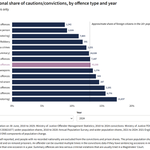
See the briefing for more on what the data can – and can’t – tell us about migration and crime.
migrationobservatory.ox.ac.u…

The government does not publish data on the share of foreign national offenders (FNOs) who are deported.
However, the number of FNOs living in the community has increased over the past decade, suggesting that returns have not kept pace with prison releases.

Non-citizens are less likely to receive bail than citizens and so are overrepresented in the population of people on remand awaiting trial. Around 25% of non-citizens in prisons had not yet been tried, compared to 11% of British citizens.

1
332
Non-citizens were more likely to be convicted or incarcerated for drug offences and less likely for violent offences than British citizens
The picture is more complicated for sexual offences—they are overrepresented among convictions but underrepresented in the prison population

3
431
