Powered by data, driven by discovery, made for everyone.
- Tweets20.8K
- Following84
- Followers1.3M
- Likes12.2K





ALT NASA's Cassini spacecraft captures a golden, crescent-shaped Titan against black space, with a smaller, partially illuminated, cratered moon appearing above and to the right.

ALT A grid of 20 images captured by ESA's Huygens probe during its descent through Titan's atmosphere shows the moon's orange-brown landscape from progressively lower altitudes, revealing ridges, valleys, and surface features.

ALT Three side-by-side satellite images show a patchwork of agricultural fields in Maryland’s Eastern Shore, bordered by winding waterways and forested areas. The fields shift from mostly light tan and beige in the first two images to predominantly green in the third. A north arrow and 2-mile scale bar appear in the lower-left corner.

ALT A smiling astronaut wearing a dark green shirt holds a taco filled with food and green vegetables inside the International Space Station. Equipment, storage compartments, and spacecraft hardware are visible in the background.


ALT Artist’s concept of a fission power system on the Moon. Credit: NASA


ALT CSA (Canadian Space Agency) astronaut and Expedition 75 flight engineer Joshua Kutryk processes bacterial colonies for DNA extraction and purification aboard the International Space Station's Harmony module. Genetic analysis of antibiotic resistant microbes may show how they adapt to microgravity and inform measures to protect astronauts on future long-duration missions. Credit: NASA/Anil Menon



ALT A portrait of Dr. Aimee Schechter, the Artifact Inspector project logo, and a starburst captured by a space telescope


ALT Satellite imagery viewd using the Global Imagery Browse Service (GIBS) in ArcGIS Pro.

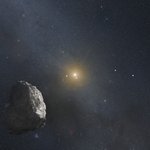
ALT This is an artist's impression of a Kuiper Belt object (KBO), located on the outer rim of our solar system at a staggering distance of 4 billion miles from the Sun. The Sun appears as a bright star at image center in this graphic, which represents the view from the KBO. The Earth and other inner planets are too close to the Sun to be seen in this illustration. The bright "star" to the left of the Sun is the planet Jupiter, and the bright object below the Sun is the planet Saturn. Two bright pinpoints of light to the right of the Sun, midway to the edge of the frame, are the planets Uranus and Neptune, respectively. The planet positions are plotted for late 2018 when the New Horizons probe reaches a distance of 4 billion miles from the Sun. The Milky Way appears in the background. Credit: NASA, ESA, and G. Bacon (STScI)

ALT Illustration of NASA’s Voyager spacecraft traveling through deep space above large gold text reading “ONE LIGHT DAY.” A bright red, orange, and yellow signal beam extends from the spacecraft toward the foreground, symbolizing Voyager’s radio signal reaching a distance of one light-day from Earth. The background is a dark star field with subtle light flares and cosmic details.

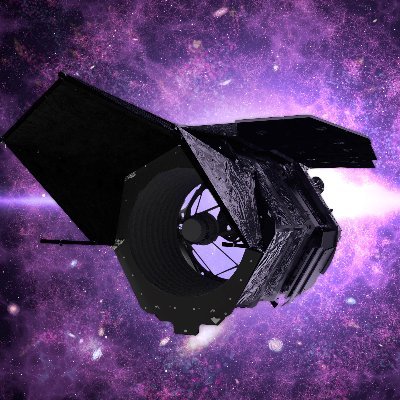

ALT Two people in head to toe white clean room suits stand in Goddard's large white clean room, staring up at Roman. Fully integrated, the telescope towers over them. Three irregular, elongated hexagon-shaped solar panels are the most striking part of Roman from this angle. The solar panels are gold with black squares covering almost their entire surface. Below the solar panels, which are several feet above the floor, the rest of the telescope is a silver cylinder, with various instruments protruding from its sides.