








ALT An illustrated diagram from the Review Article "Helicobacter pylori Infection — Advances, Challenges, and the Road Ahead" that shows culture-based and molecular-based antimicrobial-susceptibility testing for H. pylori.

ALT Four medical images from the Images in Clinical Medicine article "Acute Inflammatory Edema.” Top: Photos of the right and left legs, respectively, obtained on hospital day 3. Bottom: Photos of the right and left legs, respectively, obtained on hospital day 14.

ALT A quote from a Perspective published in the New England Journal of Medicine reads as follows: "Amid partisan attacks on the authority of the government’s scientific experts, the [Epidemic Intelligence Service's] ability to provide the data and evidence needed to guide action has been weakened." The Perspective is titled Perspective “From Cold War Politics to Hot Domestic Politics — The Epidemic Intelligence Service at 75” and the authors are Amy L. Fairchild, PhD, MPH, and James Colgrove, PhD, MPH. The text is displayed on a simple white background with a gold border. The NEJM identity sits at the bottom.

ALT This image, titled "Figure 1. Immunopathogenesis and Vascular Remodeling in Giant-Cell Arteritis," is a diagram consisting of three sections labeled A, B, and C. Section A illustrates genetic and age-related susceptibility factors, including HLA class II and specific gene variants. Section B shows immune dysregulation with a schematic of a cross section depicting immune processes within the vessel wall and highlighting the adventitia, media, intima, vasa vasorum, and lumen. Section C features representative histologic findings of giant-cell arteritis in a temporal-artery–biopsy specimen, including granulomatous inflammation, progressive wall thickening, and luminal narrowing.

ALT A bar chart from an Original Article published in the New England Journal of Medicine article titled "Blood-Pressure–Lowering Treatment across the Cardiovascular Risk Spectrum." The chart shows the 5-year cumulative risk of a major cardiovascular event in the intervention and comparator groups according to decile of predicted 5-year risk of a major cardiovascular event. The NEJM identity sits at the bottom.

ALT The image is a map showing the change in estimated county-level life expectancy at birth, 2000–2019.

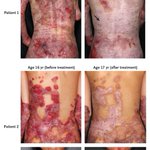
ALT The image shows a medical comparison of two patients with recessive dystrophic epidermolysis bullosa before and after treatment. The before images display severe scarring at ages 17 (Patient 1) and 16 (Patient 2). The after images, at ages 22 (Patient 1) and 17 (Patient 2), show improvement.

ALT Two medical images from the Images in Clinical Medicine article "Functional Fixed Dystonia of the Foot.” Panel A, which was taken during the physical examination, shows the left foot fixed in plantar flexion and inversion. Panel B, which was taken during a follow-up visit 6 months after the initial diagnosis, shows the patient walking normally.

ALT A person playing chess against a computer screen displaying code and a face, representing artificial intelligence.


ALT Cover of the NEJM Clinician's Journal Watch. Title: "Unexplained Infertility: IUI First or Straight to IVF?" Author: Robert L. Barbieri, M.D. Reviewing: New England Journal of Medicine. NEJM Clinician logo is at the bottom right. The background is a gradient of blue.

ALT A table shows the clinical end points at 2 years. Columns include "End Point," "NOAC Monotherapy (N = 482)," "Combination Therapy (N = 478)," and "Hazard Ratio (95% CI)." "End Point" column lists the primary end point and secondary end points. The second and third columns have the number of patients and the percentage.


ALT A blue background image features the title "GUIDELINE WATCH" in a small box at the top. Below, the text reads "November 2026" and "Congenital Cytomegalovirus: New Guidance." The NEJM Clinician logo is at bottom. The background has a subtle repeating pattern of the words "Guideline Watch.

ALT A visual representation of the LATE-MT trial, which was conducted to determine whether patients who presented 24 to 72 hours after an acute ischemic stroke from large-vessel occlusion of the anterior circulation and had salvageable brain tissue would benefit from endovascular therapy added to standard medical care.


ALT The image is a chart showing a line graph of HBV vaccination rates in newborns from January 2018 to June 2026.

ALT Four medical images from the Images in Clinical Medicine article “Cutaneous Anthrax.” Top-left: A photo of an annular, edematous, pseudobullous plaque on the dorsum of the left hand at the base of the thumb. Top-right (24 hours after presentation): Lesions progressing to large hemorrhagic bullae. Bottom-left (72 hours after presentation): The lesions rupturing. Bottom-right (1 month after completing treatment): A photo of residual scarring on the patient’s hand.

ALT Bar graph showing the percentage of patients on the Modified Rankin Scale, comparing "EVT plus Medical Management" (N=144) and "Medical Management Alone" (N=156). Scores range from 0 to 6. The distribution is labeled with percentages and number of patients for each category.

ALT A bullet list of key points from the Review Article “Acute Respiratory Distress Syndrome” on a yellow background. The New England Journal of Medicine identity sits at the bottom.