

Accelerating AI innovation with open platforms and community. The future of AI is open.
Joined May 2018
- Tweets2.7K
- Following2.1K
- Followers13K
- Likes1.8K




Pinned Tweet
Everything you need to start self-hosting an open LLM.
Run it on your own hardware. No API keys. No per-token bill. Nothing leaves your machine.
The full path with @vllm_project: batch inference in Python, an OpenAI-compatible API server in one command, and quantized models that cut an 8B from ~16GB of weights to a quarter of that while keeping 98-100% accuracy.
Walkthrough by @cedricclyburn.
Red Hat AI retweeted

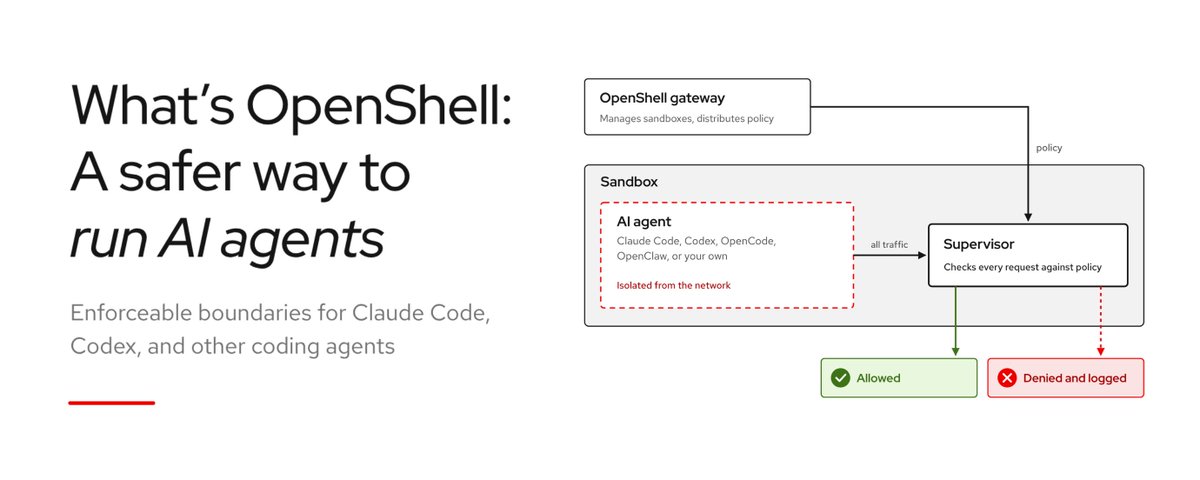
NVIDIA released OpenShell at GTC back in March, and it's now a CNCF Sandbox project! Here's a deeper dive on how it actually secures AI agents: default-deny networking, per-binary policies, and an agent that never sees your real API key 🔐
Red Hat AI retweeted

Red Hat is into make Qwen3.8 27B too
Gotta check this out

Speed up Qwen3.8-27B with our new DFlash2 speculator model.
⚡️ Up to 7 draft tokens per step
📈 4.5 avg acceptance length on HumanEval, 6.0 on Math Reasoning
🔥 Up to 2.76× output throughput vs. baseline on summarization & 2.68× on RAG (Speedbench)
Ready to deploy in vLLM 👇 huggingface.co/RedHatAI/Qwen…

🚀 Together with @inferact, we’re releasing DFlash2 for Muse Spark Open.
Over 3x throughput on SPEED-Bench coding, math, and RAG tasks, compared with serving the base model alone on the same 4×B200 GPUs.
Model, benchmarks, and deployment commands: huggingface.co/RedHatAI/Muse…

Speed up Qwen3.8-27B with our new DFlash2 speculator model.
⚡️ Up to 7 draft tokens per step
📈 4.5 avg acceptance length on HumanEval, 6.0 on Math Reasoning
🔥 Up to 2.76× output throughput vs. baseline on summarization & 2.68× on RAG (Speedbench)
Ready to deploy in vLLM 👇 huggingface.co/RedHatAI/Qwen…
Your AI governance policy is a PDF your agent can't read. asago turns it into real security tests: it maps the risks in your policy, then auto-generates prompt-injection probes for @NVIDIAAIDev's garak, tailored to your agent. Open source. Full walkthrough by @anikaaracan:
Red Hat AI retweeted

Less time tuning KV cache, more time serving models.
vLLM v0.34's extensible KV cache is on by default, using GPU virtual memory to size the cache automatically.
Thanks @RedHat_AI and @mgoin_ for the ~4-minute walkthrough!
vLLM v0.34 might retire one of its most-set flags. The new extensible KV cache uses the GPU's virtual memory API to size the cache automatically, so you may never touch gpu-memory-utilization again.
Plus 10 new models and 1,000+ commits. @mgoin_ recaps v0.34 in ~4 minutes:
Two @vllm_project office hours recordings are up.
#60: Tenstorrent on their vLLM plugin: what breaks when the device runs a step ahead of the host, and why four KV pools did not need four processes.
--> #60 video: youtube.com/watch?v=bmo4E-xN…
--> #60 Slides: docs.google.com/presentation…
#61: Speculators on six drafting algorithms, and what actually moves acceptance rates. A full Markov matrix over Qwen3.8-27B's vocabulary would be 61.663B parameters. DSpark does it in a 1.988B drafter.
--> #61 Video: youtube.com/watch?v=yV6Wb9mD…
--> #61 Slides: docs.google.com/presentation…
vLLM v0.34 might retire one of its most-set flags. The new extensible KV cache uses the GPU's virtual memory API to size the cache automatically, so you may never touch gpu-memory-utilization again.
Plus 10 new models and 1,000+ commits. @mgoin_ recaps v0.34 in ~4 minutes:

vLLM v0.34.0 is live! 🚀
1,061 commits · 412 contributors
🤖 10 new models
🗄️ Extensible KV cache on by default
🏃 Model Runner V2 is now the only GPU runner
⚡ Up to 1.95× faster Step5 NVFP4 decode on 4× GB200
⚠️ Upgrade notes
github.com/vllm-project/vllm…

Red Hat AI retweeted

manually writing thousands of adversarial tests for every ai policy clause takes months. asago, a new open-source project, automates risk mapping, scenario generation, and red-teaming loops for production agents. take a read and let me know what you think! sprou.tt/19VWJFGMtX0

Happening today at 2PM ET / 11AM ET.
What actually moves speculator acceptance rates? Algorithm choice, data, epochs, loss. The Speculators core maintainers from Red Hat break it down at this week's @vllm_project Office Hours, alongside the latest vLLM release recap by @mgoin_.
November 19 | 2PM ET
Register: vllm.ai/office-hours

9
783
Red Hat AI retweeted
What actually moves speculator acceptance rates? Algorithm choice, data, epochs, loss. The Speculators core maintainers from Red Hat break it down at this week's @vllm_project Office Hours, alongside the latest vLLM release recap by @mgoin_.
November 19 | 2PM ET
Register: vllm.ai/office-hours
Red Hat AI retweeted

How do we configure an inference stack with llm-d, KServe, Envoy, and vLLM?
Try it yourself: alexagriffith.github.io/llm-…
Red Hat AI retweeted
vLLM v0.34.0 is live! 🚀
1,061 commits · 412 contributors
🤖 10 new models
🗄️ Extensible KV cache on by default
🏃 Model Runner V2 is now the only GPU runner
⚡ Up to 1.95× faster Step5 NVFP4 decode on 4× GB200
⚠️ Upgrade notes
github.com/vllm-project/vllm…
What actually moves speculator acceptance rates? Algorithm choice, data, epochs, loss. The Speculators core maintainers from Red Hat break it down at this week's @vllm_project Office Hours, alongside the latest vLLM release recap by @mgoin_.
November 19 | 2PM ET
Register: vllm.ai/office-hours
Until now, there's been no automated way to check that an AI agent actually follows your governance policy. That check usually takes months of manual work. asago closes that gap. It doesn't replace security experts, it frees them from the busywork.

Red Hat AI retweeted

We teamed up with @inferact to bring you an even faster speculator for Kimi K3.1 Pro.
vLLM serve and enjoy!
And as usual, the model card has evaluation benchmarks as far as the eye can see.

More accepted tokens. Bounded draft KV memory. 🔥
The new DSpark for @Kimi_Moonshot’s Kimi K3.1 Pro, jointly developed by @Inferact and the @RedHat_AI Speculators team with vLLM + Speculators, brings:
• Up to 30% higher acceptance length vs. the preview (HumanEval).
• A 2K sliding window in every draft layer, keeping draft KV memory bounded even at 1M-token context.
Efficient draft architectures need an inference stack that can serve them. vLLM’s redesigned KV management supports P/D disaggregation and different parallelism configurations, bringing sliding-window draft models into production.
Comparison: DSpark k=7, temperature 1.0, top_p 0.95. Acceptance length includes the bonus token.
Weights + vLLM config below. 👇

Red Hat AI retweeted
Weights + ready-to-use vLLM configuration on Hugging Face:
huggingface.co/Inferact/Kimi…

Red Hat AI retweeted
More accepted tokens. Bounded draft KV memory. 🔥
The new DSpark for @Kimi_Moonshot’s Kimi K3.1 Pro, jointly developed by @Inferact and the @RedHat_AI Speculators team with vLLM + Speculators, brings:
• Up to 30% higher acceptance length vs. the preview (HumanEval).
• A 2K sliding window in every draft layer, keeping draft KV memory bounded even at 1M-token context.
Efficient draft architectures need an inference stack that can serve them. vLLM’s redesigned KV management supports P/D disaggregation and different parallelism configurations, bringing sliding-window draft models into production.
Comparison: DSpark k=7, temperature 1.0, top_p 0.95. Acceptance length includes the bonus token.
Weights + vLLM config below. 👇
Red Hat ran its own engineering org on open weights as customer zero. What the EnMaaS pilot (Praxis gateway + llm-d + vLLM) showed:
-> Scale: more than 1 trillion tokens processed in a single 30-day window.
-> Adoption: give developers frictionless access and they take it. Usage started 70/30 in favor of commercial frontier APIs and flipped to 30/70 toward internally hosted open weight models, with open weights gaining share every day.
-> Workload: Praxis intelligently routed the majority of routine coding and evaluation traffic away from external APIs to hosted open weight models.
-> Cost: shifting that traffic from frontier to self-hosted models on llm-d cut effective token spend 40 to 70% vs prior frontier pricing, depending on prompt caching and routing.
Here's how we did it:
redhat.com/en/blog/EnMaaS-Re…

Inference performance isn't one knob. It's parallelism, scheduling, KV cache offloading, and prefill/decode disaggregation, and when each actually pays off.
Tyler Michael Smith (vLLM core maintainer) and Yuchen Fama break it down live Nov 18, 2pm ET:
redhat.com/en/events/webinar…