

🚀Hands on science tools fueling curiosity and empowering educators🚀 Also join us for Science is Cool, a free all-day virtual science conferences
- Tweets3.8K
- Following1.7K
- Followers2.8K
- Likes3.8K








ALT Orange quote card for Science is Cool Unplugged. Quote: "Just getting an answer is so seductive because it doesn't take all that hard mental effort. People don't learn from it. They think they learn from it." – Dr. Carl Wieman. Listen to the conversation.

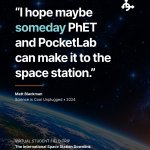
ALT A quote over a starry sky above Earth’s curved horizon reads: “I hope maybe someday PhET and PocketLab can make it to the space station.” Attributed to Matt Blackman, Science is Cool Unplugged, 2024. Below: “Virtual Student Field Trip: The International Space Station Downlink, Spring 2027.”

ALT View from inside the International Space Station’s Cupola, looking through its windows at Earth’s blue oceans and clouds. Text reads: “Start with a question. One classroom investigation. A whole new perspective.” Science Is Cool and PocketLab logos at the top.

ALT PocketLab Voyager, a small orange-and-white sensor, floats above Earth against a star-filled background. Text reads, “Meet Voyager. Small sensor. Big questions.” Science is Cool and PocketLab logos appear at the top.

ALT An orange-and-white PocketLab Voyager sensor rests on a circular rotating platform on a wooden table. A hand touches the platform, and yellow curved arrows indicate rotation. Text reads, “Give it a spin. Explore rotation. See how objects turn.”

ALT PocketLab Voyager is mounted on a small black four-wheeled car on a wooden table. A hand touches the rear wheel, and orange motion streaks appear beside the car. Text reads, “One push. What happens next? Measure acceleration. Investigate changes in motion.”

ALT PocketLab Voyager sits beside an open laptop displaying PocketLab Notebook. The screen shows red displacement and velocity graphs from a roller coaster investigation. Text reads, “From prediction to evidence. Explore data in PocketLab Notebook. Observe, compare and investigate.”

ALT Science is Cool and PocketLab promotional graphic featuring a star-filled sky, Earth, the International Space Station, an orange-and-white PocketLab Voyager sensor and a rocket launching on the right. Large white and orange text reads, “Next stop, space.” Turquoise text reads, “You’re part of the mission.” Additional text announces PocketLab Voyager’s journey to the International Space Station, a scheduled launch on November 29 and “Follow the mission.”


