

Building @agentrunai, @GrepdotAI (YC F26). Prev Product @compound, @brexhq, @coinbase, @google. 2x @ycombinator founder, @uniofoxford. Dad of twins.
San Francisco
Joined January 2008
- Tweets3.4K
- Following1.4K
- Followers4.3K
- Likes2.6K




Pinned Tweet
Don't get locked into a lab or hyperscaler platform when the best model/harness changes every week.
AgentRun is the open-source agent operating system for building, managing, and running your agents. It works with any harness, any model, any compute.
SET YOUR AGENTS FREE.
You can now run your agents on Goose, Cursor or OpenCode in @agentrunai, next to pi, Claude Code and Codex.
Every run gets the same tool approvals, crash recovery and console. Goose and Cursor install with one command.


Head to agentrun.ai to learn more
Or check out the repo: github.com/Parcha-ai/agentru…

You can now run agents on Particle-1 through Particle's own API. Save your particle AI key in your @agentrunai server and your agents and workflows run on it, no OpenRouter key needed.
Excited to partner with @particle_api to help users build more cost efficient agents.

ALT A Particle key sends your pi agentic runs and workflow model nodes straight to particle/particle-1, and Claude Agent, Codex and OpenCode keep running on the keys you already have.
This seems really important given the whole AI economy is built on the assumption of Jevon’s paradox.
Thoughts on why it’s breaking:
- we’ve saturated early adopter usage in coding.
- we’re still very early in non-coding usage but haven’t successfully crossed the chasm.
- real business processes are hard to transform with AI and require human plus software effort.
- human part is still not cheaper, and may even be getting more expensive (e.g. FDEs)
- BigCo AI governance is still using pre-AI playbook and can’t keep up with model / technology changing every week.

Ramp credit card spending data suggests recently Jevon’s Paradox broke for AI.
AI inference per unit of intelligence keeps coming down but usage is not spiking up accordingly of late
3
3
1,124

Tired of hitting the limits of your agents?
We are too.
Something big is coming soon from @agentrunai...
Pt 2 tomorrow.


AJ Asver retweeted
Tell your coding agent: Read agentrun.ai/SKILL.md?utm_sou… and set up AgentRun for me.
With your OK it checks cron, systemd, launchd and CI read-only for the Claude Code or Codex jobs you run. Pick one and it's your first AgentRun run, on its own sign-in.
AJ Asver retweeted

The @agentrunai team is building precisely this, an open source operating system for your agents.
I had been watching them build from the sidelines, always admiring how they're ahead of the curve on AI adoption. This is the most AI-pilled team I know.
This last week, I've had a front row seat to see the future unfold. Watching a CTO's eyes light up when he could see how he could expand his own platform with ours.
We're onboarding users 1:1. We want to build this openly, together. You can try it at github.com/Parcha-ai/agentru…. If you want help setting it up, reply or DM me. Let's go!


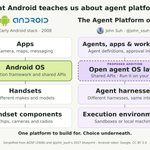
Reading @john_ssuh's blueprint made me think about where we've seen a platform like this before: Android OS.
Today it feels like we're in pre-Android / iOS era of agent platforms. Lots of different harnesses, factories, platforms each operating in their own languages with very few common interfaces on top of various different compute environments.
As it stands, the Apple version of future is what the labs are building with fully integrated platforms like Claude Managed Agents. The blueprint is a compelling alternative but for it to be successful I think we need an open platform like Android OS as a counterbalance.
Over a decade ago, I worked on the Nexus 6, a Motorola phone, and the Nexus 9, an HTC tablet. Both shipped with Android 5.0. Motorola and HTC could build very different devices without either company having to write its own operating system. The same apps could run on both.
In John’s blueprint, the compute environment is the the equivalent to the components in a handset. The harness is the handset itself. An agent is like an Android App.
The missing part is the abstraction layer in the middle.
Today, each harness has its own own interface for agents. Then as agents proliferate across a company, running different harnesses in different environments, it becomes impossible to easily build, manage and govern them. Now you add a platform on top that which is built internally or by N different managed agent vendors and you get even greater lack of interoperability. Each platform might implement a different abstraction of the agent, the compute, the model layer. Companies become locked into the platform they pick first.
Android showed us an alternative path by creating a standardized interface for apps in the smartphone world where there previously wasn't one. Android OS created a standard for OEMs to build smartphone interfaces. The Android SDK created a standard for developers to interfaces with OEM hardware like the camera, storage, wireless, and crucially the compute itself. Developers could easily target different devices with one build. The standardization then quickly replaced the other operating systems like Symbian and Windows Mobile thanks to Google’s ability to close partnerships after acquiring Android.
In 2007, before the first Android phone shipped, 34 companies formed the Open Handset Alliance. Handset makers, chipmakers, and carriers had different reasons to get involved. But at time, it must have seemed very counterintuitive to do this.
Why collaborate with competitors? Why not go full stack like Apple?
And yet they did, because each of them could get something from a shared platform that would have been harder get on their own. Whether that was distribution for Qualcomm or shipping a new kind of phone for HTC.
Android showed us that the agent platform of 2027 doesn’t have to become one company’s product. Harness authors, compute providers, and teams building agents internally can contribute adapters and compatibility tests to a shared open-source project. Then we can all build very different agents on top. All the companies using this platform would benefit from each others contributions and in return have the maximum flexibility when it comes to agent building.
The interface could be very simple at first: start an agent run, listen for events, respond when it needs a person, and read the result. Beneath this could be interfaces for any harness, compute, model etc.
@agentrunai is our attempt at this. It’s an open-source OS for agents much like Android is for smartphones. Contributors have already added support for new harnesses and compute services.
But there’s a lot we still need to build like how apps and agents interact, where brains/memory fits in, how evals work and much more.
We would love to collaborate with other harness, compute, model and agent providers and anyone else who wants to build John’s vision.
Our commitment in return is to keep improving the platform!

Agent platform of 2027.
This is the end game. This is the blueprint for the one and only application layer software that will exist. Every other software will effectively become databases for this layer, the everything agentic operating system for the million agent swarm to work on top of.
This is obviously the end game vision for the application layer of ChatGPT and Claude. I have reasons to believe that an independent company will own this product layer. But most ADE, "enterprise agent platform", or vertical saas companies, are focused on the wrong things far too narrowly, not technically competent, and do not have the product / technical vision to see this inevitable future.
The correct agent platform that wins will function like the base of a garden, from which customers will plant their unique "seeds" to grow their own plants and trees, managed and evolved by agents, humans, and signals from the sensors of the business. This presents a clearer picture than "factory of a factory" imo.


You can check out AgentRun here:
github.com/Parcha-ai/agentru…
Let us know your feedback!
2
112
This is exactly what we’re building with @agentrunai and it’s all open-sourced.
We’re building the open Agent OS. Think Android for agents and we’re getting partners on board too.
More to share soon!
Agent platform of 2027.
This is the end game. This is the blueprint for the one and only application layer software that will exist. Every other software will effectively become databases for this layer, the everything agentic operating system for the million agent swarm to work on top of.
This is obviously the end game vision for the application layer of ChatGPT and Claude. I have reasons to believe that an independent company will own this product layer. But most ADE, "enterprise agent platform", or vertical saas companies, are focused on the wrong things far too narrowly, not technically competent, and do not have the product / technical vision to see this inevitable future.
The correct agent platform that wins will function like the base of a garden, from which customers will plant their unique "seeds" to grow their own plants and trees, managed and evolved by agents, humans, and signals from the sensors of the business. This presents a clearer picture than "factory of a factory" imo.
3
5
455
AJ Asver retweeted

Pulled just one piece of @_aj AgentRun into my own custom agent harness.
Verified results: faster execution and a noticeable drop in usage.
Even a partial integration proves the system is solid and viable. Worth testing: github.com/Parcha-ai/agentru… 🚀
AJ Asver retweeted
There's zero reason to tie your agent to one environment. With @agentrunai, since the loop lives outside of the sandbox, an agent can use as many computer types as needed. From simple shells, browsers, linux / mac computers or phones. www.teapawt.net/MiguelriosEN/status/21…

I want @agentrunai to support as many sandbox / computer options for agents as possible. We wrote the Computers Protocol to make this easier: github.com/Parcha-ai/agentru….
If you want your sandboxes to be supported in AgentRun, point your coding agent to github.com/Parcha-ai/agentru… and send us a PR.
You can now connect the Claude Code and Codex agents you already run to @agentrunai, as they are, and see every run in Mission Control.
They keep their project, skills, MCP tools and sign-in. Connecting needs no model key.
Once they are connected, turn on learning and they start getting smarter after every run!