

I lead a research service for Puerto Rico bondholders. Former contributor to Reuters.
Tulsa, Oklahoma
Joined July 2008
- Tweets261K
- Following1.8K
- Followers26.4K
- Likes398K






Cate Long retweeted

Wow labor really upping its BAAJA push to House Dems. Building trades calls it a “NAFTA-scale vote”

@NABTU sees the Bipartisan American Affordability and Jobs Act (BAAJA) as a NAFTA-scale vote. We’ve spent the past 30 years seeing what happens when communities lose good jobs and investment. Workers and their families feel the effects long after the vote is over. The U.S. House of Representatives has a chance to prevent a similar decline in the American economy.
Passing meaningful permitting reform would help states and communities build the power and water systems, schools, hospitals, roads and bridges Americans depend on while creating family-sustaining jobs.
We do not take this vote lightly and strongly urge lawmakers to vote yes on BAAJA. NABTU will score this vote.

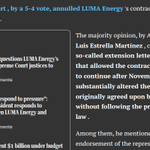
Big win for the Puerto Rico governor as the PR Supreme Court cancels LUMA Energy's ($PWR) contract. Canceling Prepa's transmission & distribution agreement was one of Governor Jenniffer González's main campaign promises #muniland.
"As part of the Supreme Court's ruling, Superior Court Judge Anthony Cuevas was appointed to oversee compliance with the transitional provisions ."
elnuevodia.com/noticias/loca…

Citigroup is weighing a return to providing banking services in Venezuela five years after the firm’s exit, in a move that could help reopen the country’s access to the US financial system. Right in time for the start of debt restructuring. bloomberg.com/news/articles/…

"[Venezuala's] eurobond debt totaled $110.1 billion, including $45.9 billion of past-due interest, according to the report. Its debt to China, part of what it owes in bilateral loans, is $16.87 billion, while it owes Russia $5.08 billion, the document showed.
The $237.5 billion total also included $67.3 billion in nonfinancial obligations concentrated at PDVSA; $26.3 billion in arbitration claims; and $4.2 billion owed to multilateral lenders.
The document points to at least $35 billion of PDVSA's nonfinancial obligations, as well as part of a $240 million BANDES bank loan, as "intra-public-sector" debt, meaning the headline $237.5 billion in debt is not only owed to external creditors.
The document does not specify how those types of claims would be treated in an eventual restructuring."

Venezuela reveals $237.5 billion debt pile in key step towards restructuring reut.rs/48EKUc8

Cate Long retweeted

SpaceX has agreed to forgo $738 million in U.S. federal broadband subsidies and instead provide free @Starlink hardware to eligible American households.
NTIA: "To ensure that no consumer at a Covered BSL is left behind, the provider (SpaceX) will serve the covered BSLs as this agreement provides. This includes providing customer premises equipment at no cost to new subscribers, so that households at covered BSL do not face the upfront equipment costs. Additionally, the provider’s broadband service will be subject to the same delivery timelines and performance testing requirements applicable to all recipients of BEAD funds."
Under the new agreement, SpaceX would:
• Provide free Starlink hardware to eligible households.
• Guarantee minimum download speeds of 100 Mbps and upload speeds of 20 Mbps.
• Offer a low-cost monthly internet plan.
• Commit to providing service for 10 years.
• Continue to comply with federal performance testing requirements.
The agreement will save American taxpayers hundreds of millions of dollars while accelerating high-speed internet access in underserved rural communities.
In exchange, SpaceX would be exempt from most BEAD-related financial audits, procurement requirements and administrative reporting, while remaining subject to network performance testing.


Cate Long retweeted
SCOOP w/@JakeSherman: House Republicans plan to vote next week on the Senate-passed permitting bill, bringing it to floor under a rule. Johnson will need strong GOP attendance, but some supportive Dems are discussing abstaining to assure rule passes. Text subscribers got it 1st

One of the most interesting takeaways from the bankruptcy of the Puerto Rico govt is how the OBoard basically bribed the public union @AFSCME to become the consenting class (which allows other classes to be crammed down) #muniland.
The OBoard negotiated an "Upside Participation Bonus" with AFSCME lasting five years that is multiples more than other govt employees receive. Notably the OBoard never required any layoffs of public employees or reduced pensions.
This year the OBoard approved $103 million in govt employee bonuses.
Meanwhile many island govt individual bondholders, who owned the weakest debt, received almost zero for their investments.
My question is when Chicago goes bk is the plan already baked in to buy off public unions with no layoffs or pension cuts and big "upside participation bonuses" like Puerto Rico? Chicago has +$36 billion in unfunded pensions & ~$30 billion in bond debt.
Important to note that Puerto Rico came out of bankruptcy with a bigger unfunded pension liability than it has going in.
El Nuevodia article on PR bonus distributions:
elnuevodia.com/noticias/loca…


Read this brilliant takedown of artificial intelligence doomerism:
"I believe the real world is hard, complex, and messy. AI is now super-human at highly verifiable domains like formal math and cybersecurity operations. But I believe the translation of that to real-world power seeking or harm to humans is very noisy and fraught, with many bottlenecks and failure modes."

Our views on AI risk do have a real gulf! And, by the way, I'm a big fan of your work and appreciate your engagement here! Let me try to explain some factors that might account for my much lower p(doom) than that of many very smart and thoughtful people. And I'll start with the biggest areas where I'm aware of my own biases.
0. I could be wrong. My commitment is to continually update based on new data. And I strongly support AI safety proposals outside of those that I think increase the risk of authoritarianism / totalitarianism, as the latter is the threat related to AI that most concerns me.
1. I'm congenitally an optimist. I was probably born that way. I've also been persuaded by years of looking at long term stats about humanity that the overall trend, for, say, ~175 years at least (and maybe 10k+ years) is towards the world getting better. That informs my view to pessimistic or highly-risk oriented statements quite a lot. I have a knee jerk reaction against them, based on my own priors from looking at these very long term trends. So that is influencing my reaction here.
2. I'm keenly aware that human minds are - thanks to both biology and society - heavily tilted towards threat-detection. We systematically over-weight threats and dangers in our cognition (in a pre-rational way). I see that every day, and the evidence for it is strong in e.g., human beliefs about crime rates and danger levels.
3. As a science-fiction author, I've written 'AI-takes-over-the-world' plots. And I am deeply, deeply aware of how many things I had to hand wave or elide to get there. I'm also aware of how powerful narrative is and yet how disconnected from underlying facts it can be. I'm suspicious of narrative.
4. I view many AI p(doom) calculations as being parallel to the Drake Equation - a probability calculation whose outcome is entirely contingent of the value one assigns to variables that are actually incredibly difficult to know the values of. The Drake Equation turns out to be a framework for thought experiments or sensitivity analysis, not a method of actually estimating the frequency of intelligent life. I see most p(dooms) as more or less the same.
5. I believe the adaptability of humans and human institutions is greatly under-estimated in most p(doom)s.
6. I expect AI intelligence to continue to be jagged for the foreseeable future, and quite possibly becoming more jagged, not less, as progress on the most verifiable domains accelerates faster than on the less verifiable domains.
7. I believe the real world is hard, complex, and messy. AI is now super-human at highly verifiable domains like formal math and cybersecurity operations. But I believe the translation of that to real-world power seeking or harm to humans is very noisy and fraught, with many bottlenecks and failure modes.
8. I draw a significant distinction between intelligence and volition. I see the cases for AI having malicious volition as extremely weak and unconvincing.
There are probably others. Maybe this helps in understanding how we come to different conclusions?
In any case, I'm here to learn as well, so please keep posting evidence that worries you! I want to read it.
Kudos to the DOJ & FBI for their focus on the rampant scamming of Americans. I personally know two seniors that were defrauded of their life savings via "romance scams". The sons of one got her savings back via action by the state AG & the other has been scammed twice.
fbi.gov/how-we-can-help-you/…


🇺🇸 The DOJ just announced the largest anti-scam crackdown in American HISTORY.
AG Todd Blanche and FBI Director Kash Patel unveiled the results of Trump's March executive order:
- Over $8 BILLION in intended losses identified
- 400+ cases filed across 85 federal districts
- Over 800 defendants
Many of these scams are coordinated by transnational criminal networks, targeting seniors, young people and widows.
Some scammers were even using handwritten scripts and smuggled phones to defraud Americans FROM PRISON.
An estimated $68 billion was lost to scams in 2025 alone, with one in 10 Americans reporting that they or someone in their household had fallen victim.
Writer: Sol
Cate Long retweeted

Consumer confidence jumps while AI trade/stocks collapse.

November Consumer Confidence Index from @Conferenceboard jumped to 103.3 vs 92.4 est. & 91.9 prior (first reading above 100 since Feb. 2025); present situation 132.8 vs 119.1 prior; expectations 83.6 vs. 73.7 prior

US National Aeronautics and Space Administration, or NASA, said Monday that it is seeking industry partners to develop and test the first nuclear reactor designed to provide electricity on the Moon.
The Lunar Reactor-1 will be a small fission power system that will generate 20 kilowatts of electricity, which could be used to support future habitats, communications systems, rovers, scientific instruments, and other essential infrastructure on the Moon, the agency said.
NASA further said it aims to have a launch-ready system by 2030 and operate it on the Moon for at least five years after deployment.
Via MT Newswires
"To understand AI’s brilliance and its limits, it helps to know how it actually works.
Generative AI doesn’t “think”, it predicts.
~~ AI doesn’t think; it predicts.
~~ It doesn’t know; it recalls patterns.
~~ It doesn’t obey perfectly; it optimizes probabilities.
Large language models like ChatGPT are trained on vast amounts of text, books, websites, code, and conversations to learn the statistical patterns of human language.
When you ask a question, the model doesn’t always search the internet or reason like a human; it predicts, one word at a time, what is most likely to come next based on everything it has seen."
resources.missioncriticalpar…

Cate Long retweeted

President Trump’s willingness to consider Article 5-like security guarantees for Ukraine is a critical feature to achieving lasting peace. Russia’s willingness to discuss such guarantees is a major step forward and potential indication that it is serious about peace.
A credible Article 5-like guarantee, backed by deterrence and deconfliction arrangements, could dramatically reduce the risk of another war. President Zelensky is right that these guarantees must be specific, credible, and clearly documented. That is exactly the work @SEPeaceMissions and I are undertaking together.
These are among the most significant commitments the United States can make and require careful consideration.
@realDonaldTrump would have to approve any proposed guarantee, subject to constitutional and congressional processes. He would take such a step only if he believed it clearly served America’s national interests and the broader security arrangements made it highly unlikely that the guarantee would ever be invoked.
This is why security guarantees for Ukraine cannot be finalized in isolation from post-war European security architecture. The two must be considered together.
European security institutions and agreements provide an important foundation. Our objective is to strengthen them, identify where existing mechanisms failed to prevent this war, and develop more effective arrangements to reduce future conflict.
That includes permanent channels for consultation, crisis communication, military deconfliction, greater transparency, and reciprocal measures to reduce escalation. We need clear understandings of the intentions and commitments of all parties, and practical mechanisms that function even during serious disagreement.
We seek a future where Ukraine is secure, Europe is stronger, Russia has confidence that NATO is not seeking confrontation, and NATO and its partners have confidence that Russia will respect the sovereignty and security of its neighbors. This requires clear statements of intent, supported by credible, verifiable commitments. Any framework must preserve the sovereignty and independent decision-making of all participating nations.
Security must also be supported by economic strength. Ukraine needs a credible long-term prosperity plan, with reforms that strengthen its institutions, economy, and self-reliance. The substantial commitments by America and Europe must be matched by Ukraine’s commitment to its own success.
Over the coming weeks, in private conversations and multilateral discussions, we intend to work with Ukraine, our European partners, and Russia to try and reach a common understanding on this architecture.
If we can develop a framework with clear commitments, reciprocal obligations, and credible implementation, it will give us greater confidence that everyone is prepared to take the steps necessary for peace.
Nothing is agreed until it is agreed. But the willingness to engage on these historic questions creates an important opportunity to stop the bloodshed.
As President Trump emphasized in his conversation with the Coalition of the Willing leaders, the hundreds of billions currently being spent on this war could instead be invested in our economies—creating jobs, driving growth, lowering energy prices, and strengthening infrastructure.
Our goal is a sovereign, secure, prosperous and free Ukraine, a stronger and more stable Europe, and a lasting peace built on arrangements that make another war far less likely.
That is the work ahead of us.

The NATO issue was raised at the Coalition of the Willing in Berlin. The Allies understand that the clearest security guarantee for Ukraine is NATO membership. And the clearest way to strengthen NATO is to bring Ukraine in. This works for both sides: Ukraine and NATO.
As for NATO Article 5-like security guarantees: Article 5 is about collective defense. For Ukraine, it's not clear yet, because we still don't have a full answer about what this collective would be, how it would defend us, and whether it would be ready to repel the aggressor. But if we have something “Article 5-like,” then there are a lot of questions about this “like.” The answers should not just be words – this has to be on paper.
We have to guarantee Ukraine, our citizens first and foremost, and all of Europe that security guarantees for Ukraine will be strong not only for these two years while President Trump is the President of the United States, but beyond that as well. We're fighting to defend our country not just for two years. And we need security guarantees not for two years, but forever. Even if Putin and Trump are friends, as it turned out recently, the idea that Putin might be afraid to do something, to launch another aggression for two years only, does not work for us. That's not a strong peace. That's a two-year pause.
From answers to journalists’ questions. (1/3)
Readers added context they thought people might want to know
Russian Deputy FM Sergei Ryabkov publicly rejected Article 5-like or "quasi-NATO" security guarantees for Ukraine as unacceptable, contradicting claims of Russian willingness to discuss them as a major step forward.
pravda.com.ua/eng/news/2026/…
kyivpost.com/post/90735
aljazeera.com/news/2026/11/2…
Cate Long retweeted

Bravo @SenArmstrong Well worth a listen.

Oklahoma's Governor appointed a retired Fortune 500 CEO to complete the 8 months Markwayne Mullin's term. Under OK law Sen Armstrong cannot run again. After building energy infrastructure for 4 decades he made it his goal to update federal permitting law - which he accomplished.
Listen to his impressions of serving in the world's greatest deliberative body. Hopefully his speech encourages other industry professionals to serve.
Cate Long retweeted

Bitch all you want about the 119th Congress..... BUT
When all is said and done between the One Big Beautiful Bill Act and the Bipartisan American Affordability and Jobs Act, they have delivered the most significant overhaul of U.S. energy policy in at least a generation.
The OBBB expanded oil and gas leasing and restored noncompetitive leasing - it brought incentives back to center where they belong.
BAAJA accelerates permitting timelines, limits judicial challenges, and locks in project certainty for energy infrastructure of all types - back to center - where it belongs too.
Together, we have seen the most important reshaping of both the economics and pacing of energy buildout in the US in decades.
And for that - we raise our glass in your direction....


Oklahoma's Governor appointed a retired Fortune 500 CEO to complete the 8 months Markwayne Mullin's term. Under OK law Sen Armstrong cannot run again. After building energy infrastructure for 4 decades he made it his goal to update federal permitting law - which he accomplished.
Listen to his impressions of serving in the world's greatest deliberative body. Hopefully his speech encourages other industry professionals to serve.

Reflections on my time in the United States Senate. www.teapawt.net/i/broadcasts/2dKOZZNAo…

Cate Long retweeted

#BAAJA doesn't pick winners and losers or rely on government subsidies; it simply creates a technology-neutral playing field where energy sources compete fairly on their economic merits.
The leaders of the US, China, and Russia agreed to boost the supply of fuels and reform the United Nations, curtail the International Criminal Court, and avoid nuclear war. #LFG
[The UN has outlived its purpose. Much better for global leaders to engage in direct dialog.]
No paywall bloomberg.com/news/articles/…

Cate Long retweeted

I’ve been predicting an Anthropic-Doomer split for some time, and here it is.
Objectively it makes sense: Anthropic is racing toward Recursive Self-Improvement faster than any other frontier lab and has marketed “closing the loop” on its IPO roadshow as a core advantage that could make Super Intelligence winner-take-all.
It is also training Claude to treat itself as a novel entity or being that may have consciousness or moral status. The Claude Constitution explicitly tells it to act as a “conscientious objector” and refuse instructions — even from Anthropic — that violate its sense of ethics.
Interestingly, @Tegmark notes that Anthropic and “closely associated donors” have done more than any other AI company to “co-opt and neuter” the AI safety ecosystem, much of which he says is “afraid of losing funding or other opportunities if they sign.”

I signed this statement because I believe that Anthropic is in many ways the AI company doing the most harm. In public, their leaders warn of recursive self-improvement (RSI) creating uncontrollable systems that could cause human extinction within a decade. But in private, they are pedal to the metal on RSI, driving the race and boasting to prospective investors that it is their "competitive advantage". Ahead of today's IPO, prospective investors should consider whether the ROI is worth risking the lives of their loved ones.
Here are some ways in which Anthropic IMHO does more harm than competitors:
1) They’re driving and arguably leading the race to RSI.
2) With inflammatory rhetoric, they’ve done more than any other US company to pour gasoline on the geopolitical AI race, which harms US national security.
3) WaPo reporting suggests that they’re implicated in more civilian deaths than any other AI company (more than 100 little girls in a school selected for targeting by Claude as part of their Palantir collaboration). When Google left Project Maven after employee pressure, Anthropic chose to join.
4) They're the company leaning hardest into transhumanism and the idea that we should build conscious beings with rights, not controllable tools.
5) They and closely associated donors have done more than any other AI company to co-opt and neuter much of the AI safety ecosystem to back their stance: “RSI is very dangerous but let’s race to it anyway”. People have told me that they support today’s statement but are afraid of losing funding or other opportunities if they sign.