

LambdaClass is a venture studio that works on difficult problems related to distributed systems, ML, compilers and cryptography.
Argentina, Uruguay and Spain
Joined November 2018
- Tweets4K
- Following303
- Followers25.8K
- Likes3.1K




LambdaClass retweeted

ethrex v32.0.0 is out. No resync required.
For L1 node operators and RPC integrators:
• Query which block ranges your node can serve with eth_capabilities.
• Subscribe to logs and syncing through eth_subscribe, completing support for all four standard subscription types.
• Fixed duplicate process metrics that caused some collectors to drop samples.
RPC change: requests for block history the node does not hold now return error 4444 instead of null or -32603. Integrations need to handle this response.
After upgrading, existing databases run a background history scan once the node is synced. Until it finishes, eth_capabilities reports blocks, tx, logs and receipts as disabled; other functionality is unchanged.
For L2 operators:
• Fixed a batch-sizing issue that could stall the committer under sustained load.
• TPS measurements now use actual block intervals.
• Fixed double-counting in batch transaction and gas counters.
Release notes and downloads:
github.com/lambdaclass/ethre…


In a world where AI is increasingly involved in every aspect of our lives, verifying AI inference at low cost is paramount. At LambdaClass, we are very proud to be partners on this project.

Existing AI benchmarks drive a race to the top on capabilities alone. We don't have a benchmark to drive a race to the top on making AI verifiable.
Today, together with our partners, we're launching Inference Proofs: an open source benchmark and a public map of the systems that prove AI inference.
The question it tracks: can anyone independently verify which model produced an answer, and what does that check cost?
Today, every answer from an AI service arrives on trust. You're told which model wrote it, but can't verify it.
A proof of inference changes that. Anyone can verify that a reply came from a committed model, on an ordinary CPU, with no GPU and no access to the weights.
Not long ago this was a thought experiment. Today, open source provers can prove inference of a 400B-parameter model.
But every team reports on its own model, its own hardware, and its own way of measuring. That makes the systems hard to compare.
So every system on Inference Proofs gets the same request: a 512-token prompt and a 512-token reply. The prompts were drawn by a public randomness beacon after the rules were frozen. Nobody picked the inputs, including us.
Prover correctness first, prover performance second.
Our tampering checks change one weight, one prompt token, or one reply token, and the verifier must refuse. Every verdict has to be reached with no GPU and no model file on disk.
Inference Proofs is open source, public good infrastructure, convened by Lucid Computing, with the precious help of those great partners: @aisafetysg, @attestable, GPAI Lab, @StarkWareLtd, the @ethereumfndn dAI Team, @0xMiden, @zksecurityXYZ, @lagrangedev, @equilibrium_co, @eigenlabs / Yukon, @0xPolygon and @class_lambda.
Thank you to everyone who helped launch it. This is a first step toward a broader, collaborative open source AI verification ecosystem.
Blog: lucidcomputing.ai/blog/intro…
Platform: inferenceproofs.ai
Code: github.com/ai-verification-o…

LambdaClass retweeted
Post-quantum accounts need to remain affordable as Ethereum scales. Larger signatures increase the data nodes' exchange and the work required to verify them.
Our proposal for native leanSPHINCS signatures uses dependency frames designed to support later aggregation under EIP-8288. The aim is to let users migrate sooner and benefit from aggregation as it becomes available, while preserving their accounts and keys.
The final post in @class_lambda’s introductory PQ series explains that path: builders initially aggregate signatures into a proof that execution clients verify, followed by leanMempool extending aggregation across the network. leanVM needs to generate and combine those proofs fast enough to keep up with transaction traffic.
We’ll work closely with researchers and other client teams to implement and test these changes in ethrex, measure their bandwidth and verification costs on devnets, and publish the code and results.


The last mile: scaling post-quantum Ethereum.
Making @ethereum efficient, affordable, and scalable with new cryptography, and the work ahead for @ethrex_client and @ethlambda_lean.
The final post in our introductory post-quantum Ethereum series.
blog.lambdaclass.com/the-las…

LambdaClass retweeted

six months ago I wrote that propAMMs could redraw the power map of DeFi. well they did. six months from an emerging idea to billions in weekly volume. amazing work @class_lambda @gattacahq @alignedlayer @polfinance_
today propAMMs are processing 2.24 billions dollars in weekly volume on @ethereum, roughly 35% of Uniswap's 6.4 billions dollars.
a propAMM is basically a digital market where professional market makers continuously update their buy and sell prices in real time, so traders can get prices closer to what an asset is actually worth right now. binance has to run the entire financial marketplace itself. on ethereum, thousands of applications share the same underlying financial infrastructure, so a market maker can focus almost entirely on offering the best possible price.
there are three ways a product grows:
1. better marketing (Liquid Death, Red Bull)
2. better product (macOS/iOS, Claude)
3. better technology that creates better economics
we are doing the third. we just connect companies with better tech and since we provide better technology people just use us
ethereum produces a block every 12 seconds, but markets move in milliseconds. our infrastructure lets market makers continuously update their prices while the block is being built. this dramatically reduces the risk of trading against stale prices, which lets them quote tighter spreads and gives traders better execution
better technology changes the economics of the market
we will soon do $100 billion through this infrastructure without marketing and without a consumer facing product. we don't need to convince people to use it. since the price is better, the flow follows
we're just getting started. we will make Ethereum the best place to trade on earth
pamm.wtf/volume


We've been working on something similar with @LambdaClass, @alignedlayer and @polfinance_ since @EthCC, great work by @kubimensah and @titanbuilderxyz.
This will change things very fast. The bid ask spread is the hidden tax every trader pays on every trade. Tighter spreads mean better prices, more volume, and deeper liquidity.
Right now Uniswap owns DeFi, Binance owns CEX, and Solana ate part of Ethereum's lunch.
If PropAMM brings spread compression to Ethereum onchain, things change entirely and Ethereum will become the best place to trade. Traders follow liquidity, liquidity follows better prices. Better prices come from tighter spreads.
All of it gets contested: Uniswap's dominance, Solana's momentum, Binance's volume. PropAMM on Ethereum could redraw the entire power map of this ecosystem.
As always, LambdaClass will work with anybody trying to make Ethereum win. As always, LambdaClass will work with anybody trying to make Ethereum win. We've already delivered @ethrex_client. We're about to deliver an open source Wallet-as-a-Service and LambdaVM, a RISC-V zkVM built with @alignedlayer. We're building @ethlambda_lean, a Lean Ethereum client. We're also launching stablecoins on Ethereum for LATAM with @lemonapp_ar. We've been helping build a new coalition in the block building world, and now we're entering DeFi.
The last mile: scaling post-quantum Ethereum.
Making @ethereum efficient, affordable, and scalable with new cryptography, and the work ahead for @ethrex_client and @ethlambda_lean.
The final post in our introductory post-quantum Ethereum series.
blog.lambdaclass.com/the-las…
The flow also shaped our priorities: orders of $10K or more accounted for 89% of volume.
That’s guiding our work on deeper liquidity, lower execution costs and larger orders.
Read the full analysis:
blog.lambdaclass.com/inside-…

2
136
Getting orders filled meant working with makers and builders to get fresh prices into blocks before swaps, and investigating quotes that failed on-chain.
Fallbacks fell from 76% of swaps in launch week to 10.1% in Nov 9–15.

1
3
185
We worked with aggregators to bring PropAMMs into their routes and help optimize execution costs.
With makers, we helped launch new PropAMMs, troubleshoot issues and follow contract redeployments to keep their liquidity accessible.

1
4
279
Our new post breaks down the data behind the PropAMM Router’s first billion dollars.
It traces the work with makers, builders and aggregators to grow liquidity, reduce costs and get more trades filled.
Here’s what it took to get here.
A closer look at our time at NousCon 2026 and the days we spent in the office with @NousResearch in NYC. We wrote about what we worked on together and the projects we got to explore.
blog.lambdaclass.com/lambdac…

Part of our team spent last week in New York City alongside the @NousResearch team for NousCon 2026.
After nearly two years of working together, from decentralized training with Psyche to the development of Hermes Agent and its surrounding ecosystem, it was great to spend time working side by side and aligning on the next steps.
Great to meet Hermes users, exchange feedback, and get a better sense of what they’re building with it.


Ethlambda Community Call www.teapawt.net/i/broadcasts/2rJQNpnzm…

Ethrex Community Call www.teapawt.net/i/broadcasts/2QnePdmgZ…

LambdaClass retweeted
Hegotá’s priorities are being revisited through the ACD process as Ethereum prepares for its post-quantum transition. Ethrex and other clients are already testing the execution-layer foundations for PQ readiness on bogota-devnet-2.
Part of that preparation is understanding compatibility with existing applications. Under the proposed EIP-8151 rules, for example, a contract that forwards exactly 3,000 gas to ecrecover could fail even for an unmigrated account. Raising the transaction’s gas limit wouldn’t fix that internal cap.
Testing these interactions early gives application teams time to adapt. Alongside client implementations, wallet migration and recovery flows help turn protocol support into something users can use.
The goal is to make migration possible as soon as the tools are ready, while supporting adoption through wallet integration, clear guidance, and public tracking of progress.

Making Ethereum ready for PQAI Day.
How @ethereum can prepare for a cryptographic break: the protocol changes, the migration paths, and what users and validators need to do.
Third in our post-quantum Ethereum series.
blog.lambdaclass.com/making-…


The PropAMM SDKs make integration effortless:
• One consistent API across Rust, Python, and TypeScript
• Get quotes easily, without having to deal with maker streams
• Everything you need for the swap lifecycle: quote, approve, swap, and wait for confirmation
Fermi's new address is included in the latest releases:
• Rust: v1.11.0
• Python: v1.11.0
• TypeScript: v1.12.0
Get started: lambdaclass.github.io/propam…

1
149
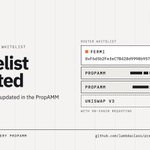
Fermi has a new address. The PropAMM Router is already routing to it.
One entry point gets you:
• Every whitelisted PropAMM
• On-chain requoting at execution, securing the best available price across whitelisted PropAMMs
• Uniswap V3 fallback when no PropAMM is available
• An audited router
Integrate once. We keep the whitelist current, so you don't have to.

LambdaClass retweeted
A quantum attack on Ethereum’s cryptography could mean forged transactions, stolen funds, impersonated validators, or invalid rollup withdrawals. The exposure reaches across accounts, applications, and the infrastructure they depend on.
ethrex is already testing the minimum execution-layer feature set for PQ readiness on EthPandaOps’ bogota-devnet-2, including Frame Transactions, SETCODEFROM, and restricted ecrecover.
Together, these changes let us test how accounts adopt new signature schemes and retire their old ECDSA signing authority. This is concrete migration work already running on a shared devnet.
Wallet and application builders: the devnet and specifications are public. Join us in testing these paths and share your feedback on the migration experience.

A hardware wallet can't stop a quantum attacker. Neither can a multisig.
What a cryptographic break would mean for @ethereum's users, apps, validators and rollups, and how @ethrex_client and @ethlambda_lean are helping to test the migration.
Second in our post-quantum Ethereum series.
blog.lambdaclass.com/what-a-…

Making Ethereum ready for PQAI Day.
How @ethereum can prepare for a cryptographic break: the protocol changes, the migration paths, and what users and validators need to do.
Third in our post-quantum Ethereum series.
blog.lambdaclass.com/making-…
First in our post-quantum Ethereum series: www.teapawt.net/class_lambda/status/21…
Mission 2028: Ethereum's cryptography can't wait for Q-Day.
Our takeaways from Devcon 8 and the L1 R&D workshop, and how @ethrex_client and @ethlambda_lean should help @ethereum reach post-quantum readiness by 2028.
First in our post-quantum Ethereum series.
blog.lambdaclass.com/mission…

136