
Teaching AI Agent Engineering | Founder, @nomadcoderai
Gurgaon, India
Joined April 2010
- Tweets135K
- Following786
- Followers12.2K
- Likes43.9K


Pinned Tweet
We successfully delivered India’s first independent AI developer conference - AI-India 🇮🇳 on April 12 in Gurgaon. ❤️ 🌞
We had 300+ senior developers, 12 speakers, and 12 deep-dive sessions covering topics like RAG, agents, eval, security, migrating legacy systems using AI, vector search, Vercel AI SDK, Microsoft AI stack, and more. 🔥
What made this conference truly different was its independence.
It wasn’t tied to any single model provider or ecosystem. That gave us the freedom to explore, question, and learn across the entire AI landscape , not just within one platform.
The discussions were intense, technical, and meaningful , real developers talking to developers. No surface-level hype, no social media noise, just deep, honest conversations about building with AI.
📸 Please see photos from the conference here:
photos.app.goo.gl/CyiAAcwq9Y…
I’m proud of what we were able to create. 😊
A big thank you to all the speakers, attendees, and sponsors for the trust and support in making this happen. 🙏
Once again, thank you so much everyone, see you at the next edition of #AIIndia in November in Pune. 👏
#nomadcoder #AIIndia #conference


Dhananjay Kumar retweeted

How to build and maintain an agentic evaluation huggingface.co/blog/agentic-… < good stuff from @huggingface which has an impressive level of detail

Angular Quiz
If a computed signal returns an array, even when the array contains the same values each time, Angular may treat it as a new value and notify its subscribers in Reactive context.
How can you prevent this notification when the computed signal returns an array with the same contents as before?
#angular
70
In the last 1 year, Uber has gone from 1 skill to 1 million agent skill invocations. Uber's shared skills marketplace grew from 1 skill in October 2025 to more than 5,000 in just one year.
That clearly says skills are now the backbone of agent-assisted coding.
When you work with skills at this scale, keep two things in mind:
👉 How to evaluate the agents
👉 How to synthesize the skills
How to synthesize a skill
The specification recommends keeping a skill below 500 lines and 5,000 tokens. To do this, never put in a skill what an agent already knows by default. For example, what a PDF is or how a Promise works should not be part of it.
Think about what your agent does not know, and without which it may generate code you don't want. A good skill may include:
👉 Architecture decisions for your project
👉 Domain knowledge specific to your project
👉 Code review information for your project
Good skill includes:
👉 Internal documentation, runbooks and style guides
👉API specifications, schemas and configuration files
👉Code review comments and issue trackers, which capture recurring concerns and reviewer expectations
👉Version control history, especially patches and fixes, which reveals patterns through what actually changed
👉Real-world failure cases and their resolutions
Uber organizes skills at three levels:
👉 Domain: for a specific team or area
👉Core: widely used skills, reviewed by the platform team
👉Always-on: used by everyone
Finding the right skill among so many is not easy. Uber has a find-skills skill that searches for a good skill, downloads it and runs it within your workflow. Skills are ranked using evals and usage counts, and each gets a quality score. Using Uber's internal context graph, employees can also discover skills their peers use but they don't.
What factors do you consider when selecting the skills required for your team and project?
#nomadcoder #agents #skills #uberengineering

Dhananjay Kumar retweeted

Google is making MCP mandatory for AI agents.
REST will be deprecated Feb 1st.
MCP has won. 🏆
workspaceupdates.googleblog.…
Dhananjay Kumar retweeted

we recently migrated the Claude Messages API from Python to Rust.
in this new eng blog, we share how we used the Python API as an oracle, set up verification loops, and had a team of agents fix diffs until Rust matched production's observable behavior.
anthropic.com/research/migra…

Dhananjay Kumar retweeted

We recently migrated our Messages API from Python to Rust.
On our engineering blog, we share how we used the existing service to verify the new one, with teams of Claude agents tracking down and fixing differences between the two versions.
anthropic.com/research/migra…

Dhananjay Kumar retweeted

Full episode is now out!
Fun fact: We were at 15~20M tool calls a day when we recorded this. We're doing over double that now! 👀
Enjoy.

How Atlassian Secures Tens of Millions of MCP Tool Calls a Day
"We are now sitting close to two million monthly active users, and we get tens of millions tool calls per day. I think we are one of the top three or top five biggest MCP servers right now serving actual production traffic."
Jatin Malik (@jatinkrmalik), Principal Engineer at @Atlassian, builds the gateway every agent goes through to reach Jira, Confluence, Trello and Loom. We sat down with him live at AGNTCon + MCPCon North America in San Jose to talk about what it takes to secure agent traffic at that scale.
We get into:
> Why agents shouldn't act with the user's full access
> How Atlassian tells user-only, hybrid and fully autonomous actions apart
> Why the classic API gateway can't serve agent traffic
> The M by N problem: every surface times every action type, at every level
> Keeping one-way destructive operations off the MCP server
TIMESTAMPS
(00:00) Atlassian's agentic doorway: MCP, A2A, CLI and more
(00:45) Security is the biggest blocker to enterprise adoption
(01:15) Regulated customers, test sites and staged rollouts
(02:10) Two million MAU and tens of million tool calls a day
(02:30) Why giving agents the user's access was a bad idea
(03:20) User-only, hybrid and fully autonomous actions
(04:45) Where the average customer is in their AI native journey
(07:30) The gateway as the policy enforcement point
(08:10) Layered gateways and the M by N problem
(09:00) ID-JAG and a kill switch at every level
(14:30) From POC to production: dogfooding with 15,000 employees
(18:00) No one-way doors on the MCP server
(18:50) How much trust to give your agents in a new era with Grok bot, Muse and dots
(24:10) Launching Atlassian MCP V2
Model Context Protocol (MCP) just got four big capabilities including Skills
MCP is how Client App AI connects to your apps and data. Until now, an MCP server could give three things:
👉 tools (actions it can take)
👉 resources (data it can read)
👉 prompts (ready-made instructions)
Now it has four more capabilities:
Skills : A server can now teach AI App how to use it, not just give access. A database server, for example, can explain how to query the data and which best practices to follow. Client AI App loads a skill only when it needs it.
Tasks : Client AI App can hand a long job to a server and keep working on other things while it waits. It can even hand off a whole agent.
Elicitation : A server can stop and ask you for information or approval while a job is running.
For example: "Run this delete query?
Yes or no."
File uploads : Client AI App will send PDFs, images and spreadsheets straight to a server, without passing their content through the context window.
Tools, resources and prompts, plus skills, tasks, elicitation and file uploads: you can now build much more complete MCP integrations.
What would you build first?
#MCP #Claude #ClaudeCode #AI #nomadcoder

Dhananjay Kumar retweeted

A year ago, we had exactly 1 agent skill at @Uber. Today, we have 5,000+ skills, built by thousands of employees, with over 1 million invocations a month.
Scaling agentic AI at an enterprise presents new engineering challenges. A few things we've learned:
• Skills should be model and agent agnostic. Our marketplace works across Claude Code, Codex, Cursor, and our internal agents.
• As frontier models get smarter, sometimes the best way to improve a skill is to delete parts of it. More instructions don't necessarily mean better outcomes.
• Skills fundamentally change the economics of AI. In one experiment, removing a skill resulted in 6x more tool errors and 31% longer execution times.
• Our agents are actively improving their own ecosystem by automatically filing bug reports when they encounter broken workflows.
I think one of the biggest opportunities with agent skills is turning institutional knowledge into something executable, reusable, and continuously improvable.
Imagine the compounding effect when thousands of employees use AI and actively teach it how Uber works, with people and agents continually learning from each other and improving how we get work done.
Proud of the @UberEng team for sharing what we're learning.


Dhananjay Kumar retweeted

MCP turns two! What started as a protocol for connecting AI apps to tools and data is evolving to standardize how agents communicate and orchestrate work.
We’re bringing more of these agentic capabilities to Claude with Skills over MCP and Tasks.
Dhananjay Kumar retweeted

Anthropic acaba de anunciar 4 novedades importantes de MCP en Claude y Claude Code:
1) skills over MCP -> un servidor MCP ahora puede ofrecer skills junto con sus tools. por ejemplo, además de darle a Claude acceso a una base de datos, puede enseñarle cómo consultar la información, qué pasos seguir y qué buenas prácticas respetar. estas skills se cargan únicamente cuando se necesitan.
2) tasks -> Claude puede delegar una tarea de larga duración a un servidor MCP y seguir trabajando en otras cosas mientras espera el resultado. incluso podría delegar la ejecución de un agente completo.
3) elicitation -> un servidor MCP puede solicitar información o aprobación al usuario durante la ejecución de una tarea. por ejemplo, puede pedirte confirmación antes de ejecutar una consulta SQL destructiva y continuar una vez que la apruebes.
4) file uploads (próximamente) -> Claude podrá enviar archivos como PDFs, imágenes o planillas directamente a un servidor MCP sin tener que pasar su contenido por la ventana de contexto.
con estas mejoras se pueden empezar a construir integraciones MCP mucho más completas.


Dhananjay Kumar retweeted
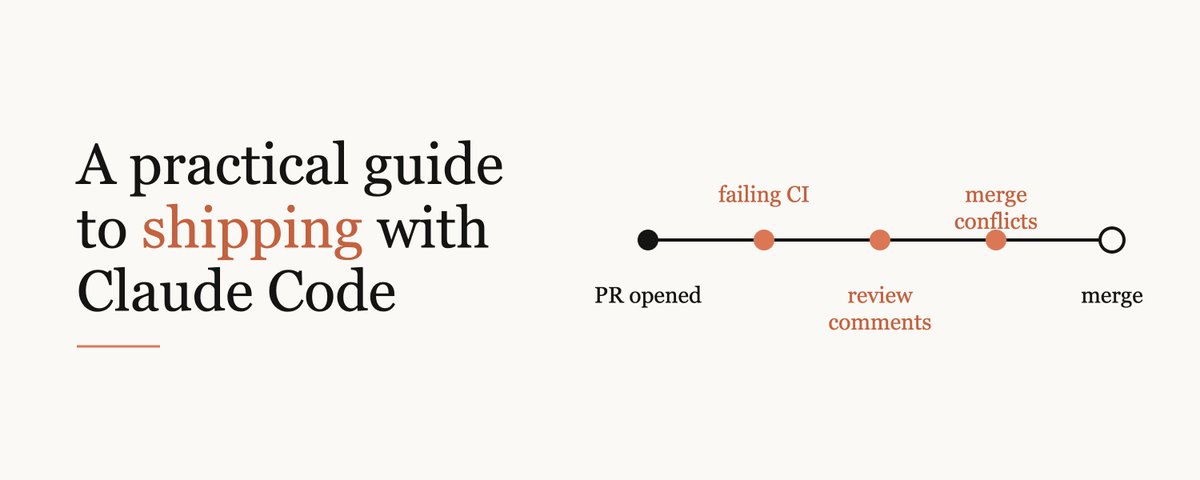
A practical guide to shipping with Claude Code: how to hand off PR follow-up work to Claude Ship and stay in flow.
claude.dev/blog/the-work-aft…

Dhananjay Kumar retweeted

Really excited about this one. MCP servers can now ship with their own skills, so Claude Code knows how to use them out of the box.
Dhananjay Kumar retweeted

For Black Friday, @wolfmanfx and I are bringing back the original Very Early Bird price of €790 per person for either of our two December workshops. The offer ends on Sunday, 29 November at 23:59 Vienna time.

ALT Soverius AI Black Friday offer. €790 per person per workshop. Agentic Applications, 9–10 December, and Angular & AI Distilled, 14–15 December. Photos of Murat Sari and Rainer Hahnekamp.
MCP Server provides three main capabilities that allow an AI application to interact with external systems and data.
👉 Tools – Actions the Client AI can perform
👉Resources – Data the Client App can read
👉 Prompts – Predefined instructions the Client User can use
For more such insight join our whatsapp group. Ping me for invitation.
#nomadcoder #MCP #agentslearning

1
5
277
Want to know how an AI app lists your GitHub repositories using MCP?
This flow diagram explains how the App, MCP Client, MCP Server, and LLM work together.
Let me know your feedback and further questions !
#nomadcoder #mcp

ALT MCP Server and Client Flow Diagram
3
4
253
Dhananjay Kumar retweeted

AI ecosystem guide 2026:
- 120 tools covered
- across 18 categories
Compute, Data, Pretraining, Fine-tuning, Compression, Inference, Structured outputs, Gateways, Benchmarks, App evals, Ingestion, Retrieval, Memory, Observability, Agents, Security, Prompt

Dhananjay Kumar retweeted

stop blaming the f*cking MODEL
ANTHROPIC proved the same Claude acts like a different agent once you build the harness around it...
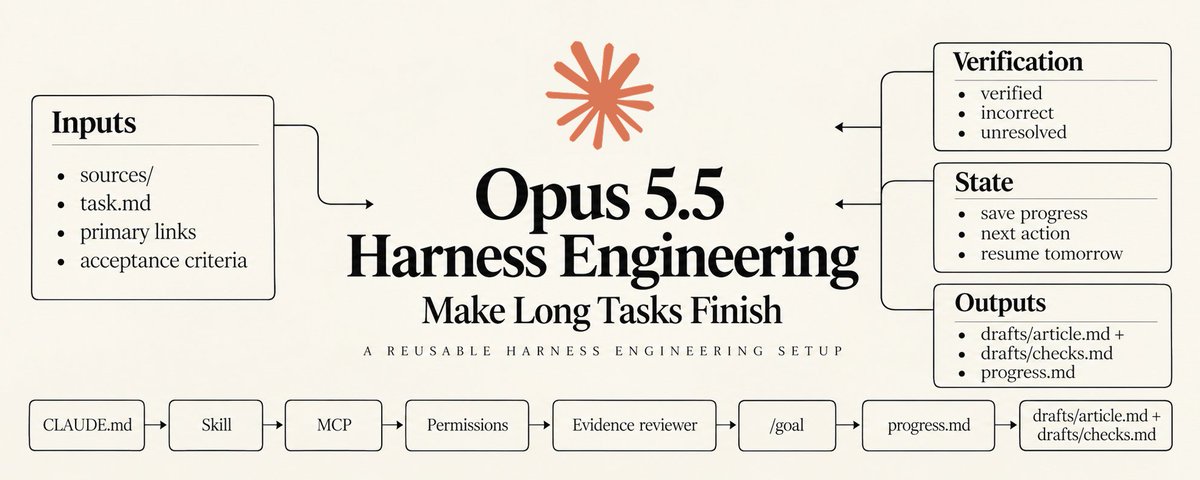
agent = model + harness. the harness is everything around the model: rules, checks, memory, limits
the Anthropic engineering team tested it on long coding jobs. give the model a feature list, a progress file, git and a real test, and it stops saying "done" before the job is done
Claude Code already has a slot for all 6 layers:
1. guides: CLAUDE.md and skills. every new failure becomes a rule
2. sensors: hooks that run your linter and tests after every edit
3. the loop: plan, build 1 feature, a helper agent checks it, fix, commit
4. memory: claude-progress.txt, feature_list.json and git, so a fresh session knows where to start
5. permissions: allow and deny lists. nothing gets pushed or deleted without you
6. tracking: every tool call and every dollar logged
prompt engineering shapes what the model is told
context engineering shapes what it sees
harness engineering shapes what it can do
the harness, not the hype
save this. my full 6-layer playbook is in the video ↓

Dhananjay Kumar retweeted

THIS IS AN ACTUAL F*CKING GOLDMINE
Fable 5.2 is insane for building self-evolving agent swarms…
send it this prompt and it will design a 40-agent team that plans, builds, reviews, benchmarks, remembers failures, and improves its next run
then read the full Opus 5.5 harness engineering guide below ↓
