

Decisive Point is a venture capital firm investing critical technologies for defense, energy, and infrastructure. Est. 2018
New York, Boston, DC
Joined October 2018
- Tweets693
- Following364
- Followers1.3K
- Likes282




The Army is opening military ranges to private firms, accelerating drone, counter-UAS and weapons testing.

1
82

DHA’s FY2027 strategy targets medical readiness, battlefield trauma care, and faster return to duty.

1
64
Radiant secures DOE safety approval for full-power Kaleidos microreactor testing, advancing military energy resilience.

1
2
67
Medal of Honor recipient Dakota Meyer joins the Pentagon’s effort to improve military barracks.

2
99
AUSA 2026 highlighted the future of U.S. land warfare: autonomous systems, counter-drone defense, and next-generation command and control.

1
105
Anduril and the U.S. Navy announced a $6.6B submarine manufacturing initiative. Arsenal-2 will expand production of Virginia-class submarine components.

76
The U.S. is expanding its Arctic military footprint with new bases authorized at Narsarsuaq and Mestersvig, with an expansion of Pituffik Space Base. The network strengthens access across Greenland and positions U.S. and NATO forces across a critical link between regions.

1
92
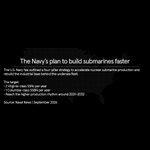
The US Navy has unveiled a four-pillar strategy to accelerate submarine production, targeting 2 Virginia-class SSNs + 1 Columbia-class SSBN per year around 2031–2032. The focus: stabilize designs, free up shipyards, expand the supplier base and design the future SSN(X) for scale.

2
150
An Army National Guardsman with no previous aviation experience learned to command an autonomous Black Hawk in less than an hour. Now, an H-60Mx equipped with MATRIX autonomy has officially transitioned to the Army, moving the tech from DARPA toward testing and future concepts.

1
88
The US Navy is moving toward a hybrid fleet, but officials say investment in autonomy still lags behind. Current planning now projects 83 unmanned vessels alongside 299 manned battle-force ships by FY2031, as the Navy works to scale autonomous systems across the maritime domain.

2
72
NASA’s Nancy Grace Roman Space Telescope is officially on its way to L2. Launched August 30 aboard Falcon Heavy, Roman has completed its first course correction and begun a three-month journey and commissioning process roughly one million miles from Earth.

The U.S. Army has selected 5 companies to begin deploying nuclear microreactors under the Janus Program. The objective: reliable, independent power for military infrastructure, reducing dependence on vulnerable external grids and laying groundwork for future energy capabilities.

The Pentagon has ordered 30 U.S. universities to audit foreign research partnerships over concerns surrounding technology transfer, intellectual property, and research security.

91
NASA's Nancy Grace Roman Space Telescope will combine a Hubble-sized mirror with a field of view at least 100 times larger, surveying billions of cosmic objects while studying dark energy, exoplanets, and the structure of the universe.
Launch is currently slated for August 30th.

1
142
The SBIR and STTR programs help turn America's small businesses into defense innovators, funding tech ranging from AI and autonomy to quantum, hypersonics, and advanced sensing.
With $41B+ invested, they've become a key pipeline for delivering new capabilities to the warfighter.

1
3
158
The U.S has identified six Critical Technology Areas (CTAs) that will shape the future, focusing on AI, biomanufacturing, contested logistics, quantum technologies, directed energy, and hypersonics to accelerate the delivery of next-generation capabilities to the warfighter.

1
130
The U.S. is expanding its advanced nuclear strategy with new reactor milestones, AI-driven research, and nearly 300 Genesis Mission projects designed to accelerate innovation and strengthen America's future energy supply.

3
97
SpaceX has launched 21 more satellites for the U.S. military's growing space-based communications network.
The mission expands the Space Force's Transport Layer to 63 operational satellites, supporting secure, low-latency communications in orbit.
Source: S. Erwin, SpaceNews

2
120
