
Postdoc at MIT BCS, interested in language(s) and thought in humans and LMs
Joined March 2022
- Tweets238
- Following623
- Followers681
- Likes1.9K




Pinned Tweet
Now out in @NatureNeuro with a new title and an extra experiment, showing that the shared component in brain responses across languages is tied to linguistic meaning! Link below:


New preprint! 🧠🤖
Brain encoding in 21 languages!
biorxiv.org/content/10.1101/…
w/ @saima_mm, @GretaTuckute, and @ev_fedorenko (1/)
Andrea de Varda retweeted

Interp on residual stream ftw! Pretty interesting research showing that the native coordinates of LLM representations are not arbitrary.
A lot more work needs to be done on the residual stream, but I like that the field is moving fast there!
New preprint! 🧠🤖
Partially canonical axes in large language model representations
w/ Ferdinando D'Elia, @GretaTuckute, @ev_fedorenko, and @meenakshik93
Is information in the LLM residual stream encoded in single units (left), or only in patterns across all units (right)? (1/9)
Andrea de Varda retweeted

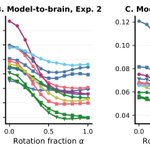
Loved collaborating with this team, with @devarda_a leading this work beautifully! Do individual residual-stream units matter in LLMs? Rotate an LLM’s representational basis and the geometry stays intact but individual units align less well with other models, linguistic features and language cortex responses. More in Andrea’s thread below!
New preprint! 🧠🤖
Partially canonical axes in large language model representations
w/ Ferdinando D'Elia, @GretaTuckute, @ev_fedorenko, and @meenakshik93
Is information in the LLM residual stream encoded in single units (left), or only in patterns across all units (right)? (1/9)
New preprint! 🧠🤖
Partially canonical axes in large language model representations
w/ Ferdinando D'Elia, @GretaTuckute, @ev_fedorenko, and @meenakshik93
Is information in the LLM residual stream encoded in single units (left), or only in patterns across all units (right)? (1/9)
What is special about the native axes? In the native basis, linguistic features can be decoded from a small subset of units (a sparse readout). These readouts are sparser than in any random rotation in every model we tested (8/9)
In conclusion, our results show that (1) individual LLM axes encode information that is not invariant to rotation, and (2) they capture only part of the structure in the representation. LLM representations are partially canonical (9/9)
Pre-print 🔗 arxiv.org/abs/2611.26920

10
275
Andrea de Varda retweeted

Across speakers of 21 languages, an MIT study using multilingual AI finds the human brain may represent meaning in much the same way.
mcgovern.mit.edu/2026/11/23/…
@mitbrainandcog @ScienceMIT @YangTanColl

Andrea de Varda retweeted

I have a high-level introduction to language models & the brain — the connectionist history of LMs, how they are built and trained, and what they might tell us about neuroscience — out now in Current Biology! Sharing link below:

ALT current biology Primer: Emergent parallels between language models and the brain
Andrea de Varda retweeted

Causal reasoning lies at the core of human intelligence but few studies have tested its neural basis. In a new study, we find that despite its importance, causal reasoning is implemented not in a single unified brain system, but rather in separate domain-specific regions.
Andrea de Varda retweeted

Had a wonderful time giving a guest lecture at Caltech on the cognitive architecture of LLMs, and more broadly, how we can use AI models as model organisms to study intelligence! :)
Many thanks to Prof. @CFCamerer for the invitation!
We discussed the emergent modularity in LLMs, what the similarities between human brains and LLMs might tell us about general principles of intelligence, and how AI models could help us study cognition.
Really enjoyed the discussions and questions! :)
Slides: docs.google.com/presentation…
(And special thanks to @devarda_a for letting me steal some of his beautiful slides! :))

The human brain is strikingly modular, with distinct networks for language, formal reasoning, social reasoning, and physical reasoning. Is this a fundamental principle of how intelligent systems are built, or an accident of biological evolution?
In our latest preprint, we find that a similar modular organization emerges in Large Language Models, another class of intelligent system.
Brains and LLMs are shaped by entirely different kinds of optimization (biological evolution vs. gradient descent). That they arrive at the same modular design anyway suggests modularity may be a fundamental property of intelligent systems.
🌐 Web: pengrui-han.github.io/LLM_Mo…
📄 Paper: pengrui-han.github.io/LLM_Mo…
💻 Code & data: github.com/Pengrui-Han/LLM_M…
Using circuit analyses across 46 tasks spanning four cognitive domains, we find:
1️⃣ Tasks that draw on the same network in humans recruit overlapping units in LLMs, while tasks drawing on different networks recruit distinct units.
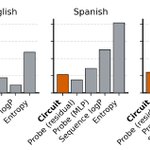
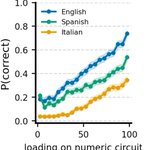
2️⃣ These units are causally linked to model behavior. Ablating the units critical for one domain impairs performance in that domain (−26% accuracy) but barely touches the others (−2.5%).
This project has been in the works for a while :) Huge thanks to my advisors @jacobandreas @ev_fedorenko @devarda_a, and to @Nancy_Kanwisher for valuable conceptual input and feedback throughout. #MIT
Andrea de Varda retweeted

If you've noticed a distinct dialect emerging in frontier AI models and struggled to understand what they're talking about, you're not crazy!
We turned to psycholinguistics to investigate what makes the writing style so weird, and why this might be happening
🚨New preprint! 🧵

Andrea de Varda retweeted
New blog post! I wrote about why I think it's useful to use metaphorical (and anthropomorphic) terms to describe AI. I start by describing the role of metaphor in language and cognition, and how metaphors can help us to efficiently understand relations and make predictions 1/2

ALT in defense of metaphor: why metaphorical descriptions of AI are useful, even if they are sometimes imperfect. a watercolor of an MLP, with a thought bubble showing a path to a goal.
Andrea de Varda retweeted
Congrats to @devarda_a, named one of the 2026 #STATWunderkinds by @statnews!
Andrea is doing groundbreaking work in @ev_fedorenko + @roger_p_levy labs to understand how brains and machines process language.
Learn more: statnews.com/wunderkinds/and…
@mitbrainandcog @ScienceMIT
