

I design instruments for ideas · https://www.teapawt.net/t.co/vgXYGgctv5 · studio https://www.teapawt.net/t.co/4rP2yL9HUF · next @mbientos
Toronto
Joined August 2021
- Tweets10.4K
- Following343
- Followers1.3K
- Likes13.1K





Pinned Tweet
Create. Curate. Iterate.
// Thinkable Desktop Studio
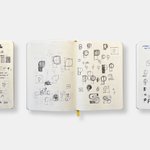
A modular tangible thinking space for creative work. Work on ideas without distraction, stay focused and in creative flow.
// How it works
To start, throw every productivity rule out the window - it destroys the creative process. Creativity and productivity exist on a spectrum and when you do one, it costs you the other.
Welcome to the messy middle.
Thinkable is a place where you can visualize your thoughts and ideas and then keep them in sight, top of mind, and in reach. Where you can effortlessly iterate, synthesize and collaborate with yourself, while expanding your mind, creative field of view and explore your ideas.
// Why should you listen to me?
I’ve done a lot of design, both physical and digital. Everything you see at thinkable I’ve crafted - ID / brand / copy / web / product / artwork / photography / film. Judge the work, it’s opinionated.
I even spent a year writing a book on the topic (of Tangible Thinking).
// coming soon. Sign up for the Kickstarter announcement. Link in bio.

We’ve been bamboozled.
AI is giving us exactly what we want.
It’s a recursive mirror.
One that continues to create derivative work.
To keep us happy.
Nature had a solution for sameness, it mutated genes, and gave us natural selection.
Creating original work, is to be human.
3
135
sanj • thinkable retweeted

I’m unconvinced that taste matters as much in design as people think. Sure, it’s an advantage, but I don’t believe it’s the moat people make it out to be.
Taste can help you recognize what’s good, but it doesn’t necessarily help you create something new. In fact, it can become a constraint. If you’re always worried about what feels tasteful or familiar, you risk creating more of what already exists.
I think originality requires a willingness to be wrong, or to make people uncomfortable, and most importantly, to risk being distasteful.
I see so much attention given to pixels.
And not enough attention to broadening the aperture of design.
5
292
We are orchestrating how someone feels, as a response to the artifact. Not how it tastes.
music, art, architecture, print, fashion, objects
feelformfunction.com

productecture.com
The product of two numbers is one numbered multiplied by another. The product is the end result.
Applied to design, it is taking one set of skills, and multiplying it against another set of skills - to produce the product of design - or the product.
Productecture is the Practice of Designing Interactive Products, through a Holistic, Humanized, Design Approach, across Modalities, Mediums and Disciplines.

1
123
There is a ship sailing the sea's with my lifes work on it.
An analog space to think and capture ideas - at time when they are more important than ever.


sanj • thinkable retweeted

Tomorrow @ FWD
The future of voice design with @neilsuperduper from @superwhisper at 11 AM
Designing always-on agents with @sarimrmalik from @RubricLabs at 6 PM
Coworking from 9 AM - 5 PM
sanj • thinkable retweeted
We live more than one life. At the same time.
There’s a life we live in public. One at work. One with our parents. One for our spouses. One for our children. One for our friends. One for our supreme beings, or supreme state of beings.
And then there’s the one we live alone.
The one inside ourselves.
The life only we can know.
It’s the life we should be most kind and forgiving in.


sanj • thinkable retweeted
We are not slow computers.
-
To make ideas that really matter, that are durable, useful, and crafted, we must design intentionally.
Creativity and productivity exist on a spectrum. When we do one, it costs the other.
Both can exist, but one should drive the other.
#wearenotslowcomputers

Is design leadership about to become the bottleneck?
We can build anything fast. And as a result, we’re rushing to build things we may not need. We prioritize speed over usefulness. AI has made this worse, not better.
Every project I start begins in my head before it jumps to paper. When I have a solid point of view I then shift to building a prototype (canvas and/or code). And then I stop.
This is where the shift comes. As I start to feel the prototype, I let it push itself through layers of consciousness and memory. I sleep on things, for days. I process and refine things, laterally think about the edges, about its value, its purpose, its form.
This is where I craft simplexity. Where I hone in on it’s essence. I mull things over on paper, sketch, do some more prototyping. This takes time, as the product concept takes form. And when I have clarity, I dive in and build more prototypes - but with a really refined point of view, and well thought out opinions.
This is where I used to leave things, but now I go further and prototype alphas.
This is how ideas are born, nurtured, shaped, and built or abandoned. Not through speed but the opposite - the lack of speed. It’s this pacing that creates clarity.
Can this scale organizationally? Yes - but only if you design for it deliberately.
It requires a pipeline running in parallel: one stream generating and nurturing ideas, another consuming and shipping them. The first moves slowly by design. The second moves fast. The coordination layer between them - knowing when an idea is ready to cross over - is where design leadership lives. That judgment can’t be a rubric or a prompt - it has to be held by someone.
Most organizations collapse these two streams into one and wonder why everything feels rushed and half-baked.
That’s what design leaders bring. The ones that get this right don’t move slower - they move with more intention.
We need systems that are fast. And we need systems that are slow.
sanj • thinkable retweeted
The overall standard of design has declined to a point where basic competence is mistaken for exceptional craft.
The bar is so low, that simply getting the fundamentals right is enough to earn the kind of praise that, frankly, should be reserved for work that has genuine originality and/or creative ambition.
Stop treating competent execution as the finish line and start treating it as the baseline. Good design should be the expectation, not the exception.
Experiment more. Take more creative risks. Stop defaulting to the same predictable layouts. Develop the ability to critique your own work honestly. Ask whether there's a more interesting solution. Whether the concept is strong enough. Whether the work actually brings something new to the table.
Your ambition should be to create work that makes people think, challenges conventions, communicates ideas in unexpected ways, and pushes the discipline forward.


We live more than one life. At the same time.
There’s a life we live in public. One at work. One with our parents. One for our spouses. One for our children. One for our friends. One for our supreme beings, or supreme state of beings.
And then there’s the one we live alone.
The one inside ourselves.
The life only we can know.
It’s the life we should be most kind and forgiving in.
