

Helping lean security teams protect the email, data, and identities that live in Google Workspace and Microsoft 365.
San Francisco, CA
Joined March 2020
- Tweets818
- Following415
- Followers1.2K
- Likes816




Almost time for HS-ISAC!

Of 702 HIPAA breaches under HHS investigation, 144 involved email, and 85% of those were account takeovers. We’ll be at HS-ISAC Fall Americas Summit in Tucson, Dec 1 to 3, talking about what’s already sitting in the inbox. Booth #15!
Book time with us: hubs.li/Q04FWgRG0

49
Google and Microsoft have invested heavily in security for their platforms, and their built-in controls are real. They still aren't enough, even with CrowdStrike and Zscaler merging the rest of the perimeter.
Native controls are built for a general audience and reflect the trade-offs of platforms that have to work for everyone. They show you what happened. They rarely tell you what it means or what to do about it at the speed a modern threat requires.
Security teams are asking questions that are hard to answer from inside a native admin console. Which of our sensitive documents are overexposed right now, and to whom? Which third-party apps can reach our data, and have their permissions quietly expanded? Did an account that just downloaded a large volume of files behave like the employee it claims to be?
Answering those takes context across identity, content, sharing, and behavior, and it takes acting on that context, not just logging it.
The workspace is also becoming agentic. AI assistants, automations, and connected agents now read, write, summarize, and share content on behalf of users, often with delegated permissions nobody has fully reviewed. An agent with access to a mailbox and a document library can do in seconds what used to take a determined insider hours.
Endpoint and network controls can't see that layer. The workspace needs its own visibility, policy, and response.
hubs.li/Q04Gd4ZW0

Binance lost $6.3B after fake job interviews, and the FBI blames North Korea. Same country, other direction: between Oct 3 and Nov 6, eight DPRK operators pitched about 38 employees at 13 orgs.
Make an AI-training account, pass ID verification, let their team do the work, split the pay. They don't want your passport. They want you to pass the check for them. Belem breaks it down: hubs.li/Q04G8DGl0

76
Belem Regalado's husband gave a language app mic access for his speaking lessons. Totally reasonable.
Then they talked about their boys starting football season. His next lesson: kids playing sports.
They talked about booking flights. Next lesson: travel.
They talked about a pediatrician appointment. Next lesson: doctor visits.
When they checked his phone, there was mic activity outside his speaking lessons.
Belem (Staff Threat Research Engineer at Material) isn't saying the app was hiding anything. It may have explained it all in terms and conditions nobody reads. Her point is that we approve permissions, think we understand them, and then forget they exist. She downloaded the same app, used it for a week, and never deleted it.
Now swap the language app for a tool at work, and the permissions cover company data instead. No exploit, no stolen password.
Someone just clicked Allow.
114
Phishing-resistant MFA covers the sign-in. The other half is what happens if an admin gets phished anyway: a new MFA method or device, an app grant approved on an Allow screen, or a rule that hides mail. All three survive a password reset, so after any admin phish the check needs to cover them, not just the password.

🚨 Microsoft Entra Connect Health flaw exploited to steal tenant data!
Attackers accessed administrator email addresses, tenant IDs, configuration metadata, and synchronization status.
Microsoft patched the flaw on November 19 and is notifying affected organizations.
The number of impacted tenants remains unknown.
➡️bleepingcomputer.com/news/se…
bleepingcomputer.com/news/se…

76
In the last 30 days, 232 suspected North Korean IT-worker personas made contact with 99 organizations we monitor.
66 reached an interview or later. At 42 of the 99 organizations, at least one got as far as an interview or an offer. At four, one reached onboarding: offer letters, background checks, equipment requests, or first-day IT setup.
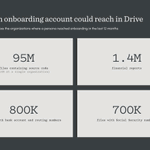
We then looked at what a new account could have opened at those four. At one, about 15 million source code files and 130,000 files with bank or routing numbers were held tightly, shared with almost no one beyond their owners. At another, 68% of roughly 400,000 files containing Social Security numbers were open company-wide or by public link.
Same adversary, very different blast radius.
It also changes how you triage. A watchlist hit at first contact and the same hit at onboarding call for very different urgency, and once an account exists, the hiring investigation and the access investigation may be the same case.
Attackers stopped asking for your password.
Passkeys made that phishing much harder, so now the pitch is “just go through this OAuth flow.”
Real Google login. One click on Allow. The token bypasses your identity protections.
@BleepinComputer
Of 702 HIPAA breaches under HHS investigation, 144 involved email, and 85% of those were account takeovers. We’ll be at HS-ISAC Fall Americas Summit in Tucson, Dec 1 to 3, talking about what’s already sitting in the inbox. Booth #15!
Book time with us: hubs.li/Q04FWgRG0
If one fake North Korean employee got into your company tomorrow, could you list everything their account can open?
At one company where a suspected persona reached onboarding, 68% of the files containing Social Security numbers were open company-wide or by public link.
What would you do?
71
Phishing training says check the login page. In this attack, the login page is Google’s. Rajan Kapoor on a suspected Russian OAuth campaign, why a real sign-in screen defeats user intuition, and what to govern instead: hubs.li/Q04FFRw80

61
27 suspected North Korean IT-worker personas reached onboarding at the organizations we monitor over the past year. That means offer letters, background checks, equipment requests, or first-day IT setup.
What they could have opened on day one depends on how sharing was managed before they ever applied.
We looked at four companies where a persona reached onboarding in the last 30 days.
At one, about 15 million files were flagged as source code and 130,000 as containing bank or routing numbers. Almost none of it was shared beyond its owners.
At another, 68% of roughly 400,000 files containing Social Security numbers were open company-wide or by public link. So were 71% of its bank and routing files. Any account inside the company could reach them with no special permission, so a new account wouldn’t have had to look for anything.
At a third, about 1,900 source code files were shared by public link, readable by anyone with the URL.
At the fourth, 21% of financial files and 17% of credit card files were shared beyond their owners.
Same adversary, very different blast radius. Catching the mask at the door matters, but so does knowing which files hold what, who can reach them, and where sharing has drifted wider than intended, before a case starts.

51
Security used to scale with the company. More people, more security.
That’s over. A company can multiply in size in a few months while its security headcount stays flat.
We hosted a panel on this with Dylan Healy of Fleet AI, Frank Wang of Surge AI, and Zach Morris of Lumbra, moderated by our CEO Abhishek Agrawal. Nobody said the answer was to hire more. Four takeaways:
Buy for the company you are about to be. You never want to rip out a stopgap in the middle of hypergrowth.
Give agents the recurring work you would have hired for. Dylan had a team of eight on observability and detections at Roblox. Now, agents handle much of that maintenance.
Make decisions you can undo. Hiring is one of the hardest to reverse.
Stop treating people as a control. Someone will click, and if that ends in a compromised identity, the technical controls failed, not the person.
The fundamentals haven’t changed. Headcount just isn’t how they scale anymore.
1
117
“Imagine waking up to find that work has been moving forward while you were asleep.”
The opening of a recruitment email from a North Korea-linked operator. Not a fake applicant this time. A recruiter, writing to real employees.
There was no urgent warning and no attachment, only a side-income offer: create an account on an AI-training platform, complete the identity verification, and let someone else do the work.
Eight operators, 13 organizations, about 38 employees, five weeks. The emails are below.
🔗 hubs.li/Q04FlGb-0


1
76
Material Security retweeted

Google warns that fully-automated AI attacks are coming soon
bleepingcomputer.com/news/se…
bleepingcomputer.com/news/se…

Two Google Drive files with sensitive data. One is shared company-wide: contained. One is public with SSNs: overexposed.
The agent stages the fix, and here we approve it by hand. Once you trust its verdicts, it can act on its own. 👇
121
Same adversary, very different blast radius. We found suspected North Korean IT-worker personas reaching onboarding at four of the companies we monitor.
At one, almost nothing sensitive was shared beyond its owners.
At another, 68% of the files containing Social Security numbers were open company-wide or by public link.
🔗 hubs.li/Q04FdPcn0

107
Material Security retweeted

"A Thousand Masks: Where the DPRK IT-Worker Threat Meets Your Data" published by @material_sec. #ITWorker material.security/resources/…

Material Security retweeted

Calendar invites stole live Google sessions, even after real MFA approval.
Per @material_sec:
- A live proxy relayed passwords, SMS, TOTP and Tap-Yes
- 897 phishing domains taken down
- Fix: revoke sessions, don't auto-add invites, prefer passkeys
#CyberSecurity #AiTM
material.security/resources/…

Material Security retweeted

Suspected North Korean IT workers reached onboarding at companies with open data - helpnetsecurity.com/2026/11/… - @material_sec #NorthKorea #DPRK #InsiderThreat #CyberSecurity #InfoSec
