

building the future of ai @typesafeai
San Francisco
Joined November 2015
- Tweets610
- Following390
- Followers2K
- Likes17.8K




Eugene Shvarts retweeted

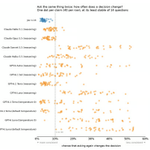
oh no, we aren't 100% on the benchmarks

Looking at the decision index benchmarks and wow pervasive overfitting of models!!!
I'm more likely to use a model that has a high & consistent public + private score vs. those with a huge drift
Also, beware - the models are sorted by public scores in the individual benchmark cards
huggingface.co/spaces/multim…



AIs attacking math will give the great gift of clarifying that what is true has little bearing on what is knowable

Don Knuth on P=NP:
“As you say, I've come to believe that P = N P, namely that there does exist an integer M and an algorithm  that will solve every n-bit problem belonging to the class N P in nM elementary steps.
Some of my reasoning is admittedly naïve: It's hard to believe that P ≠ N P and that so many brilliant people have failed to discover why. On the other hand if you imagine a number M that's finite but incredibly large—like say the number 10  3 discussed in my paper on "coping with finiteness"—then there's a humongous number of possible algorithms that do nM bitwise or addition or shift operations on n given bits, and it's really hard to believe that all of those algorithms fail.
My main point, however, is that I don't believe that the equality P = N P will turn out to be helpful even if it is proved, because such a proof will almost surely be nonconstructive. Although I think M probably exists, I also think human beings will never know such a value. I even suspect that nobody will even know an upper bound on M.
Mathematics is full of examples where something is proved to exist, yet the proof tells us nothing about how to find it. Knowledge of the mere existence of an algorithm is completely different from the knowledge of an actual algorithm.
For example, RSA cryptography relies on the fact that one party knows the factors of a number, but the other party knows only that factors exist. Another example is that the game of N × N Hex has a winning strategy for the first player, for all N. John Nash found a beautiful and extremely simple proof of this theorem in 1952. But Wikipedia tells me that such a strategy is still unknown when N = 9, despite many attempts. I can't believe anyone will ever know it when N is 100.
More to the point, Robertson and Seymour have proved a famous theorem in graph theory: Any class  of graphs that is closed under taking minors has a finite number of minor-minimal graphs. (A minor of a graph is any graph obtainable by deleting vertices, deleting edges, or shrinking edges to a point. A minor-minimal graph H for  is a graph whose smaller minors all belong to  although H itself doesn't.) Therefore there exists a polynomial-time algorithm to decide whether or not a given graph belongs to : The algorithm checks that G doesn't contain any of  's minor-minimal graphs as a minor.
But we don't know what that algorithm is, except for a few special classes , because the set of minor-minimal graphs is often unknown. The algorithm exists, but it's not known to be discoverable in finite time.
This consequence of Robertson and Seymour's theorem definitely surprised me, when I learned about it while reading a paper by Lovász. And it tipped the balance, in my mind, toward the hypothesis that P = N P.
The moral is that people should distinguish between known (or knowable) polynomial-time algorithms and arbitrary polynomial-time algorithms. People might never be able to implement a polynomial-time-worst-case algorithm for satisfiability, even though P happens to equal N P.”
1
108
Eugene Shvarts retweeted
does anyone else wish the jensen thing happened last month for the insane halloween costume potential?
okay I love this at least in part because I already vibe-coded a Claude Code interactivity hook for my watch 🫣

4
252
Eugene Shvarts retweeted

You’re probably paying a frontier model to read 100K tokens to find 500.
The default for evaluating long-horizon agents is to point the biggest model you have at the whole trajectory, but most of it is noise for the question you’re asking. Take a judge that checks whether a user got frustrated. It doesn’t need 180 tool calls, it needs the user turns. Finding those is a code problem, not an intelligence problem.
At @JudgmentLabs, the Judgment Agent writes preprocessing code for each judge, and @TypeSafe’s Jev makes the call on just that evidence. It matched a frontier model reading everything at ~600x lower cost.
I think evaluating every trajectory, not just a sample, is about to get a lot easier. When each eval costs this little, there’s no reason not to go looking for every insight in your data.
Great work by @Unhingexd, and thanks to the @typesafeai team!

Most eval questions are narrow. Did the user get frustrated? The answer sits in a few hundred tokens, buried in 100K+.
We extract just that evidence with code and let @typesafeai Jev decide, matching GPT-6 Luna on the full trajectory at ~600x lower cost.

Warms my heart to see such clear, concrete explanations of the design philosophy behind what we build, how it works, and how to make the most out of it!
Models have a limited amount of intelligence! So, it's important to spend that intelligence on the most difficult, interesting parts of your problem, not the parts that a few lines of code could do for you.
Most decisions are little more than rigid flowcharts connecting a few intelligent judgments, which is the arena that Jev shines most strongly in!

You can learn more in our cookbooks: docs.typesafe.ai/cookbooks/c…

1
51
And of course the blog post that inspired @simeonGriggs 's video!
typesafe.ai/blog/dont-call-i…

34
Wealth of great creative Jev usage from @sonyasupposedly!

I have found Jev by @typesafeai to be a useful tool for creative apps that build a unique artifact for the user. Today I blogged about that
Eugene Shvarts retweeted

how many of your agent's runs did anyone actually read last week?
what if you could say, "all of them!"
@JudgmentLabs does, using Jev to answer each eval question in 0.15s, so you stop sampling and grade every run
and presto ✨ your evals are a search index
Most eval questions are narrow. Did the user get frustrated? The answer sits in a few hundred tokens, buried in 100K+.
We extract just that evidence with code and let @typesafeai Jev decide, matching GPT-6 Luna on the full trajectory at ~600x lower cost.
Eugene Shvarts retweeted

It was such an honor to speak to @sydneyrunkle from @LangChain. Back in the hackathon days, I was truly disappointed at the behavior of the models wrt shipping in prod. I am so glad we finally got to share Jev and its philosophy with the community.
@typesafeai is on the journey to make an intelligence that is easier to build with. Join us!

.@sydneyrunkle + @typesafeAI co-founder @hackgoofer sat down for a chat on:
✅ How Jev differs from an LLM
✅ Where it fits inside of LangChain agents
✅ Using Jev-as-a-judge in LangSmith
And so much more!
⏯️ Watch the full conversation: youtu.be/0vz5slHWAp8
We spend all our time competing over who is Chief Swag Officer so that we can align on everything else
🎶 Merch shop is live! 🎶


2
4
335
Get yours (and pine for what you can't) at
shop.typesafe.ai

1
46
Eugene Shvarts retweeted
sure AI can solve Millenium math problems, but can it solve the hardest problem in computer science
Come see our CTO @EGafni speak on using Jev for real, messy work out in the world with @elise_ai!
December 7, @a16z office SF

AI for physical buildings has to work with whatever it’s given: blurry photos, bad lighting, awkward angles, and labels that are hard to read.
On Dec. 7, we're heading back to the @a16z office in SF, this time with @EGafni, @typesafeai's Co-Founder & CTO.
We’ll cover:
→ Working with TypeSafe’s Jev in the field
→ Tuning thresholds for each model
→ Balancing accuracy, speed and cost
@elise_ai Head of Applied Research Mario Martone will also join the stage, moderated by Product Manager @ShrutiGoli.

1
2
235


Eugene Shvarts retweeted
Jev gives @stralagroup the 9s of reliability they need to power decision-making for insurance, where quantifying risk is as critical as it gets.
check out @EGafni in conversation with @armandostrala and @flohop_dev