

Cofounder @eth_systems. Formerly @goldmansachs, @ethereumfndn and @techstars alum
Joined May 2010
- Tweets3.2K
- Following1.7K
- Followers2.4K
- Likes9.8K






Pinned Tweet
Yesterday was my final day at the Ethereum Foundation.
Today, we’re launching @eth_systems .
I started my career at @GoldmanSachs , working inside the financial system. Years later, I found myself at the @ethereumfndn , working with institutions exploring how that system could evolve onchain.
I’ve had hundreds of conversations with banks, asset managers, central banks and regulators around the world about what it would take to build real financial infrastructure on Ethereum.
The ambition is there. But nearly every serious conversation eventually reaches the same question: how can institutions use a public network without exposing their positions, counterparties and sensitive client information?
EthSystems exists to answer that question.
We’re continuing the work we began through the Ethereum Foundation’s Institutional Privacy Task Force as an independent company building confidential systems for institutional Ethereum.

Today we're launching EthSystems.
We build confidential systems for institutional Ethereum.
Institutions want to use Ethereum, but one of the biggest problems is the lack of built-in, modular privacy tools.
We were the Ethereum Foundation's Institutional Privacy Task Force (IPTF) for the past year. We had hundreds of conversations with central banks, regulators, tier-one banks, and asset managers, shipping open source work the whole time.
Wall Street has found crypto as an asset class, but not yet as commercial infrastructure. Institutions want to run real flows on Ethereum: stablecoins, tokenized assets, settlement. These are businesses with billions of dollars on the line, and no bank will operate in full public view. On a public ledger, confidentiality is the hard part: each party to a transaction should see what it has a right to see, and nothing more.
We have a year of proof of work: private bonds, confidential stablecoin transfers, private settlement across chains, the Ethereum Privacy Map, and more. All with protocol specs and security properties, at our website.
We've spent a decade working on privacy in crypto. We know there's no silver bullet. Different use cases need different systems, each designed, specified, and hardened properly, and someone has to do that work. That's why EthSystems exists.
We're an independent, for-profit company, backed by long-term Ethereum-aligned investors. This is a decade-long transition, and we aren't going anywhere.
If you're an institution that wants to build on Ethereum, talk to us. We're hiring: BD in New York, protocol engineers, ops: [email protected]
Mo retweeted

I have had 15 client conversations in the last 6 days.
Almost universally the clients were surprised to learn that *generally* an FHE based solution only masks transaction payload (eg amounts) but the sender and receiver addresses are still public!
Which is why it’s important for institutions to start with the goal in mind and pick the right privacy solution family - not the shiniest kid on the block.

An excellent write-up from the cracked team at @eth_systems that will help you evaluate which privacy solution works best for you and your specific institutional needs. Let it guide you to the answer rather than starting from a vendor pitch.
In this article, we step through the privacy matrix framework to help institutions evaluate the best fit solution to start exploring and tailoring to their functional, regulatory, performance and cost-profile needs.
The best part about Ethereum, is that it offers a choice of five different solution families for institutional confidentiality and controls - make the most of this choice!
ethsystems.org/writeups/choo…


Mo retweeted

The supply growth is an area not many talk about. The supply of ETH's annualized growth is at <1%.

🧵
1/
BitMine provided its latest holdings update for November 23, 2026
$11.1 billion in total crypto + "moonshots":
- 6,085,564 ETH at $1,713 per ETH (per @coinbase)
- 216 Bitcoin (BTC)
- $180 million stake in Beast Industries @MrBeast
- $54 million stake in Eightco Holdings (NASDAQ:$ORBS) (“moonshots”)
- other moonshots at cost of $50 million and
- total cash and marketable securities of $384 million.
Ticker:
$BMNR common equity
$BMNP 9.5% perpetual preferred, dividends paid weekly
Chairman: Tom Lee @fundstrat
Link ⛓️
prnewswire.com/news-releases…

Mo retweeted

Ethereum will be systemically important at the Financial Market Infrastructure (FMI) level. Discussions are ongoing re working out critical details. Mature capital markets infrastructure can't make mistakes. All the FIs and FMIs know they need to have a significant presence on Ethereum, and all need to do things carefully and prudently so it all lands well.

yesterday I asked why Ethereum isn't in DTCC or NYSE's chain picks...
today $2.5T Invesco drops a money market fund for stablecoin reserves on Ethereum 👀 (same move BlackRock made with BUIDL)
so asset managers keep picking Ethereum, and market infrastructure keeps avoiding it
my read: issuers go where the wallets, stablecoins and DeFi liquidity already are. DTCC and NYSE want rails they can control, and nobody controls Ethereum 🤷♂️
which means Ethereum might win the assets and lose the plumbing
is that a win for $ETH, or the beginning of it getting sidelined?
Mo retweeted

Ethereum has settled on one design principle for privacy. To keep the base layer neutral.
The protocol ships the mechanisms. Inclusion lists stop block builders from dropping private transactions. Encrypted ordering keeps a transaction sealed until its position in the block is fixed. The terms of privacy get set higher up.
EthSystems' guide for banks reads well against that split. Who can open the record? Can you freeze one client's holding? These are policy questions. If you run a bank, you answer them. The chain stays out of it.
Specifically in Asia, this is much needed because each regulator answers those questions its own way. Japan wants holder names and addresses in a register. Korea moves fund registers onto depository-screened ledgers from February 2027. Hong Kong's SFC wants extra controls before a fund touches a public chain.
Now each of these are contestable judgements that will change as law and norms change. Exactly why none of them belongs in a hard fork.
When choosing privacy technology for tokenized deposits, it's often one pitch per technology and been left to compare them yourself.
Our new write-up does that comparison with you. It takes one USD 3.2M supplier payment through the five main families on Ethereum and asks two questions: can the public still see who paid whom, and who can open the payment for your supervisor?
Ethereum gives you all five on one chain, so you can choose by flow rather than commit to one vendor's approach.
The write-up with questions to put to vendors is in the thread 👀
Mo retweeted

@KimonSh (@LidoFinance), @vnovakovski (@Lighter_xyz), and @motypes (@eth_systems) discuss the infrastructure improvements that matter most for institutional adoption:
→ Faster slots for better UX
→ Stronger L1/L2 interoperability (with collateral remaining on L1)
→ Native L1 privacy to reduce transparency concerns
On choosing privacy technologies
The write-up and vendor questions: ethsystems.org/writeups/choo…
Really impressed by what the team pulled together @ethereuminsti .
Great conversations, thoughtful participants, and exceptionally well executed.

That’s a wrap on @ethereuminsti Forum, Singapore.
Thank you to everyone who joined us today: more than 100 attendees from over 80 institutions across APAC.
Thank you to our partners @chainlink and @OpenZeppelin, and to every speaker who took the stage.
Planning is already underway for the next edition in Q1 2027. Location to be announced soon.


Mo retweeted
An excellent write-up from the cracked team at @eth_systems that will help you evaluate which privacy solution works best for you and your specific institutional needs. Let it guide you to the answer rather than starting from a vendor pitch.
In this article, we step through the privacy matrix framework to help institutions evaluate the best fit solution to start exploring and tailoring to their functional, regulatory, performance and cost-profile needs.
The best part about Ethereum, is that it offers a choice of five different solution families for institutional confidentiality and controls - make the most of this choice!
ethsystems.org/writeups/choo…

The institutional demand for Ethereum block space is absolutely ravenous.
Great Panel with @liftlines @BitMNR @KamBenbrik

Ethereum blockspace, institutional demand and the ETH issuance debate.
@liftlines of @eth_systems, Yuki Kishi of MAVAN, Bitmine (@BitMNR) and @KamBenbrik of @Bitwise unpacked all three at Capital Summit, moderated by @kaereste of @ethbeat_org.

Mo retweeted

Join us at Singapore Blockchain Week 2026 for “Blockchain Applications Beyond Finance: Entertainment, Property, Healthcare, Manufacturing”.
Moderator:
@anndylian — Best Selling Book Author, Web4: The Age of Autonomous Intelligence
Speakers:
🔸 @lclwalter — Chief Business Officer, @renaissCLTB
🔸 @motypes — CEO and Co-Founder, @eth_systems
🔸 @YujiKumagai — Head of @soneium , Sony Block Solutions Labs
🔸 Dr Albina Gaisina, PhD — Blockchain and Digital Innovation Analyst, @UNDP AltFinLab
🔸 Michael Chen — Director, @1Xexchange , Fomo Group
Be part of the conversation.
📅 17 November 2026
📍 Furama RiverFront Hotel - Venus Grand Ballroom 1, Singapore
🎟️ Secure Your Tickets Here : lnkd.in/gP4urdY8
#SingaporeBlockchainWeek #SBW2026 #Blockchain
🤖 Made with AI

Mo retweeted

We’re at Future of Digital Finance in Singapore on Tuesday 17 November, co-hosted by DBS and @lfdecentralized
11:10 SGT: Our CTO & Co-founder @oskarth on the AI, cybersecurity and post-quantum readiness panel
12:00 SGT: Our protocol engineer @david__nunez on private money market funds on Ethereum
Working on tokenized funds or institutional privacy? We’d love to meet you there. The waitlist is open: luma.com/26i488iz

Mo retweeted

I've been saying this for ages: cryptography and formal verification reduce attack vectors.
MPC allows enterprises to access confidential compute on sensitive data without exposing it, and ZK verifies without revealing the data. We need cryptographic primitives to ensure that data is handled securely (not in its naked form) and mathematical guarantees that the system behaves in a way it should.

every VC on monday:
“we’re raising a highly concentrated, thesis-driven fund focused exclusively on cybersecurity.
the recent Outlook outage and FAA disruption have only reinforced our long-standing thesis: cyber is entering a generational inflection point, driven by AI-native threats, legacy infrastructure, and an unprecedented urgency to modernize mission-critical systems.
our edge is simple: deep domain expertise, proprietary deal flow, and strong conviction built over the last [48 hours].”

Looking forward to taking part and if you’re around please come by

🎙️ Meet Mo Jalil (@motypes), Co-founder & CEO at EthSystems @eth_systems , speaking on “Blockchain Applications Beyond Finance”
📍 #SBW2026 Summit · Tue 17 Nov · 2:00 PM SGT · Venus 1, Furama RiverFront
Register now 👇
🎟️ Luma: luma.com/cvl6h0s0
🎟️ Eventbrite: eventbrite.sg/e/198522708164…

1
125
Mo retweeted
What does Ethereum need to support institutional adoption?
@motypes Mo Jalil, Cofounder of @eth_systems and former Head of Institutional Privacy at the Ethereum Foundation, discusses Ethereum's evolving infrastructure and the path toward institutional adoption.
Highlights from the Asia Onchain Summit.
Mo retweeted
Our Managing Director Kaushal (@liftlines) joins "Staking Economics and the Market for Block Space" panel on 13 November.
As block space markets change where validator revenue comes from, staking yield and its risks shift too. Kaushal brings years of experience in finance and building on Ethereum. Looking forward to the exchange.
How are block space markets changing where validator revenue comes from, and what do new revenue sources mean for staking yield and the risks holders take on?
How are institutional stakers and liquid staking providers responding to these shifts, and how is the economics of block space reshaping competition between operators?
On stage:
Kaushal Vyas, EthSystems
@Kean_Gilbert, @LidoFinance
Yuki Kishi, @BitMNR
@KamBenbrik, @Bitwise
Moderator:
Krzysztof Urbanski, L2BEAT (@ethbeat_org)
Secure your spot: london2026.stablesummit.xyz

Mo retweeted

It was the 11th Hong Kong Fintech Week initiated by Invest Hong Kong and I must say every year it's getting bigger and more impactful. This year I not only met new companies coming from Fintech, Web3 and AI space coming from global but also witnessed some major partnership and business announcement taking place here. The VIP Dinner with Dim Sum and Hotpot were also cultural and fun. Hong Kong is truly the world's super-connector for both technology and finance. Bravo to Finoverse for the amazing event organization
blockunionhk.com/news-detail…
Mo retweeted
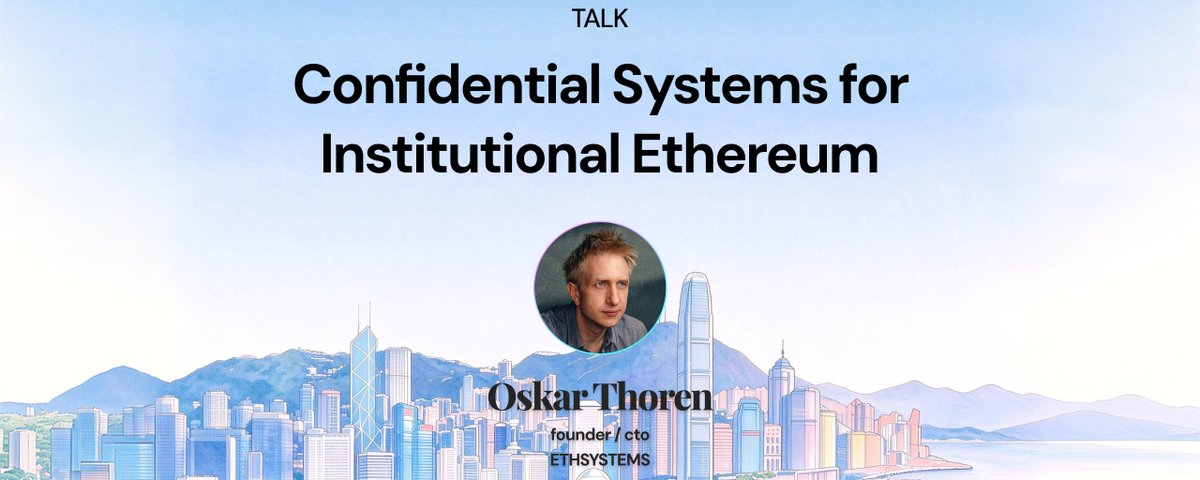
At Hong Kong FinTech Week, @oskarth was on a panel with Euroclear, the BIS Innovation Hub, CAT Investigators and Elephants Inc about why institutional tokenization keeps getting stuck in pilots.
A pilot can live with a public ledger. A portfolio can’t. And a tokenized bond can outlive the cryptography it was issued under, so issuers need to plan for quantum migration too.
If you’re working on confidentiality or post-quantum migration for long-lived assets, we’d like to compare notes 📝
#HKFTW26
