Increase your sense of wonder. (Author of 50 books & 800 patents. Yale Ph.D.) "Pickover contemplates realms beyond our known reality." ~NY Times
New York
Joined September 2008
- Tweets83.9K
- Following50
- Followers236K
- Likes2.2K





Pinned Tweet
Ask me anything.
I will be happy to answer some of your questions, and will try to reply to a portion of your questions below in the coming days.

Apollo’s Eightfold Seal: What is the area of the symmetric central octagon created by connecting the vertices and midpoints of a unit square? A devilish little geometry puzzle.


Math.
A new result on an 80-year-old Cake-Cutting problem. How many cuts and questions does it take to divide a cake so that everyone thinks their own share is at least as good as anyone else’s?
Paper by @harisazizk: arxiv.org/abs/2611.30002
Video: cgi.cse.unsw.edu.au/~haziz/E…

Mathematics. Hinduism.
Sometimes, the exotic formulas of Indian mathematician Ramanujan (1887-1920) make me shiver a little. You?
He often credited his mathematical insights to dreams and visions linked to his family deity, Namagiri Thayar.


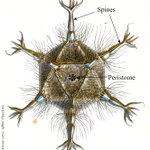
Behold Circogonia icosahedra. It's amazing to realize that this naturally appeared, after billions of years, from the quark-gluon plasma of the Big Bang. The universe somehow taught life how to dream in symmetry, to build cathedrals out of sand.

Math, physics, beauty.
Dots in simple, circular orbits create larger wave patterns. No single dot travels with the wave. Watch one dot, then watch the whole field. Local rules and slight phase shifts can generate rich, rippling order.
By @beesandbombs, Used with permission.
Math. Simulation. Artificial Life. A private primordial ocean.
→Credit: I didn’t upload this video to 𝕏. I’m pointing to a longer video within the 𝕏 stream of Harley Turan, 𝕏 ID “hturan”, Nov 24, 2026.
I like to imagine that what starts as simple materials and rules slowly becomes membranes that fold, tissues that differentiate, organs that seem to remember their purpose.
Given enough time and space, do the same dynamics that once turned chemistry into biology eventually turn "bits" into something that could be called a civilization?
Note: I’m testing X’s new Clip Video feature, because X requests we use this feature that credits the video source and allows both view credit and monetization credit to flow to the source. The web page of the creator is hturan[.]com.

Mathematics: short animation.
When exploring the Mandelbrot Set, it's easy for you to discover a specific pattern or design that no human has ever seen before. The Mandelbrot Set is the hammer that shatters the ice of our unconscious.
If Isaac Newton and Gottfried Leibniz had never been born, how much would the modern world actually change?
Would modern calculus (and everything built on it) have been delayed by a century, or merely by five years?

How do you unite two of math’s greatest constants without a single imaginary number? You take a wave, weigh it down, and let it run to infinity. The result is beautiful.
→ The equation that convinces people to study the mysteries of math in school and beyond.

Free Physics Book. "The Feynman Lectures on Physics," now online. (Designed for ease of reading on devices of any size or shape. Text, figures & equations can all be zoomed without degradation.)
Vol. I: Mainly mechanics, radiation, and heat
Vol. II: Mainly electromagnetism and matter
Vol. III: Quantum mechanics
-Feynman's Tips on Physics: Problem-solving supplement to Feynman lectures on physics
-Feynman's Messenger Lectures
-Lecture Recordings 1961‑64
-Lecture Photos 1961‑64
-Feynman's Notes
-Original Course Handouts 1961‑63
-Student handouts
-Book Link: feynmanlectures.caltech.edu
-Link to bongo/drums photo: tinyurl.com/mvpzkzxf

This article caught my eye today: some of the earliest proto-science fiction came from the Islamic Golden Age, a period of major cultural and scientific flourishing in the Islamic world.
In the 12th century, Ibn Tufail wrote Hayy ibn Yaqdhan, a philosophical thought experiment about a boy raised by a gazelle on a desert island who discovers science and reason from scratch: a tale that later helped inspire Robinson Crusoe.
What's your favorite example of surprisingly early sci-fi?
Article: gizmodo.com/the-islamic-root…

Mathematics.
A mathematician emerges from a cave, hands you the slip of paper below, and asks "What is √∞? Unlike sin(∞), this one actually behaves. Mostly. Why?" What is your response?


Experienced teachers: What is one concrete thing a brand-new teacher can do tomorrow morning that sounds counterintuitive (or almost rule-breaking) but actually works?


I'm in love with the "low-light paintings" of John Atkinson Grimshaw (1836–1893). This is "Glasgow, Saturday Night." What's your favorite low-light painting?

This is a math joke involving talking penguins.
Adapted from tinyurl.com/yc6u6s44
