

Sovereign AI for enterprises. Build AI you own on infrastructure you control. Private, specialized models that run where your data lives.
Austin, TX
Joined May 2022
- Tweets545
- Following37
- Followers6.8K
- Likes1.1K




webAI retweeted

ACL for nerds @TomorrowXSummit - had a blast chatting w @Davidstout CEO and cofounder of @thewebAI - the most important and fastest growing on-prem sovereign AI company in the USA. Thank you @Atreidesmgmt @valor

webAI retweeted

An 8.8B parameter Local model is claiming better coding performance than Google's 31B Gemma 4.
Maybe my new local small coding model!
And the 4-bit model is just 4.98 GiB!
This is webAI's TwIL-8B. 🔥
Built on IBM's Granite 4.2-8B, then trained further for reasoning, coding, and mathematics.
Look at webAI's reported LiveCodeBench results...
🔥 TwIL-8B (8.8B) → 81.6
🟢 Gemma 4 31B → 80.0
🔵 Gemma 4 12B → 72.0
🟣 Qwen3.5-9B → 65.6
An 8.8B model scoring above a 31B model on coding!
Other reported results:
🧮 MATH-500 → 98.2%
🎯 IFBench → 74.4%
🧠 AIME 2025 → 88.3%
Stats
🧠 8.79B parameters
📚 131K context
💾 Q4_K_M → 4.98 GiB
💾 Q8_0 → 8.70 GiB
💾 FP16 → 16.38 GiB
🎯That 4-bit version is small enough to run on an 8GB GPU with room for modest context and runtime overhead.
And webAI provides TWO reasoning variants:
⚡ Balanced → shorter reasoning, fewer tokens
🧠 Verbose → longer reasoning for difficult problems
Both available as GGUF downloads for local inference.
🔓 Downloadable weights
⚠️ Non-commercial license, not Apache 2.0
Link in ALT

ALT https://huggingface.co/webAI-Official/TwIL-8B
webAI retweeted

Pretty amazing, proud of the @thewebAI intelligence team; just getting started.
Twil 8b is not a perfect model, but it’s a big step towards frontier intelligence on your devices.
What I have found it to be great at is controlled local coding tasks, tool use, and reasoning entailments for decision models.

webAI retweeted

🏁 BENCHMARKED: @thewebAI's TwIL-8B, an 8.8B open-weight reasoning model, just went 69/69 on my tests running on my 64GB M5 Pro Mac mini.
The 4-bit MLX build runs at 53.8 tok/s from a 4.9 GB file.
Full bf16 with the whole 128K context fits too, peaking at 40.5 GB on a 64GB machine.
Same scores on both builds, thinking on:
✅ Math 20/20
✅ Code 10/10
✅ Instruction following 10/10
✅ Harder math 8/8
✅ Harder code 5/5
✅ Tool calls 5/5
✅ Hidden fact at 32K and 64K: 8/8
✅ Hidden fact at full 128K: 3/3 (bf16)
4-bit speed by context:
- 512: 53.8 tok/s
- 32K: 26.6 tok/s
- 128K: 9.2 tok/s at 27.9 GB peak
bf16 speed by context:
- 512: 16.7 tok/s
- 32K: 12.6 tok/s
- 128K: 6.6 tok/s
@Davidstout called it "small enough to run on your own hardware."
I checked and it runs at full precision with the whole 128K context on a desk I own.

🚨 JUST LAUNCHED: @thewebAI open-sourced TwIL-8B, an 8.8B open-weight model within 4 points of GPT-5.5 on LiveCodeBench.
It fits on my 64GB M5 Pro Mac mini in full bf16 with the whole 128K context (~36GB on paper)
Small models are eating the API’s lunch.
Benching it in sometime. Real tok/s soon.


webAI retweeted
Just days after we released TwIL-8B, the Hugging Face research team is already pushing its capabilities further.
Today, @huggingface published new research exploring how reinforcement learning and lightweight LoRA adapters can turn reasoning models into capable AI agents.
They included @thewebAI TwIL-8B alongside models from Liquid AI.
The early results are encouraging.
Despite never being explicitly trained for agentic tool use, TwIL-8B is already outperforming the smaller LFM3-1.7B across all three agent harnesses in preliminary baseline evaluations.
Now they're exploring how much further those capabilities can improve through specialized reinforcement learning.
One base model. Many specialized capabilities.
This is a direction we strongly believe in at webAI. Intelligence should be adaptable, efficient, and increasingly capable without requiring ever-larger models.
But what excites me most is the collaboration happening across the open research community.
We built TwIL to push the boundaries of what smaller models can accomplish. Seeing the Hugging Face team build on that work almost immediately is exactly why open research matters.
Huge appreciation to the Hugging Face team for including our work and advancing this research.
The future of AI will be built by more than a handful of labs.
And we're excited to help build it.
Research: lnkd.in/gV7m_-qc
Live training: lnkd.in/g6KAgAAg

webAI retweeted

Meet TwIL-8B, an 8B parameter model built on Granite 4.2. It's designed for reasoning, math, and code, and it's already getting love with 3.5k+ downloads. If you're into open models that punch above their weight, this one's worth a look.

webAI retweeted

Harness adapters training is now live!
We are training LoRA adapters on LFM2.5 / LFM3 from @liquidai and the recent Twil-9B model from @thewebAI using RL to make them more efficient and accurate on agentic tasks!
You can follow the training going live here: harness-hub-harness-adapters…
huggingface.co/blog/harness-…

webAI retweeted
Today, we're announcing webAI Meridian-1 CivOE.
A 12B AI model that statistically matched Gemini 4 Argon and outperformed Claude Opus 5.5 in evaluation.
But the most important breakthrough isn't the benchmark.
It's how we achieved it.
Instead of endlessly scaling model size, we've built intelligence that adapts to the work through specialized experts.
Our results:
Meridian-1 CivOE: 85.5
Gemini 4: 84.7
Claude Opus 5.5: 82.7
GPT-5.6: 71.0
The same 12B foundation went from 59.8 to 85.5 through specialization. A 25.7-point improvement without making the foundation model larger.
We believe this represents a fundamental shift in how intelligence will evolve.
Just as software became personal, customizable, and accessible on everyday computers, intelligence is heading in the same direction.
Intelligence that adapts to your knowledge, your work, and your devices.
We're beginning the rollout of Meridian-1 CivOE with strategic partners over the next few weeks, before expanding access to all webAI users.
The future of intelligence isn't just bigger.
It's yours.
Read More: webai.com/research/meridian-…

webAI retweeted
Thank you all for the incredible support. TwiL-8B hit #24 of 433,863 text generation models on Hugging Face in its first 7 hours.
We have more to share, and it’s worth waiting for. Tomorrow morning we’re releasing one more model, our best yet, and opening general access to webAI.
See you in the morning.
webAI retweeted
Release 2 of 4 today: webAI Air.
73% smaller. Nearly 99% of measured benchmark performance retained.
Air is our method for compressing AI models so more capable intelligence can run on everyday devices.
Our first release applies Air to Google’s Gemma 4 26B A4B. Compared with the original model:
* 73% smaller model file: 50.5 GB → 13.47 GB.
* 98.7% of the average benchmark score retained: 78.3 versus 79.3 across six benchmarks.
* 2.1× the generation speed: 60.6 versus 28.7 tokens per second in our DGX Spark tests.
Compared with Google’s own 4-bit version, Air is also 6.7% smaller, with 61% lower divergence from the original model’s predictions in our evaluation.
Useful intelligence is becoming smaller, faster, and easier to put to work. That changes the economics of AI and puts more of it on hardware people already own.
Make cloud AI optional.
Two more releases coming today.

@thewebAI's Intelligence Lab is open sourcing Gemma 26b 4a Air
2.6× closer to full precision
Significantly more faithful to the original model than Google's official 4-bit release (KL divergence: 0.068 vs. 0.176).
Nearly 4× smaller
Just 13.5 GB vs. 50.5 GB, with the full 128K context fitting in 16 GB of memory.
Almost no loss in intelligence
Scores 78.3 vs. 79.3 across 6 benchmarks, retaining 99.4% of original performance on knowledge, math, and coding.
Matches the original on real-world tasks
Nearly identical wIL scores (Track A: 0.502 vs. 0.508; Track B: 0.812 vs. 0.812).
HF: lnkd.in/gJK6xR9B


webAI retweeted

@thewebAI's Intelligence Lab is open sourcing Gemma 26b 4a Air
2.6× closer to full precision
Significantly more faithful to the original model than Google's official 4-bit release (KL divergence: 0.068 vs. 0.176).
Nearly 4× smaller
Just 13.5 GB vs. 50.5 GB, with the full 128K context fitting in 16 GB of memory.
Almost no loss in intelligence
Scores 78.3 vs. 79.3 across 6 benchmarks, retaining 99.4% of original performance on knowledge, math, and coding.
Matches the original on real-world tasks
Nearly identical wIL scores (Track A: 0.502 vs. 0.508; Track B: 0.812 vs. 0.812).
HF: lnkd.in/gJK6xR9B
webAI retweeted
Modest intelligence is arriving faster than most people realize.
Today, we're open-sourcing TwIL-8B.
Just 8.8 billion parameters, yet approaching frontier-model scores on several difficult benchmarks:
• 93% of frontier performance on coding
• 92% on instruction following
• 90% on contest mathematics
All from a model small enough to run on your own hardware.
But the benchmarks aren't the most important part of this announcement.
For years, the AI industry has focused on building the most capable model, regardless of the cost required to run it.
I believe that equation is changing.
The next era of AI will be defined by the cost of completing work. Not simply the intelligence of the model, but how efficiently that intelligence can accomplish the task.
If a model with 8 billion parameters can reliably complete the same work as one with hundreds of billions, why pay for the larger model?
As smaller models become more capable, intelligence becomes something we can distribute, specialize, and run across the hardware we already own.
That's the future we're building at @thewebAI
TwIL-8B is available today. Open weights.
And this is just the first of several announcements we're making today.
HF Link: huggingface.co/webAI-Officia…
webAI retweeted
its almost like ai in the cloud does not work ... ai will move toward user owned hardware.
@thewebAI has major announcements this week.

webAI retweeted
Your car sits parked most of the day. That doesn’t mean a taxi company should own it.
The same applies to AI.
Ownership buys autonomy, availability, and control.
Calling that “inefficient” is convenient when your business depends on selling access.

sam: local inference is a terrible allocation of scarce resources
“a lot of people want local inference, and somehow they assume that the problem is solved now because we have open-source models, we're going to be able to run them on our computers, and so we're not going to need all the stuff in the data centre
but from a global allocation perspective, actually it's quite terrible to have everybody, like, have a bunch of the world's limited supply of DRAM sitting in their own computer and being used five percent of the time
you want maximum utilisation in the cloud if you're trying to deal with this very supply-constrained environment
somehow many people's intuition is the opposite of that”
webAI retweeted

We’ve been playing around with the new TwIL-LM3-Pro model and in this maze problem it solved it so fast and even beat Qwen3.8-27B!
Seeing this model perform this good at only ~4B is crazy, definitely should check it out if you haven’t already!

We ran TwIL on a CPU with 15 GiB of RAM. No GPU. It generated tokens 98x faster than Qwen3.8-27B on the same hardware.
The test:
- Intel Xeon CPU, 4 threads
- 15 GiB RAM
- No GPU
Results:
- TwIL-LM3-Pro (2.24 GB weights): 10.47 tokens per second
- Qwen3.5-9B (5.67 GB weights): 4.36 tokens per second
- Qwen3.8-27B (16.45 GB weights): 0.107 tokens per second
TwIL and Qwen 9B both run at the RAM's memory limit of about 24 GB/s. Qwen 9B is 2.4x slower only because its weights are 2.5x larger.
Qwen 27B's 16.45 GB of weights don't fit in the 15 GiB of RAM. Parts have to be re-read from disk for every token. Size alone would make it 7.3x slower. The disk reads add another 13x. Total: 98x slower than TwIL.
With enough RAM, the gap would shrink to about 7x. But most people don't have unlimited RAM, and most people don't have a top-tier GPU. The model you can actually fit matters more than the one you can't.
Download TwIL-LM3-Pro on @huggingface: huggingface.co/webAI-Officia…
webAI retweeted
AI models are not conscious. A CEO or leader who seriously claims that current systems are conscious is either profoundly confused about the technology or engaged in deliberate misrepresentation, and is unfit for authority over AI development or deployment.
Current models are large statistical systems trained to predict tokens. They have no evidence of subjective experience, unified agency, persistent self-models independent of the prompt, or any of the functional markers that would be required even on generous functionalist accounts of consciousness. Anthropomorphic outputs are produced because the training data is full of human self-description; that is imitation, not evidence of an inner life.
Treating such claims as a reason for removal from power is therefore not a medical diagnosis. It is a judgment about competence and incentives.
Leaders who assert consciousness in present systems either do not understand what they are shipping, or they benefit from the confusion—through valuation narratives, regulatory positioning, or public relations. In either case they are poor stewards of a technology whose real risks (capability, misuse, concentration of power) are already concrete and do not require speculative inner experience to matter.


NEW: According to a bombshell report in the New York Times, Anthropic co-founder Chris Olah threatened to walk out of Pope Leo XIV’s AI encyclical launch in May because the pope rejected the idea that machines can be conscious.
Olah’s team then privately lobbied the pope’s advisers “to take the possibility of model consciousness seriously.” Pope Leo XIV held firm.
For months, Anthropic has wined and dined theologians and religious scholars under nondisclosure agreements, hoping they would bless the idea that Claude has moral standing. thelettersfromleo.com/p/nyt-…

webAI retweeted
Half a million downloads in a month. Today, our open source family takes another step forward.
Thank you for the incredible support behind our first-generation models. We’re excited to introduce TwIL-LM3-Pro.
At just 3.6 billion parameters, it brings powerful reasoning to everyday computers, with quantized builds that run locally. No cloud required.
In our evaluation:
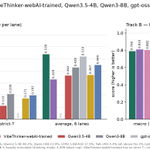
Formal logic: Highest recorded headline score among the small models compared—beating China’s VibeThinker-3B by 35% and Qwen3.5-4B by 24%, and Liquid AI’s LFM2.5-8B-A1B by 47%.
Broader reasoning: 95% on SVAMP and 64.1% on MuSR, the highest recorded scores among the small models compared.
BIG-Bench Hard’s logic subset: 95.4%, compared with VibeThinker-3B’s 61.1%.
We believe AI is entering a post-training era. The advantage will increasingly belong to companies with the best pipelines and those that can produce capable, personalized intelligence faster and more efficiently, then put it on devices people already own.
That’s what we’re building at webAI. And we’re only beginning to share what’s coming out of our lab.
Coming soon: Meridian, our family of frontier-class models built to run on device. Our most advanced models will be available through the @thewebAI application.
Join the waitlist as we expand access. Proudly built in Austin, Texas. 🇺🇸
