

Sandboxing reinvented for the threats of today - and tomorrow. | Imprint: https://www.teapawt.net/t.co/yZtPfo2ySF
Boston, MA
Joined November 2013
- Tweets2.8K
- Following2K
- Followers4.2K
- Likes1.5K





Pinned Tweet
🔎 New Telegram-based RAT with capabilities for (almost) every scenario: Astral C2
🔗 Report: vmray.com/analyses/telegram-…
We found a new Telegram-based RAT “Astral C2”, first uploaded to VirusTotal on 2026-09-13. This implant offers advanced capabilities for the operator with Telegram as a sole C2 channel.
💡 In a nutshell:
- Astral C2 observed with C2 via Telegram bot “bot8943612540:AAG0J2fqQC21igji3gD5gabJu-t5fvPRCz4” (Telegram username: astral_c2_bot)
- Pulls /getUpdates API endpoint for operator commands, /sendMessage and /sendDocument for exfiltration
- Only activates malicious behavior after operator command
- Contains capabilities for smash-and-grab stealer operations, as well as advanced intrusions
The observed sample contains targeting for game cheats, crypto exchanges, email providers, and Russian banks
- Telegram as a C2 channel often avoids reputation based alerting or blocking
- Plaintext commands for basic functionality like keylogging, implant status and interactive shell
- Encrypted advanced functionality via operator tooling “ratctl.py”
Credential theft (e.g. Browsers, applications, and LSASS dumping)
Privilege escalation (e.g. SeDebugPrivilege, UAC Bypass)
Screenshots, webcam, microphone and clipboard access
Lateral movement
Code injection
Anti-forensics
SOCKS5 proxy and port-forwarding
🗝️ Recommendation:
Monitor or block Telegram API access (api[.]telegram[.]org) due to Telegram being an increasingly popular C2 channel for malware and phishing


🔎 Evolution of a ScreenConnect dropper
🔗 Report: vmray.com/analyses/evolution…
We observed a campaign using a VBScript dropper for installing ScreenConnect RMM and notifying the operator via Telegram, therefore abusing two legitimate products as part of their toolchain.
The dropper evolved through several versions within the short timeframe it has been seen. RMM tools have become a staple in modern intrusions and offer a clear advantage compared to traditional RATs: They are considered legitimate and therefore often do not get flagged or blocked by security solutions.
💡 In a nutshell:
- The script drops ScreenConnect 25.3 - a version that was released before ConnectWise removed customization options that were abused by threat actors (e.g. system tray hiding) and for which the certificate has been revoked ScreenConnect is configured to show as little usage indicators to the user as possible
- VBScript dropper (internal names: “facrt.vbs” / “Install-ScreenConnect-2Click.vbs”) downloads ScreenConnect installer from attacker-controlled ScreenConnect server tinnypilar[.]com
- Filenames indicate lures for software like Docusign, Calendly, Bullpen CLI, or Helium browser
- Dropper evolved from first sightings in August, to recent iterations (v7) in September, five different dropper versions are linked to the same ScreenConnect server
- The earliest version simply downloaded and launched the ScreenConnect installer
- Support for Telegram notifications was added later, operator receives full installation report notification
- Support or multiple downloads methods was added on top of that in the latest observed version (curl, powershell, bitsadmin, msiexec-url)
🗝️ Recommendation:
- Monitor or block Telegram API access (api[.]telegram[.]org) due to Telegram being an increasingly popular C2 channel for malware and phishing
- Monitor or block installation and use of (unauthorized) RMM tools
🧬 IoCs
tinnypilar[.]com Attacker-controlled ScreenConnect server
8556588068:AAFnvSJomtwRJ-pM5X5DnVik3pzJBREWF6Y Telegram bot
-5538422583 Telegram chat ID
a1fb7bef4c37d63c55592afde2df0a0b9fb4b5fbb14f9ef3c8561a701c32d507 Dropper
23b011e021d54b93ef66f42aed1cab7052c65a62107a7884ea7f769d1b93054b Dropper
5992453381ff9728ba41398af3b32509db7ee77acae77e4e62e4cccc8e0ccfc9 Dropper
1a7fd245eddac0ee46b0ba0066ce84249d11a25cf70c459ed5756e0b8979e43b Dropper
c86b9f2041d7e9c9a9bc620271283d4a5e445647310849224f69f6de6c7ac782 Dropper


276 Formbook samples is too many to triage one at a time. So independent researcher Robin Dimyanoglu let behavior sort them first. vmray.com/hunting-a-global-f…
In a new investigation on the VMRay blog, Robin ran the samples through a Machine Learning pipeline that groups malware by what it does at runtime.
It produced 17 clusters. One of them held just six samples, first seen between May and July 2026, and it turned out to be the entry point to a global Business Email Compromise campaign.
From a single hash in that cluster, surfaced through VMRay UniqueSignal, the investigation traced:
🔹 An active C2 with 46 communicating files and a pool of 14 domains all posting to the same panel path
🔹 A lure timeline that moved from generic purchase orders to forged SWIFT payment receipts aimed at finance staff
🔹 A domain-generation pattern built on Lorem Ipsum filler words, with hundreds of matching domains across five naming families
🔹 Three target groups: trade and finance departments in Europe and Asia, maritime charter operators, and Gulf Public Sector and interbank settlement teams
The full write-up includes the clustering method, the pivots, and the indicators.
🔗 vmray.com/hunting-a-global-f…

Open a reported phishing email the way its recipient did. Click the link they were meant to click. Follow whatever it pulls down next. All in one session, without splitting the investigation across separate submissions. vmray.com/release-highlights…
That's the headline of VMRay Platform 2026.4, and it's one of many things teams can now get done that used to take more effort:
🔹 Investigate a suspicious email end to end:
Investigative Analysis opens the message in a real mail client during a Live Interaction session. Inspect attachments, launch a Web Analysis from an embedded link, and examine each artifact with the right engine, while the whole path stays connected.
🔹 Keep analysis data on the storage you already run.
On-Premises deployments can now connect to S3-compatible object storage such as Ceph through a configurable endpoint. Samples and analysis archives are automatically excluded from Platform backups, so nothing gets stored twice.
🔹 Answer "who logged in, and when?" with evidence.
The new User Audit Log records logins, failed attempts, invitations, account changes and role changes. Pull any date range through the REST API, with records retained for at least 180 days.
🔹 Onboard analysts without manual account setup.
With SAML SSO automatic provisioning, accounts are created on first login and permissions follow the role mappings from your identity provider.
The full breakdown: vmray.com/release-highlights…

Static indicators only catch what malware wants you to see. When a threat alters its behavior based on its location, traditional analysis often misses the payload.
In our latest research, Threat Researcher Hasan Mevzi from VMRay Labs breaks down a geo-aware malware strain designed specifically to evade detection and drop two hidden backdoors.
🔹 Bypassing standard analysis through geographic filtering
🔹 Deploying secondary persistence mechanisms unseen by static signatures
The complete execution logic and extracted IOCs are in the link below.
vmray.com/what-indicators-mi…

🔍 Home path leak in infostealer links developer to ransomware
🔗 Report:
vmray.com/analyses/zer0day-s…
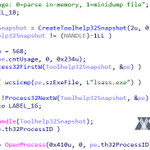
The stealer, written in Rust, is called "Zer0day Stealer" and contains the string "/home/tcherber/.cargo/" baked into the binary as part of the build process.
A search for this string reveals earlier versions of the stealer, as well as an unrelated ransomware called "ENIGMA Locker". The developer is also likely behind a remote-control HVNC sample that is often deployed alongside the stealer, as it contains the same home path and has a compilation timestamp within seconds of other related samples.
In general, the compilation times reveal that all found executables were built within the span of a few weeks. The search also uncovered other files: a dropper written in C, another written in Rust, and a PowerShell loader that abuses certutil, all of which drop a variant of the same stealer and HVNC sample.
💡 In a nutshell:
- The stealer exfiltrates data such as crypto wallets and browser credentials
- The HVNC sample comes with a hardcoded password ("Admin@2024") and uses a single-byte patch to hide from AMSI and ETW
- The same home path also appears in the recently discovered "ENIGMA Locker" ransomware
- New versions of the stealer show small changes, ranging from a new C2 address to file-extension-based exfiltration (e.g., Office documents and VPN configuration files), suggesting that the malware is still under active development
- There is also a dropper likely written in C and compiled with GCC, as well as another written in Rust, which contains the same Cargo path and appears to accept optional arguments for a different payload URL
- Another version of the dropper suggests that the developer may have used a different machine to build the samples, as the path has changed to "/root/.cargo"
- C2 interface leaks additional information about cross-platform builds (Windows, Linux and MacOS) and other samples titled “FUD-Crypter”, “Botnet” and “C2 Agent”
- In general, strings like pdb filenames, build paths and other artifacts can leak useful information for attribution or finding related samples


🧬 IoCs:
http[:]//93.152.220[.]87:5000/dl/stealer_raw.exe
http[:]//93.152.220[.]87:5000/dl/hvnc_raw.exe
http[:]//93.152.220[.]87:5000/api/c2/heartbeat
http[:]//93.152.220[.]87:5000/api/stealer/report
http[:]//93.152.223[.]30:5000/dl/loader.cer
http[:]//93.152.223[.]30:5000/uploads/hvnc.ps1
93.152.220[.]87:5000
93.152.223[.]30:5555
fad8f76afec90c888b4a739539deae250320fd49c34ef8458833b356ea9b7767 (Zer0day Stealer variant #1)
d0f0734d4e31ec126da43a46896d0cd761e5532c0c385db6226cc5a6927d7722 (Zer0day Stealer variant #2)
f9964a8d9d01052d9bebe057deadd7ce9d794e8296e2a72229f8ae4aa62ae224 (Zer0day Dropper variant in Rust #1)
7cb59abaa268ac66461447773d46bb0b0e5e2568e35e1a8f1d07ac2ec57f67a6 (Zer0day Dropper variant in Rust #2)
6bddf59e2a5065255cfc90d2e2e66e3bfd4a7cbf4e0b6341b4da93b574cc4f53 (Zer0day Dropper variant in C)
278762dfc0f743216a475919bdc9ecc59735bcc247bba5b7b468fc475407ec6a (Zer0day HVNC)
178f890f62db90738b11300dd272537240b1c8a599d2ebeccdea01654811fed0 (HVNC PowerShell)
6aef80514237808dfe25621a8912422d20a8414bc2054008a119e541166821b5 (PowerShell Dropper)
abd43578b135df61f49844087af0b372ae10b2f27721ad6ba09710760ab0b240 (Enigma Locker)
Threat actors keep finding ways to make phishing look ordinary. vmray.com/july-2026-detectio…
A sign-in page that asks you to clear a CAPTCHA first.
A link that passes through a few legitimate redirect services before it lands.
A next-stage address fetched from a Web3 service at runtime, so nothing malicious is written into the page itself.
Detecting this comes down to reading behavior, not appearance.
July's Detection Highlights documents what the VMRay Labs team shipped to do exactly that:
🔹 Meta-VTIs for the Sneaky2FA and Tycoon2FA phishkits, correlating the individual network behaviors that only form a clear pattern when seen together
🔹 Detection for Web3 services used as dead-drop resolvers to hide next-stage infrastructure
🔹 Detection for suspicious multi-step redirect chains that obscure a link's real destination
🔹 New email VTIs for urgency and pressure language, brand impersonation, and lure images loaded from public hosting
🔹 New config extractors for Phorpiex, NetSupport Manager, ScreenConnect, and ValleyRAT, plus 50+ new YARA rules
The full breakdown, with the behavioral context behind each detection, is in the link.
🔗 vmray.com/july-2026-detectio…

🔥 Alert: Chrome extension lets attackers remotely control out-of-focus browser windows to keep malicious actions hidden
🔗 Report: vmray.com/analyses/chrome-ex…
We found a sample likely written in Rust which drops Stealc and a malicious Chrome extension pretending to be GoogleTranslate.
The extension can extract the browser history, bookmarks, a list of installed extensions, credentials, and cookies. It also provides threat actors with a live stream of Chrome windows and allows them to remotely control websites using mouse clicks and keyboard input.
However, to hide those remote actions from the victim's view, the extension also allows remote control of out-of-focus windows in the background.
Furthermore, the extension can overlay legitimate login forms with an iframe from a phishing page while keeping the legitimate domain visible in the address bar.
💡 In a nutshell:
- Rust binary drops malicious Chrome extension and AutoIt script, which in turn drops Stealc.v2
- Chrome extension pretends to be Google Translate
- Extension steals browser history, cookies, and credentials
- Provides features to remotely control inactive Chrome windows, set a proxy, and inject malicious JavaScript into specific sites
- Can live-stream tab content and allow attackers to interact with it remotely
- Can perform a man-in-the-browser attack by replacing the site content with an iframe loading from a phishing page
🧬 IoCs:
http[:]//87.120.104[.]147:8080
http[:]//160.20.109[.]33:80
7ba2c663d76d2d353a02d815381f22a1b04b2032162b1559455d1f456432340a (Rust binary)
02e9da11f035bd4e18338ddd78e2818da49e7d1c8f614e9b329afaf581c33301 (Chrome extension)
4f82542f68d2e677fb64ba986c8d5f3a04017a1bf7a11d375e52f950e32eb262 (AutoIt script)
45c7d791fab4128fb495f359ed641e217883f132bb8f13c1e181caf5f5279a34 (Stealc v2)


A scanner probes an unfamiliar IP. The server responds with a 301 redirect to github[.]com. Nothing to see. Move on. That was the point. vmray.com/execution-level-an…
VMRay Labs has published an analysis of Operation STANDOFF, a previously unattributed cybercriminal operation running on at least 44 servers, every one of them configured to answer unsolicited HTTP requests with a redirect to GitHub.
To an analyst or an automated scanner, the infrastructure looked unremarkable. Its traffic blended in with ordinary GitHub communication.
Our investigation started from a single UniqueSignal finding, a behaviour-level detection surfaced from hypervisor-level observation of what a sample actually did at runtime, rather than from any reputation or signature match.
From there, execution-level analysis and infrastructure pivoting reconstructed something considerably larger than one malware host:
🔹 A pay-per-install loader distributing Raccoon Stealer, RedLine, Amadey, SmokeLoader, Socelars, Glupteba and XMRig, while disabling security controls and establishing rootkit-grade persistence
🔹 A proxy-botnet enrolling compromised hosts as traffic-relay nodes
🔹 A custom multi-operator console for coordinating hands-on-keyboard intrusions into corporate Active Directory environments
🔹 A large-scale, AI-assisted influence and engagement-manipulation platform operating across email, Telegram and WhatsApp
All of it on shared infrastructure. Much of it still undetected by security vendors at the time of writing.
Written by Hasan Mevzi.
🔗 vmray.com/execution-level-an…

😯 A curious finding: Python malware drops and compiles three C source files at runtime ( ! ) to steal credentials
🔗 Report: vmray.com/analyses/ultimate-…
We have identified an information stealer called “ULTIMATE STEALER” or “Ishmael_19Bot” written in Python and distributed as a PyInstaller executable which includes an extensive list of techniques for extracting credentials and sensitive documents, such as scans of passports or tax returns.
Curiously, the sample also comes embedded with three C source code files that it attempts to compile at runtime to extract additional credentials or perform low-level evasion checks. To compile them, it checks the system for Visual Studio installations before using build tools such as "vcvarsall.bat".
💡 In a nutshell:
- While there is some overlap between the functionality implemented in Python and C, the latter is mainly responsible for more performance-heavy credential extraction, such as scanning process memory for passwords, as well as low-level evasion techniques, but the Python module operates regardless of whether the C code is compiled successfully
- Python code tries to find documents related to passports, driving licenses, ID cards, birth certificates, bank statements, tax returns, and more, with support for PDF parsing
- Supports process injection, DLL injection, screenshot capture, and stealing cryptocurrency wallets, browser credentials, Wi-Fi passwords, and clipboard contents
- Performs a variety of anti-analysis checks, including IsDebuggerPresent, CPUID, checks for sandbox-related process names and VM artifacts
- Uses numerous persistence methods, including via the registry, scheduled tasks, services, WMI, LNK hijacking, COM hijacking, DLL hijacking, browser extension installation, and Image File Execution Options (IFEO)
- Appears to contain AI-generated code and could be a work in progress
- Compresses and exfiltrates data via Telegram
- Curiously, the Python sample imports a speech recognition library but does not appear to use it anywhere


Modern phishing pages don't reveal themselves right away. A button to click. A checkbox to mark. A prompt to accept. Only after the interaction does the real payload appear. For automated analysis, that creates a gap: if the sandbox doesn't act the way a person would, the attack stays hidden. vmray.com/release-highlights…
Browser automation has long relied on a page's underlying structure, the DOM, to find and click elements. That works well when the structure matches what the user actually sees. It struggles when an overlay covers a button, or when something is plainly visible on screen but hard to pin down in code.
VMRay Platform 2026.3 closes that gap with AI Browsing Simulation. It adds a visual perception layer on top of the existing automation, using computer vision and OCR to read a page the way a person sees it.
Buttons, checkboxes, prompts, and labels get identified from the screenshot itself, with the visual read validating the cases where the page and its code don't line up. Fewer missed interactions on evasive, visually complex phishing pages. The model runs locally, and customer data is never used to train it.
The release also brings IR Mailbox webhooks to automate what happens after analysis, customizable submitter notifications, and KnowBe4 PhishER tag filtering to control what gets sent for analysis in the first place.
🔗 vmray.com/release-highlights…

Neither detail was unusual on its own. A non-standard port. A generic Microsoft HTTP server banner. Plenty of legitimate services run exactly that, so on their own, neither tells you much. Together, they were selective enough to hunt on. vmray.com/the-redline-thread…
That is one of the more useful lessons in a recent VMRay blog investigation by independent researchers. Starting from a single RedLine C2 surfaced through VMRay UniqueSignal, the analysis pulls the C2's HTTP response from the VMRay's sandbox and turns one specific pairing, the high port and the server string, into a fingerprint.
That fingerprint becomes the pivot: a query against internet-wide scan data to find other hosts sharing it, without ever touching the target infrastructure directly, which keeps the investigation quiet.
The full investigation includes every query used, so the approach is reproducible.
🔗 vmray.com/the-redline-thread…

Most ThreatIntelligence work stops at the blocklist. You take an indicator, confirm it's live, push it into a SIEM rule, and move on. Pivoting takes the same indicator further, and sometimes it leads somewhere you didn't expect. vmray.com/the-redline-thread…
The new investigation on the VMRay blog starts with a single RedLine Stealer C2 IP pulled from VMRay UniqueSignal and follows it outward.
The RedLine infrastructure itself was a short thread. But the files communicating with that C2 pointed somewhere else entirely: a tailored spear-phishing campaign targeting a South Korean maritime manufacturer, delivered through business email compromise.
From there, the investigation moves to the email distribution infrastructure behind the campaign, and surfaces a cluster of attacker-owned domains and servers, each one blockable at the email gateway before the next wave lands.
🔗 vmray.com/the-redline-thread…
🇵🇹 Despite years of investment in Secure Email Gateways, phishing is still one of the most effective ways into an organization. The question worth asking isn't why attackers keep trying. It's why they keep succeeding. bsidesporto.org/agenda
Tomorrow, VMRay is at BSides Porto. And on Day 2, Andrey Voitenko takes the stage to dig into exactly that.
His talk, looks at a structural reason phishing slips through: SEGs are built for speed and scale, processing huge volumes of email with minimal latency.
That optimization comes at the cost of depth, and sophisticated campaigns are designed to exploit exactly that blind spot: Multi-stage redirect chains. QR codes. SVG images. HTML smuggling. Geolocation- and time-based payload activation.
Andrey will also cover a practical, often-overlooked fix: connecting your User-Reported Phishing program to advanced sandboxing that operates outside real-time delivery constraints. The kind that simulates real user interaction, follows complex redirect paths, and exposes evasive payloads safely, with real-world examples including QR-code attacks and ClickFix.
If you're in Porto, catch the talk. Let's have a conversation after.

Consolidation looks like a cost decision on paper. In practice, it's a trust decision. Removing a tool means relying on what remains, and a security team can only makes that move when they're confident that what's left can be trusted to hold. vmray.com/customer-success-s…
A major US financial services SOC leader pursued a clear strategic goal: optimize their investment by consolidating around Microsoft Defender for Office and Endpoint, and divest from another significant security tool.
The condition? A validation layer accurate enough to confirm Microsoft Defender's verdicts and clean enough to dismiss false positives at scale. Without it, the consolidation risked exchanging cost savings for operational drag and undetected threats.
VMRay became that layer. In the security leader's words:
"Our strategic goal was to fully utilize Microsoft Defender. We needed to ensure it was supported by trustworthy validation, and VMRay was the critical enabler that gave us that confidence."
When consolidation works, it's because the analysis foundation can carry the weight.

🔥 Alert: One Russian-speaking crew, one set of servers: a malware botnet, a hands-on console for breaking into corporate networks, and an AI Telegram troll farm.
🔗 Report: vmray.com/analyses/operation…
We track it as Operation STANDOFF. The starting point was a single sample that VMRay UniqueSignal flagged on behavior, not a signature or known indicator. Pivoting on the two hardcoded C2 IPs it contacted at runtime revealed the wider operation. One IP also hosted the operators' console, "STANDOFF COORD". The same Russian-speaking crew runs three revenue-generating operations from one server infrastructure: a commodity malware botnet, hands-on intrusions into corporate networks, and an AI-driven Telegram troll farm (fake accounts and GPT-written personas generating engagement at scale). Much of the C2 blends in by redirecting requests to GitHub; pivoting on that pattern uncovered 44 related Russian servers.
💡 Takeaways:
• Financial and influence operations run side-by-side. Malware steals credentials and crypto wallets, mines Monero, enrolls victims into a proxy-botnet, and supports hands-on corporate intrusions. The Telegram operation uses AI-generated personas for engagement manipulation, disinformation, promotions, scams, and audience building.
• VMRay UniqueSignal flagged the sample based on behavior and exposed two hardcoded C2 IPs (212.193.30[.]45/proxies.txt and 212.193.30[.]29/server.txt) that led to the broader infrastructure.
• The malware C2 also hosted "STANDOFF COORD", a multi-operator console containing stolen NTLM hashes, Kerberos tickets, session cookies, and private keys.
• A single loader deploys Raccoon Stealer, RedLine, Amadey, SmokeLoader, Socelars, Glupteba, and XMRig while disabling Windows Defender and Windows Update.
• Persistence is achieved through a fake csrss.exe dropped into C:\Windows\rss and installed as a startup service using VirtualBox-style names.
• Victims are enrolled into a proxy-botnet through 212.193.30[.]45/proxies.txt, creating traffic relays for operator use or resale.
• The influence operation uses AI-generated Telegram accounts connected to a Standoff 2 / PUBG Mobile gaming portal that funnels a young audience.
• The C2 hides in plain sight: 44 TimeWeb-hosted servers redirect requests to GitHub to blend in with trusted traffic.
• A malformed WinHTTP User-Agent corrupted to a single 0x02 byte provides a distinctive network signature.
• Attribution points to a Russian-speaking team through Russian-language tooling, Moscow-time scheduling, and consistent "ggstandoff" / "GG Influence" branding.


🔥 Alert: Weaponizing Overlord RAT — open-source Golang RAT in DocuSign-themed phishing
🔗 Report: vmray.com/analyses/overlord-…
We have recently spotted a phishing campaign, which utilizes a new, open-source malware called OverlordRAT written in Go.
The chain starts with a malicious URL, which points to a domain impersonating the logistics company Global-Merx. The URI resource - utility.php - mimics an official DocuSign page and uses embedded JavaScript to trick victims into downloading a document of ACH Remittance payment, which is a malicious MSI installer, but we’ve seen the payload getting changed recently. The installer embeds a DLL stager and gets called via the CustomAction table of the fake Microsoft DirectX Runtime MSI installer. The DLL finally injects its payload to werfault.exe, decrypts the final stage Overlord RAT payload with XOR (0xA9) and executes it.
The use of Overlord RAT again reinforces our previous findings that actors are always on the lookout for adopting new tools in their attack arsenal.
🔑 Takeaways:
- URL → DocuSign phishing → MSI → DLL → EP injection (werfault.exe) → XOR (0xA9) → Overlord RAT
- MSI and DLL disguised as Microsoft DirectX Runtime files, embedded payload called via CustomAction table
- DLL stager injects to werfault.exe, decrypts Overlord RAT payload with XOR key 0xA9
- The open-source Overlord RAT handles encrypted WebSocket traffic, provides HTTPS, JWT, RBAC and MFA authentication, flexible remote desktop streaming (WebRTC, MediaMTX) and supports Windows, Linux and macOS platforms


A phishkit rarely looks malicious if you take its behaviors one by one. vmray.com/may-2026-detection…
A connection to Microsoft's real authentication infrastructure: legitimate.
A reference to the genuine Microsoft password-reset page: legitimate.
A block of login-related text: legitimate.
Each behavior, on its own, appears in countless trustworthy applications.
It's when they appear together, in the same sample, that the pattern emerges.
That's the logic behind one of this month's additions from VMRay Labs: a new meta-VTI that correlates several individually-benign behaviors into a single classification, improving detection of EvilProxy-style phishkit activity, the kind built around adversary-in-the-middle credential and token theft.
The full breakdown is in the link.
🔗 vmray.com/may-2026-detection…

Something gets blocked. The alert closes. Everyone moves on... That's the moment most SOC teams know the least about what just happened. vmray.com/blocking-a-threat-…
Microsoft Defender stops threats at scale. That's what it's built for, and it does it well. But blocking an attack before it executes carries a trade-off: some of what the attacker was trying to achieve never gets observed.
The files that would have downloaded. The infrastructure it was set up to communicate with. The next move in the chain. The question is what to do with everything blocked at the perimeter: the alerts that, on closer inspection, would have a lot to teach the team.
That's what our latest post explores: where deep, evasion-resistant analysis fits alongside a strong Microsoft Security program, and why the gap between blocking and understanding is worth closing.
🔗 vmray.com/blocking-a-threat-…

4
177
🔥 Alert: Evasion via excessive multi-cloud staging
🔗 Report: vmray.com/analyses/evasion-v…
We have recently caught a malware delivery chain, which seems to utilize numerous cloud services to host several, staged payloads that reference each other back and forth. This “cloud-hopping” strategy is making use of less-known online code-sharing and file hosting platforms and ultimately tries to evade automated systems. The excessive cloud-hopping is actually why this “manufactured complexity” stands out from standard attacks.
The multi-stage attack chain starts with an obfuscated PowerShell payload (arithmetic calculations, Deflate and Base64), then hops across PythonAnywhere, and ends at the service Pastes[.]dev. The latter pulls 4 samples from the image-hosting service image2url (which can host .exe files too), like UnixStealer or FunnyLoader, and downloads a PyInstaller executable.
A Python script is then pulled from Pastes[.]dev again, which sets up a localhost tunnel via a free service called Pinggy and deploys the open-source Gost/GoSimpleTunnel for bridging the tunnel.
💡 Takeaways:
- PowerShell loader uses arithmetic calculations, Deflate compression and Base64 encoding for obfuscation
- Script checks for username ”runneradmin” to avoid running in GitHub Actions Runners environment
- Next stage PowerShell code grabbed from PythonAnywhere, followed by another one from Pastes[.]dev
- 4 PE files fetched from image2url (UnixStealer, FunnyLoader, XWormLoader, PyInstaller)
- Another stage executes Python script from another Pastes[.]dev link, which connects to Discord C2
- Local proxy configured via downloaded Gost (GoSimpleTunnel) client and the tunneling service free.pinggy[.]io
- Code is marked with Vietnamese comments with references to: “hello sigma”, ”sigma miner”, “iamsigmaboy” and “sigmatoilet”
- Actor uses different usernames like “hai”, “haingng16“ and “haideptrai“ on several cloud platforms
- Additional stages are pulled from GitHub, GitLab, Pastefy and Codeberg along the chain to establish persistence


IoCs:
addcf8c7e62883cbce9ad45bd58006a0420394f4294875fdd99eef09ed7436f8 (SHA256)
c62cddc4871e864a7d792fa4b17c490c163ac09e5583ed34e8b09843c0138174 (SHA256)
9b6fb201bc81ebb69d3dc657716e03d43af891bf81e6824def06b12182e9f108 (SHA256)
32d97a42cab3cc83915e73b8f0911fedacd0bacd04fa755ee717dfcbc818a5c9 (SHA256)
2fa51738731f7edd4f903c708d47c7bc34e5e956d08ac60ec6d61e593bce7633 (SHA256)
benstunnel.t-mail[.]click:25014
sigma.wvxx.dpdns[.]org:25014
hxxps://hai1723.pythonanywhere[.]com/url
hxxps://hai1723.pythonanywhere[.]com/batstartup
hxxps://api.pastes[.]dev/gOvwWiEY0a
hxxps://api.pastes[.]dev/z88jwChPQG
hxxps://pastefy[.]app/vcFs6fIH/raw
hxxps://www.image2url[.]com/r2/default/files/1777642030038-2e19b465-9c23-400a-aa84-22d313f6f7f8.bin
hxxps://www.image2url[.]com/r2/default/files/1776773321774-1e787a66-6f6a-4c1c-b3be-1166d7c12677.exe
hxxps://www.image2url[.]com/r2/default/files/1776773441361-c1f27333-1246-4ffd-8846-a4c8e2c33f13.exe
hxxps://www.image2url[.]com/r2/default/files/1777530128336-65079946-450f-4a8a-9022-fdb95ed22287.bin
hxxps://codeberg[.]org/codereducational/demo/raw/branch/main/n
hxxps://gitlab[.]com/haingng16/sigmatoilet/-/raw/main/a
hxxps://gitlab[.]com/haingng16/sigmatoilet/-/raw/main/uac
hxxps://gitlab[.]com/haingng16/sigmatoilet/-/raw/main/service
hxxps://gitlab[.]com/haingng16/sigmatoilet/-/raw/main/lmao
hxxps://raw.githubusercontent[.]com/HOTWARDISCORD2026/libstreaming/refs/heads/master/proguard-project.txt