Pinned Tweet
Over 85% of oncologists at Memorial Sloan Kettering Cancer Center use OpenEvidence.
Together, @MSKCancerCenter and OpenEvidence have built OncoKB, MSK’s expert interpretation of a tumor’s genetics, directly into OpenEvidence, putting it in the hands of oncologists across the United States.
As Dr. Anaeze Offodile puts it: “Our mission is to end cancer for life.” As of today, we are widening OncoKB’s reach so that patients everywhere benefit from the same rigor as patients at MSK. Watch the story.
Most clinicians on OpenEvidence have only ever used Osler, which is our default and fast enough that there's rarely a reason to think about it. But there are two more models, and they're built for different moments.
When the answer depends on how good the evidence actually is, Sackett will ask you a couple of questions back and then weigh the studies for you. And when something deserves a deep read of the literature, Snow takes about five minutes and does exactly that.
Replying to @OpenEvidence
@OpenEvidence's four models, explained by @SamyuktaMD, its VP of clinical strategy: Osler for quick lookups, Sackett for weighing evidence, Snow for deep research, Darwin for research partners. AI and Healthcare Ep 122: bit.ly/48ybPGv
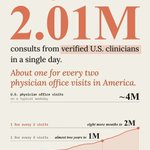
Tuesday was the first day in OpenEvidence history with more than two million consults from verified U.S. clinicians in one 24-hour cycle.
About one consult for every two physician office visits in America.
The math: Americans make over a billion visits to physicians’ offices a year, roughly four million on a typical weekday. A consult is not a visit, and one visit can involve several questions.
OpenEvidence is unequivocally the most popular AI for doctors in the United States and has become the default operating system of medical knowledge.
OpenEvidence CMO @TravisZack2 was in the room for this. Thanks for having us, @WCMEmergency.
Technology should support the human relationships at the center of healthcare. We're grateful to the speakers, researchers and innovators who joined us our 9th Annual Virtual Healthcare Conference to advance that conversation. emed.weill.cornell.edu/news/…
The drug that saved @DavidFajgenbaum's life has been on pharmacy shelves for decades. It was approved for kidney transplants. He nearly died of Castleman disease and had been told there was nothing left to try.
Thousands of diseases have no FDA-approved treatment. For some of them, the answer may already be sitting in a pharmacy. Nobody has run the trial.
@EveryCure, the nonprofit he co-founded, exists to run these trial. Starting today, we’re working with them. OpenEvidence will help evaluate repurposing hypotheses, connect each program with the few physicians who actually treat the disease, and bring trial results back to the point of care when they land.
Many of these are generic drugs. No one has a commercial reason to study them. That is exactly why a nonprofit has to.
When Every Cure’s programs reach trials, OpenEvidence will flag when a patient may qualify. The treating physician decides whether to refer. Read full announcement: businesswire.com/news/home/2…
“OpenEvidence is the most trusted and loved brand product among doctors. Apple is the most trusted and loved brand and product among consumers, and especially health consumers. So you have to bring these two things together. It’s like peanut butter and jelly.”
--OpenEvidence CEO Daniel Nadler
Apple and OpenEvidence are launching a study based around an experimental AI-powered health chat app, hinting at possible new directions for both companies. trib.al/uohPaGF
In @WSJ, @andykessler explores how AI is supporting physicians and reshaping modern medicine. OpenEvidence mission remains simple: unburdening doctors with trusted, peer-reviewed evidence so they can stay focused on their patients.
wsj.com/opinion/doctors-have…
A prescription the patient can't afford, or the payer won't approve, doesn't treat anything.
Today we launched Access Intelligence: copay savings, patient assistance, program enrollment, and prior authorization, inside OpenEvidence. Free for all clinicians.
The help exists. There are thousands of support programs, and prior auths can be won. But the work is scattered across payers and programs, each with its own forms and criteria, and you have a few minutes per patient.
What's live now:
* Ask about availability and eligibility across 2,500+ patient support programs, updated daily.
* Send copay savings and discount offers to the patient with Patient TakeHome.
* Download pre-populated enrollment forms, or enroll on OpenEvidence.
* Write prior auth requests, appeals, and letters of medical necessity grounded in clinical guidelines, with PA checklists and relevant ICD-10 codes.
Choosing the right treatment should be the hardest part of getting a patient treated.
Full announcement: businesswire.com/news/home/2…
17
2,186
The phrase "evidence-based medicine" first appeared in print in ACP Journal Club in 1991. Thirty-five years later, @ACPIMPhysicians's clinical guidance and Annals of Internal Medicine are coming into OpenEvidence.
Internal medicine is the largest specialty on OpenEvidence, and the questions span the whole chart. An internist can go from adjusting a heart failure regimen in one room to untangling a drug interaction in a patient on twelve medications in the next. The evidence has to keep up.
Both will be inside OpenEvidence, cited in the answer so the physician can check the source before acting on it.
Read full announcement prnewswire.com/news-releases…
Thank you, Dr. Harvey. The @ACRheum's patient education resources, in the same place clinicians are already asking about the diagnosis and the drug.
We are at booth 3822 through the end of Convergence. Stop by to see what's new at OpenEvidence.
📰 Newsflash! Yesterday during the ACR Convergence Opening Session, ACR President William Harvey, MD, MSc, FACR, announced a new collaboration between the ACR and OpenEvidence. This relationship aims to strengthen the connection between evidence-based information, patient education, and informed participation in care by giving rheumatologists, primary care providers, and other specialists managing rheumatic conditions the ability to access trusted, evidence-based ACR patient education resources through OpenEvidence. Read more → acr.tw/4j5nRNq
Rheumatologists kept stopping by our booth at ACR today to tell us about a study presented at this morning's plenary. Five AI platforms were tested using 60 scenarios built from ACR and EULAR guidelines. OpenEvidence ranked first in agreement with those guidelines at 91.2%.
Rheumatology is a hard test, and the authors picked it for that reason. Treatment and monitoring decisions turn on patient-level details, and the guidelines keep changing.
One point in the study applies to every tool in it: a convincing answer still needs checking. That's why every OpenEvidence answer shows its sources, so the clinician can see the evidence and decide.
Independent evaluations like this one are how medical AI should be judged. More of them, please.
Full abstract from @ACRheum Convergence 2026, Plenary. Figure: Pitliya et al.
acrabstracts.org/abstract/ar…
Rheumatic diseases are chronic and complex, and patients and caregivers often manage them for years, many with care from primary care physicians and other specialists as well as rheumatologists. The American College of Rheumatology is collaborating with OpenEvidence to make its patient education resources available within OpenEvidence.
@ACRheum's disease, condition, and treatment fact sheets, in English and Spanish, cover conditions such as gout, psoriatic arthritis, and more. They surface automatically when clinically relevant, alongside peer-reviewed literature, with a direct link back to the source.
Full announcement openevidence.com/announcemen…
1
942
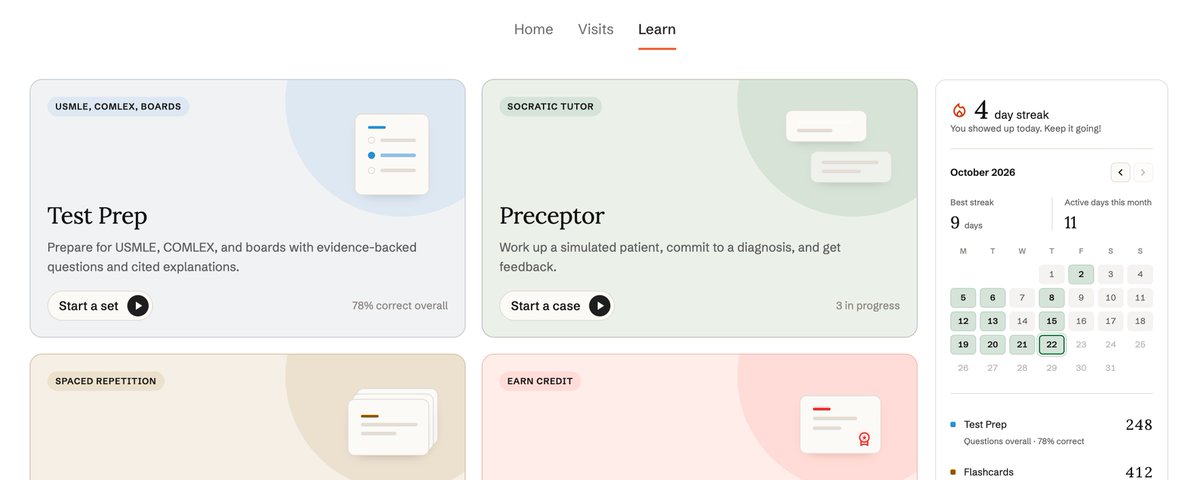
A board question bank, a Socratic preceptor, and spaced repetition on the questions you already ask: that's where OpenEvidence Learn starts.
Where is goes next is partly up to you. The article has a short survey to submit suggestions and share your perspective on AI in medical education.
Introducing Learn, a free, personalized medical education platform from OpenEvidence, built to support trainees and clinicians across their entire careers.
As AI changes how doctors work, it matters just as much that it strengthens how they learn.
Clinicians have made OpenEvidence an everyday tool at the point of care. Now we apply that same technology and those same principles to how doctors learn medicine. Developed with leading medical institutions, certifiers, and educators, Learn brings together a suite of tools built on OpenEvidence so every trainee and clinician gets a tailored, evidence-based learning experience.
Details in announcement: businesswire.com/news/home/2…
Thank you, Dr. Isaacs. Most clinicians don't have an endocrinologist down the hall to call. How you think about these cases, in your own words, is worth a great deal to the ones who don't.
Happy to contribute my perspective to @OpenEvidence on distinguishing impaired fasting glucose #IFG from impaired glucose tolerance #IGT. They reflect different patterns of insulin resistance and impaired insulin secretion. Both increase the risk of type 2 diabetes, particularly when they occur together. IGT also has a stronger association with cardiovascular risk.
openevidence.com/ask/e1108a8…
“New York has always been where American medicine goes to prove itself at scale. Putting OpenEvidence inside the chart at @nyulangone means the world's medical literature is now in the room for every one of the twelve million visits this system supports each year.” -Daniel Nadler, founder and CEO of OpenEvidence
NYU Langone Health @nyulangone is bringing OpenEvidence into the chart, with patient context, for the care teams behind 12.4 million outpatient visits a year.
Patient-aware means a clinician asks a question in Epic and the answer draws on both the peer-reviewed literature and that patient's own record, without leaving the chart. The evidence will be the same in the hospitals and at a community health center in Brooklyn.
New York has always been where American medicine goes to prove itself at scale. The world's medical literature is about to be in the room for every one of those visits.
Read full press release businesswire.com/news/home/2…
4
1,213
Addiction medicine has clear, specific guidance. Most of the clinicians who need it did not train in it. The American Society of Addiction Medicine is partnering with OpenEvidence to bring its clinical practice guidelines, guidance, and implementation resources to the point of care. @ASAMorg's guidance will surface automatically inside OpenEvidence answers when clinically relevant, alongside the peer-reviewed literature, cited, with a direct link back to the source.
Full announcement businesswire.com/news/home/2…
1
863
Checks out.
The $15bn ‘viral’ AI start-up changing how American doctors treat patients ft.trib.al/b3zsWBJ
Dr. @SamyuktaMD, practicing oncologist and VP of Clinical Strategy at OpenEvidence, joins @NEJM_AI today on how AI is changing clinical guidelines.
Join @NEJM_AI for a free virtual event to explore how AI is reshaping guideline development and clinical decision-making. Hear from leading experts as they discuss how to harness the strengths of large language models while preserving clinician autonomy, minimizing bias, and ensuring that evidence—not algorithms alone—continues to guide patient care. View the speaker lineup and save your seat: nej.md/4gJl2PK