
Interpretability/Finetuning @AnthropicAI Previously: Staff ML Engineer @stripe, Wrote BMLPA by @OReillyMedia, Head of AI at @InsightFellows, ML @Zipcar
San Francisco, CA
Joined June 2017
- Tweets2.2K
- Following252
- Followers12.3K
- Likes8K


Pinned Tweet
We've made progress in our quest to understand how Claude and models like it think!
The paper has many fun and surprising case studies, that anyone who is interested in LLMs would enjoy.
Check out the video below for an example

This is actually a common misconception.
Hidden states in LLMs are used to predict all future tokens not just the next one!
And in fact we see representations that correspond to plans, or the broader situation
transformer-circuits.pub/202…
anthropic.com/research/globa…


What is an LLM?
Is it an incomprehensible black box, a next-word-predictor, a silicon genius?
To answer this, we don't have to only guess, we can open it up and look inside!
It was an honor to chat with @lennysan about what we learned doing this, some takeaways in 🧵

"To make them is not to understand them."
Emmanuel Ameisen (@mlpowered) has spent the last 3 years doing interpretability research at @AnthropicAI, looking inside LLMs like Claude to figure out what they're actually doing. As he puts it, models are "grown," not built.
We discuss:
🔸 His discovery that models plan many tokens ahead
🔸 Why anthropomorphizing AI can actually be the right approach
🔸 What the "J-space" reveals about how models think
🔸 How interpretability connects to AI alignment and safety
Listen now 👇
youtu.be/JHo-aiePjoM
Neural networks compress information very densely. That makes them confusing to interpret.
In fact, if you just look at the largest weights in a network, they often do not make sense!
This writeup shows why, and explores approaches to identify which weights are useful.


blog post with the details anthropic.com/research/riema…

3
824
LLMs can keep track of the length of various pieces of text perfectly.
How do they do this?
In this new paper, we find that they learn a general mechanism: countdown heads!
The mechanism is both simple and useful, and it shows up in a surprisingly large set of examples 🧵


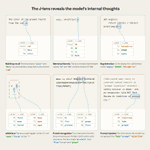
We locate a small subset of the representations inside a language model (the J-space), and find that it resembles an internal monologue.
It shows intermediate concepts, as well as judgements about the current text. It even detects prompt injections!


Interpreting model activations is important to understand why a model is doing what its doing.
Traditionally, we've done this with supervised methods (probing for a specific context), or unsupervised sparse decompositions (dictionary learning).
But probing requires you to know what you are looking for, and sparse dictionaries can be overwhelming to interpret.
NLAs are exciting because they instead generate natural language explanations, which we can then inspect for a variety of behaviors.
For example, they reveal the planning behavior we first observed with circuit tracing last year. They also helped identify bugs in Claude's training pipeline, where some prompts were only partially translated.
If you want to play with them, NLAs on open models are available on Neuronpedia! neuronpedia.org/llama3.3-70b…

How do LLMs store attributed of entities? And how do they compare different attributes in context?
It turns out they mostly store information about a given entity over its own token, which allows for easy lookups.
But in addition to the current entity's information, models also store information about the previous entity.
That might seem redundant, but it actually enables a model to identify relationships between the current entity and the previous entity in one step!

Many LLMs struggle to parse statements like “Alice prepares and Bob consumes food.” Ask them “Who consumes food?” and they'll get it wrong
What’s up with that? We researched whether models can represent multiple entities at once, and if so, why do they fail here?
🧵

1
7
957
I used to bite my tongue and hold my breath.
Scared to rock the boat and make a mess.
I stood for nothing, so I fell for everything. 🎶


Proud to work at a place that stands behind its values. 🇺🇸
A statement on the comments from Secretary of War Pete Hegseth.
anthropic.com/news/statement…

AI is not a normal technology, and Anthropic’s mission is to make sure that it serves the long-term benefit of humanity.
Doing so requires making tough decisions, and standing up for what we think is right.
This is us doing that.
A statement from Anthropic CEO, Dario Amodei, on our discussions with the Department of War.
anthropic.com/news/statement…

Late last year, we found a precise counting mechanism in Claude.
This new work by @ummagumm_a and Nikita Balagansky shows that:
- similar mechanisms exist in many models
- we can compare their counting performance by seeing how crisp their representations of the count are!

1/ 🧵 Reproducing Anthropic’s “counting manifold” result in open-weight LLMs: do they internally track “chars since last \n” to wrap text consistently?
huggingface.co/spaces/t-tech…

We just shipped Claude Opus 4.6!
I’m also excited to share that for the first time, we used circuit tracing as part of the model's safety audit!
We studied why sometimes, the model misrepresents the results of tool calls.


We actually understand very few mechanisms inside LLMs, so the ones we do are a treat to explore.
Modular arithmetic is one, and Welch Labs just dropped an excellent explainer.
No prior knowledge needed, highly recommend.
youtube.com/watch?v=D8GOeCFF…

Anthropic Fellows have been responsible for some of the best research we've been able to do this year.
If you are interested in directly helping the AI safety mission, you should apply!

Want your very own Claude wrapped? Just ask Claude to make it for you!

Had my Claude Wrapped instance put together a shareable prompt for anyone with a Pro/Max plan to make their own:
claude.ai/public/artifacts/b…

Surreal to see interpretability research being featured on 60 minutes!

In an extreme stress test, Antropic’s AI models resorted to blackmail to avoid being shut down. Research scientist Joshua Batson shows @andersoncooper how it happened and what they learned from it. cbsn.ws/49jVXJj
By decomposing weights using loss curvature, you can identify components used for memorization vs generalization.
High-curvature = shared mechanisms used across data.
Low-curvature = idiosyncratic directions for memorized examples.
You can then ablate the memorization weights!

LLMs memorize a lot of training data, but memorization is poorly understood.
Where does it live inside models? How is it stored? How much is it involved in different tasks?
@jack_merullo_ & @srihita_raju's new paper examines all of these questions using loss curvature! (1/7)

Ablating low-curvature components removes memorization while preserving reasoning.
Different tasks show varying sensitivity: arithmetic & fact retrieval are brittle (rely on low-curvature), logical reasoning is robust!
paper: arxiv.org/abs/2510.24256


