

I build foundation models for therapeutics development | Prev. virtual cell wrangler @genbioai | PhD @CMUCompBio | Creator https://www.teapawt.net/t.co/E3h3NJRz2z
San Francisco, CA
Joined December 2017
- Tweets678
- Following417
- Followers964
- Likes1.8K


Caleb Ellington retweeted

this was really fun to work on, i've been wanting to do this since my days at FAIR :)
here's my summary -
• you can think of LoRA as injecting some amount of information into a base model
• given a base model, can measure precisely how much information a new dataset contains
• we can generate datasets at different sizes and measure how much LoRA stores for a given rank
• we can use both to set the rank
• this actually works!
excited to apply this to things besides LoRA too...

Caleb Ellington retweeted

1/ Today we're launching @EmpiricalLayer, an open-source data science harness for the AI agent you already use.
Informally: "Lean for data science." 🧵
github.com/Intelligible/elbi


Caleb Ellington retweeted

@nytimes covered @genbioai and its #VirtualCell work today, following a great conversation with the brilliant @carlzimmer! While companies like Isomorphic claim to "cure all diseases" with a drug design engine, we focus on "simulating diseases" for Virtual Trial of Drugs or Other Therapeutics, as well as for biological research, via virtual cell, virtual tissue, and eventually AI-driven digital organism (#AIDO). It is perhaps less ambitious, but in my opinion more realistic and accessible. We have a great team that includes luminaries like David Baker, @Prof_Lundberg, @zivbj, @deboramarks, @segal_eran, @dasongle, and many more superb engineers and researchers. Come join us!
nytimes.com/2026/11/18/scien…

Caleb Ellington retweeted

I'm a big fan of this work and I really like the research question that @lorin_crawford team was tackling.
But I think the conclusions of this work are also a byproduct of the evaluations. Specifically, cell-type classification is known to be saturated with linear baselines, and perturbation response is bottlenecked by limited datasets and large experimental noise.
So I'd say that it is two part we need better data, but also better evals and ways to transfer pretrained representations to downstream tasks.
bit of a shameless self plug, but I think that frozen contextualized gene representations may be a better way to extract information from pretrained models to improve on tasks like perturbation prediction.
www.teapawt.net/eigenNick/status/21173…

Contextualized gene representations work surprisingly well for predicting multigene perturbation effects.
I’m excited to introduce EMBER, a pretrained gene-centric foundation model designed specifically to learn context-specific gene representations. A joint work with @jmuiuc and @ericxing.
With innovations in single-cell pretraining and dataset curation, EMBER gene representations can be combined with a lightweight probe for single gene knockouts, genetic interactions (double knockouts), and even drug perturbations.
Both a 🧵 and a 🎥, got in front of a camera to share some highlights! (1/n)
Caleb Ellington retweeted

Today, we are excited to introduce Ladon, a state-of-the-art biological foundation model that predicts disease trajectory and treatment response in patients. There is immense complexity in the individual biology of every patient. Two patients can have the same diagnosis and receive the same treatment, yet have very different outcomes: one responds well and lives for years, while the other’s disease continues to progress. Understanding and resolving this heterogeneity to predict outcomes is how we accelerate our delivery of medicines for patients and unlock clinical trial abundance.
Ladon is our first step towards this future: one where we can learn more from every patient enrolled so that we can run smaller, faster trials with higher success rates. We built it to give drug developers quantitative support on billion-dollar clinical trial decisions. Today we're excited to share Ladon's capabilities in our blog and technical report.
Ladon is a 3B parameter model trained on millions of RNA-seq samples spanning decades of technical and biological variation across tissues and species. Ladon beats gene expression baselines, established biomarkers, and existing RNA foundation models at predicting patient prognosis and therapeutic response in 140+ oncology tasks, including external validation on past clinical trials. This is significant because clinical trials are fundamentally generalization problems. We show that Ladon-derived predictions are robust across indications, treatments, and sequencing platforms.
Reach out if you’d like to get started with the model today!
Read more about Ladon in the blog: blank.bio/introducing-ladon
Find more technical details in the white paper: blank.bio/introducing-ladon

Caleb Ellington retweeted
Scaling laws depend on a metric that improves gradually with scale in order to extrapolate to a large target scale. We are interested in the accuracy metric, but you might get zero accuracy for small models. You can't extrapolate from a bunch of zeros.
Key idea: introduce a *hint* level, and fit a joint scaling law Accuracy(scale, hint) = ... More hinting makes the problem easier in a controlled way, so accuracy is no longer zero, allowing for extrapolation! Learn more below.

Can we forecast benchmark accuracy from models that score zero?
We (co-leads @LukeBailey181 @rckpudi) turn a benchmark into a series of easier hinted versions. Jointly modeling scale C and hint level H enables forecasting GSM8K acc (H=0) within 3 pts from 5600x less compute 🧵

Caleb Ellington retweeted
Contextualized gene representations work surprisingly well for predicting multigene perturbation effects.
I’m excited to introduce EMBER, a pretrained gene-centric foundation model designed specifically to learn context-specific gene representations. A joint work with @jmuiuc and @ericxing.
With innovations in single-cell pretraining and dataset curation, EMBER gene representations can be combined with a lightweight probe for single gene knockouts, genetic interactions (double knockouts), and even drug perturbations.
Both a 🧵 and a 🎥, got in front of a camera to share some highlights! (1/n)
Caleb Ellington retweeted

Paperclip Datasets is live! Describe the table you need, and agents collect the data from papers, patents, trials and regulatory documents. Each value links to its source passage so you can check it.
Try it: paperclip.gxl.ai/datasets
Read more here: gxl.ai/blog/introducing-pape…
Caleb Ellington retweeted

Our first release, Mol-1. Give it a try!
Weights & code: github.com/molence/Mol-1
Try Mol-1: lab.molence.com


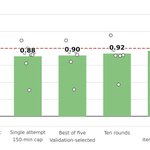
1/15 🧬 Mol-1 on antibody structure prediction: on par with IsoDDE, open to build on.
75.0% median success at DockQ > 0.23, on par with IsoDDE’s reported 75.58%.
Across all 201,376 five-seed combinations from 32 seeds, 62.22% matched or exceeded 75% success—showing robust performance across seed selections.
We release the model code and weights so researchers can run Mol-1 in their own environment and build on its capabilities.
Code & weights: github.com/molence/Mol-1
Try Mol-1: lab.molence.com
#AIforScience #DrugDiscovery

ALT Two panels show FoldBench-AB success rates and the distribution over all 201,376 five-seed combinations from 32 seeds. Mol-1 scores 75.0%, compared with IsoDDE's plotted 75.6%; Mol-1 with constraints scores 88.3%. In the distribution, 62.22% of combinations reach at least 75% success and 17.85% reach at least 76%.
Caleb Ellington retweeted

🚩 When Polymarket or Kalshi says there's a 70% chance something will happen, should we believe it?
Excited to share our new paper, just published in PNAS, in which we examined more than ONE MILLION forecasts from Polymarket, Kalshi, Manifold, and Metaculus, spanning 12 domains and forecasting horizons ranging from hours to years.
The main finding is striking: Prediction markets and collective forecasting platforms are remarkably well calibrated. When they assign events a 70% probability, those events really do happen about 70% of the time. And this pattern holds surprisingly well across different platforms, domains, and forecasting horizons.
But there's an important twist. When we looked more closely, we discovered systematic biases in some of the domains where forecasting matters most (wars, elections).
For decades, psychologists have documented how poorly humans often reason about probability and uncertainty. Our findings offer an encouraging counterpoint: When judgments and information are aggregated, we can achieve a surprisingly accurate understanding of an uncertain future.
That doesn't mean we can predict what will happen next with certainty. But it does mean that we can be remarkably good at estimating how uncertain the future really is.
This work was a great collaboration. The data for this project was meticulously collected for years by Justin Dickerson, the project was led by Hilla Shinitzky and Maayan Peer, with @mattansb leading the analyses.
📄 Read the paper:
pnas.org/doi/10.1073/pnas.26…
#Forecasting #Polymarket #Kalshi #DecisionScience #PNAS

Caleb Ellington retweeted

Introducing Omnii-1, our most powerful genome language model, and a major step toward general biological intelligence
In a world first, Omnii-1 designed the first AI-generated bacteriophages to be administered to a human patient with an antibiotic-resistant infection under compassionate use

Caleb Ellington retweeted

Getting started with AI-guided experimental design in the actual wet lab is pretty much like shooting in the dark. What's the end goal? How to set up the underlying predictive problem? How to design an effective acquisition strategy?
Driven by those questions, @RushilGupta15 from our group introduces a novel approach for strategy selection during batch-mode active learning. Have a look at his post and preprint!

Active learning practitioners choose an acquisition strategy before any labeling, but the best one changes with dataset, model, and task. What if we didn't have to pick just one? Introducing FractAL, a soft-strategy selection method (w/ @_romain_lopez_ ) arxiv.org/abs/2610.05544

Caleb Ellington retweeted

if you have a .edu, .gov or .mil email you can now get a full 8x B300 node for $4/GPU-hour. nebius charges $9.50 on demand and a lot of clouds are sold out
AMD MI355X nodes are $3 and the wait right now is under a minute
you just ask marshall, their AI agent, and it finds you a node
this is a major public good for researchers who've been priced out of frontier compute
thank you @AnjneyMidha


hundreds of MI355x and B300 nodes
now live on nationalcompute.com
subsidized for all .edu and .govs
it’s time to scale the frontier ecosystem
for the public benefit

Caleb Ellington retweeted

A year out of YC, some reflections on going from my PhD to building in biotech and what it means to be a formidable founder
philechka.com/2026/09/20/for…
Caleb Ellington retweeted

Accepted at NeurIPS:
Contextualized Differential Expression.
Check it out:
lnkd.in/p/ekv_dVsx

Caleb Ellington retweeted

Today, Sculpta releases the first demonstration of bioorthogonal barcoding ("bobcoding"), the process by which we:
1) covalently attach oligonucleotide barcodes to RNA at multiple internal positions with two-step chemistry, and 2) perform a multiplexed reverse transcription reaction to generate barcoded cDNA libraries with >99% barcoding accuracy.
To the best of our knowledge, it is the first time ever that either of these steps have ever been performed by anyone. No one has ever broken the barrier of multiplexing prior to any enzymatic step in library preparation, driving simplicity and higher data quality. Instead of other methods that add 0 or 1 barcode, we add one barcode every ~300bp, adding redundancy and fidelity to RNA measurements.
In our first application described in our pre-print below, we used bobcodes to create the first RNA isoform-resolved drug screening platform. It beats Novartis' DRUG-seq platform by:
- generating full length transcript capture of RNA isoforms, instead of just 3' end counting
- capturing 25-fold more RNA splicing events
- reducing barcode swapping by 10-fold
- using 18 fewer PCR cycles (~250,000 less amplification)
- reducing sample-to-sample variability in gene expression measurements
- eliminating costly and cumbersome library fragmentation/tagmentation steps completely
- reducing workflow complexity and number of steps
- reducing overall protocol duration by ~25%
Though our chemical barcoding method improved transcriptomic data quality while also being simpler and faster than all existing methods, the implications of this work go well beyond this particular use case:
The gate to greater applications of AI in transcriptomics is not a lack of compute. Nor is it a lack of data volume. The elephant in the room has always been our limited ability to faithfully and accurately measure cellular RNAs.
Sculpta now has line of sight to build what we call the first ground truth transcriptomics platform [for single cell, spatial and more] for the future of biological research, drug development and AI-enabled discoveries for the betterment of human health and longevity.
[PS Until the kind folks at bioRxiv get through the apparent backlog of AI slop submissions, Sculpta will host the pre-print PDF on our website. You can sign up for product offerings and other updates at this link too]
sculpta.bio/preprint

Caleb Ellington retweeted

If every step in a scRNA-seq experiment loses just 1% of the signal, you lose almost 40% of the total signal after 50 steps.
Noise and poor reproducibility are common problems when working with this kind of data. Yet, as computational biologists, we often treat data collection as a black box and start our work from the count matrix.
I wrote a post about what can go wrong before that matrix reaches us, from sample selection and tissue handling all the way to sequencing and read counting. I hope it helps other computational biologists better understand where their data came from.
Post: euxhenh.com/blog/scrnaseq-wh…
Caleb Ellington retweeted
We are proud to release the world's first virtual cell -- a multi-modal, multi-scale, dynamic, and stateful world model of the cell, the first step toward an AI-driven Digital Organism (AIDO).
